

By Jeevan Thiagarajah
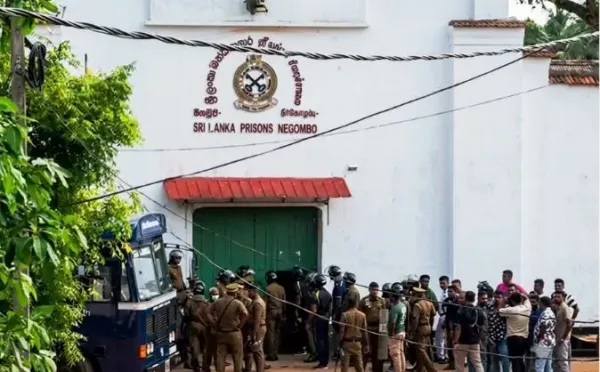
At about one o'clock on Sunday, 5 July 2026, two detainees in Ward 2 of Negombo Prison got into a quarrel. Within thirty hours, ten officers of the Prison Emergency Response Tactical Force and twenty-two detainees were dead. Two more detainees died the following night after they were transferred to other prisons. More than a hundred people were injured.
The Human Rights Commission of Sri Lanka published its findings on 27 October. The 98-page report draws on statements from several hundred detainees in eleven prisons and from twenty-two officials. It finds that the violence was "not simply a single clash between detainees." The causes go back to failures the Commission recorded in a 2018 study of twenty prisons, which it handed to the authorities in 2020. The report says that if those recommendations had been implemented, "such violence could have been prevented."
A prison run by prisoners
On 5 July Negombo held 2,418 detainees in a prison built for about 825. It had 178 officers, against a requirement of 435. One guard said that at night four officers covered the whole prison. Across the country, Sri Lanka's prisons held about 41,000 people in mid-2026, close to four times their capacity. Roughly two-thirds were held for drug offences, and many of them were on remand waiting for a laboratory report.
Because officers are so few, prisons depend on what inmates call the "party" system. Detainees with a record of good behaviour are picked informally to help run the wards. They hand out food, keep lists and tell officers what is happening. The Commission found that every prison in Sri Lanka works this way, because there are not enough staff to do the job.
At Negombo, ordinary detainees told the Commission that "party" members harassed them and passed false information to the discipline section, and that officers then beat the people who had been named. Nobody acted on their complaints. On 5 July that anger broke out. Groups moved from ward to ward looking for "party" members and killed two of them. Detainees broke into the discipline section, where seized drugs were kept, and into the hospital's medicine store, and took overdoses of both.
The Commission says overcrowding and understaffing "directly cause control in institutions like Negombo to slip from authorities to detainees." It adds: "If enough officers were deployed, they would not need detainees' help, and the room for such a division would shrink." Long before the riot, the state had left much of the day-to-day running of Negombo to detainees because it had not hired enough guards.
The second morning
By the evening of 5 July the prison was calm. Senior officials, among them the Acting Commissioner General of Prisons, spoke to detainees and promised fans, quicker laboratory reports and better medical care. The Commission notes, however, that although two men had been killed and the damage was heavy, not one detainee was transferred out. The men who led the violence stayed where they were. Ward locks had been broken and could not be closed. Hundreds of detainees who had taken drugs and medicines were still moving around inside.
The next morning officers served breakfast one ward at a time. A team went in to assess the damage, and Tactical Force officers carrying only batons, shields and helmets went in with them for protection. Fighting started again. Officers say detainees attacked an injured prisoner who was being taken to safety. Some detainees say the Tactical Force struck first. The Commission says it cannot establish which account is true.
There is no dispute about what happened next. Large groups of detainees armed with clubs, stones, roof tiles and iron bars attacked the officers. One guard who survived said officers escaped through windows into the Superintendent's office, where they were found and beaten. When help came, he was the only one among the officers lying by the gate who could still lift his hand and speak. A 55-year-old jailor was stripped and clubbed to death. Detainees broke through the iron gate and reached the wooden door behind it, the last barrier. A rifle muzzle was pushed through a hole in the door. A guard fired into the air and then through the hole at the inner wall. The detainees pulled back, and police and the Special Task Force retook control.
The Commission chooses its words carefully, but it clearly questions the decision to send the officers in. It raises "questions about the decision-making process and the adequacy of security planning" in sending unarmed officers into the prison "without proper attention to their safety," and asks whether they went in "without properly understanding the detainees' state." A jailor from another prison told the Commission that the deaths could have been avoided if the damage assessment had waited until the situation settled.
The Commission also found that seized drugs and medicines were kept "where detainees could easily reach them," and it describes the intoxication that followed as "a main cause of so large a clash." The weapons in daily use had been moved somewhere safe, but older weapons were left in the armoury and detainees took them. Two officers who fled a gun tower left two loaded magazines behind. There were guns on both sides of the gate. The Commission cannot yet say which guns were fired, who fired them, or how many of the dead were shot. The Special Task Force and police say they did not fire. Some detainees say they did. Forensic reports had not reached the Commission when it wrote its report. Nearly four months after the riot, the state still cannot say which guns were fired inside one of its own prisons.
Who is responsible
The Commission says responsibility must be assigned "not only for the violence committed by detainees, but also for the institutional, administrative and security shortcomings that allowed it to arise and grow." I agree with both parts of that.
Detainees who beat officers and other prisoners to death must be prosecuted for murder. Bad prison conditions may help explain the violence, but they are no excuse for it. The Criminal Investigation Department took over the case on 8 July, and the public needs to see it reach conclusions.
Prosecuting detainees is not enough on its own. Officials decided to leave the men who started the violence on 5 July inside the prison, to leave drugs and weapons where detainees could get them, and to send unarmed officers into a prison that had been out of control less than a day before. Those officials can be identified. The families of the ten officers who died have a right to know who decided to send them in that morning, what that person knew and why they thought it was safe.
The use of force also has to be examined. Section 77 of the Prisons Ordinance allows officers to fire when prisoners try to break out, but requires them, as far as possible, to disable rather than kill. The Commission accepts that officers had that power at the wooden door. It says the way the shots were fired and any harm they caused must still be investigated, and that detainees' claims about the Special Task Force must be checked against the forensic evidence.
The same applies to what happened after the riot. Detainees moved out of Negombo told the Commission they were beaten when they arrived at several other prisons, and the Commission says its statements "indicate that officers did assault detainees." Article 11 of the Constitution prohibits torture and cruel or degrading treatment without exception, and the Supreme Court has long held that this protection applies even to hardened criminals. Many of the prisoners who were beaten say they had no part in the killings. Revenge beatings are illegal, and they do nothing to honour the officers who were killed.
The Commission also recommends compensation for the families of the officers, and for detainees who died or were injured without taking part in the violence. Some people will object to the second recommendation. I think they are wrong. A remand prisoner killed in a riot that the state failed to prevent is a victim of that failure, just as the officers were.
The 2018 warnings
For me, the sections on the 2018 study are the most damaging part of the report for the authorities. That study found severe overcrowding, too few officers working too many hours, long pre-trial detention, unsafe storage of medicines, a practice of beating new arrivals, and officers resorting to live ammunition because they had no training in non-violent methods of control. Almost every failure seen at Negombo appears in that list. The Commission says it raised these findings with the prison administration several times. The Department of Prisons' own strategic plan promised "a rights-based correctional approach" for 2021 to 2025, a period that has now ended.
Negombo was also not the first warning. Twenty-seven prisoners died at Welikada in 2012 and eleven at Mahara in 2020. On 1 August this year, less than four weeks after Negombo, there was another riot at Mahara. After each riot the response has been about security: police at the gates, drones overhead, transfers. None of it has dealt with the conditions that lead to the next riot.
The objections
Many officers and their families will argue that this is about criminals rather than prison conditions, and they will point to newspaper reports linking the leader of the 5 July violence to an underworld network. That argument has some weight. Gangs inside prisons are a real threat. But gangs do best in prisons where there are too few officers to watch them and too little space to keep groups apart. Dealing with prison gangs means dealing with prison conditions as well.
Others will argue the Commission has been too easy on the state. It accepts that officers had the right to fire at the wooden door, it leaves the shooting allegations unresolved, and it lets the Department of Prisons investigate its own officers. I agree on the last point. The forensic evidence should be made public, and the investigations should be handed to bodies that are independent of the department.
Some will say the country cannot afford reform after the economic crisis. Holding large numbers of people on remand is expensive too. Diverting drug users away from prison and speeding up laboratory reports would save money as well as lives.
What needs to change
Most of what needs to be done is already known, and much of it has been proposed by the officials who run the prisons. The backlog of Government Analyst reports should be cleared and bail made realistic, so people are not held for months waiting for a test result. The prisons should recruit up to the number of officers they actually need, train them in non-lethal control and stop relying on "party" detainees. Drug stores, medicine stores and armouries should be moved outside the main walls, and wards rebuilt so that each one can be locked and kept separate. A prison that has just been out of control should be treated as still out of control until a written assessment says otherwise. Investigations into abuse should be independent. Parliament should debate the Commission's recommendations and require the Ministry to explain each one it does not implement.
The account of W6
One account in the report has stayed with me more than any of the figures. It comes from a detainee identified only as W6. On the morning of 6 July he saw ten or fifteen detainees beating a jailor in the Superintendent's office and shouted at them to stop. When they moved away, he put the jailor's arm around his neck and started to carry him out. The attackers came back, split W6's head open and beat the jailor to death.
Much of what went wrong at Negombo is in that account. Staff were so few that a group of detainees could surround an officer in his own office. A prisoner risked his own life to save the officer in charge of him. The state had been told in writing what conditions like these would lead to, and had done nothing.
The ten officers who died were First Class Jailor S.H.G. Chandrawansa and nine sergeants of the Tactical Force. No more officers should die this way. The families of the twenty-four detainees who died are owed an explanation of how they died, based on evidence and given in court.
The Commission has asked the Ministry of Justice and the Commissioner General of Prisons to report back on its recommendations by 28 January 2027. If that date passes without remand prisoners being released, officers recruited, armouries secured and an honest account of who sent unarmed men into Negombo on 6 July, nothing will have been learned. The same thing happened after Welikada and after Mahara, and it will happen again at another prison.