
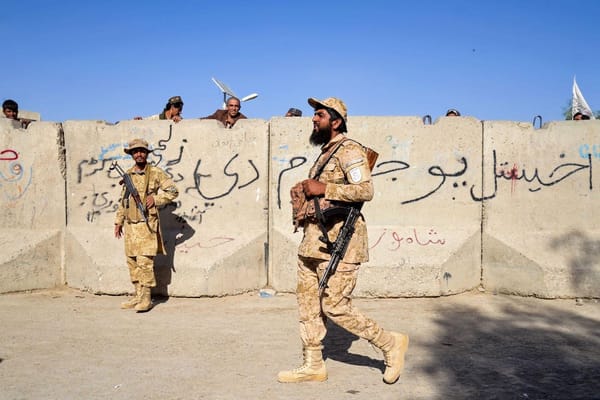
Somewhere along the Afghan-Pakistan border this week, a family is on the move again.
They have done this before — through Soviet tanks, civil war, the Taliban’s first rule, twenty years of American military presence, and the Taliban’s return to power. Each time they gathered what remained of their lives and began again. Now, artillery and airstrikes are forcing them to do it once more.
The United Nations estimates that nearly 118,000 people have been displaced since fighting escalated in late February 2026 — more than 115,000 inside Afghanistan and several thousand on the Pakistani side of the border. These figures are not abstractions. They represent parents carrying children through mountain paths, teenagers dragging mattresses and cooking pots, elderly people struggling to keep pace with families determined simply to survive.
What is unfolding is not only a humanitarian emergency, though that alone should command global attention. It is also a strategic crisis whose consequences will extend far beyond the mountains where the fighting is taking place — touching nuclear security, regional economic stability, climate resilience, and the fragile livelihoods of millions.
On paper, the military balance appears clear. Pakistan fields a larger and more technologically advanced military: modern fighter aircraft, armored divisions, drones, and a professional officer corps experienced in conventional warfare. Afghanistan’s Taliban forces possess mostly light weapons, captured equipment, and extensive experience in guerrilla tactics, but little heavy weaponry and no meaningful air force.
History, however, suggests caution in drawing quick conclusions.
Afghanistan has repeatedly outlasted stronger adversaries. Afghan fighters fought the British Empire to a stalemate in three wars over the nineteenth and early twentieth centuries. They wore down the Soviet Union during a decade-long insurgency that ended in Moscow’s withdrawal in 1989 — a defeat many historians see as contributing to the Soviet Union’s broader collapse. More recently, they endured twenty years of American-led military intervention, the longest war in United States history.
“Afghans have a documented history of outlasting far larger adversaries,” the analyst Priyajit Debsarkar has noted.
None of this means Pakistan cannot inflict serious damage — it already has. But the belief that this conflict will end quickly or decisively is almost certainly misplaced. Wars in this terrain rarely remain short.
Pakistan, in particular, has limited capacity for a prolonged conflict.
The country is still recovering from the catastrophic floods of 2022, which submerged nearly a third of its territory, killed more than 1,700 people and caused economic losses estimated at over $30 billion. Farms remain damaged, schools and hospitals are still being rebuilt and millions of families remain economically vulnerable. A new war would impose additional burdens — military expenditures, disrupted trade routes, reduced foreign investment and stalled economic reforms — that Pakistan’s already fragile economy can scarcely absorb.
Afghanistan faces its own constraints. Persistent drought has pushed rural communities to the brink, while declining water levels in the Helmand River — a source of tension between Kabul and Islamabad — have intensified competition for scarce resources. The Taliban administration, already internationally isolated and dependent on humanitarian assistance, is now diverting limited capacity toward military operations instead of economic recovery or agricultural development.
“Both countries desperately need sustained focus on climate resilience and sustainable livelihoods,” said Srinivasan Balakrishnan of the Indic Researchers Forum. “War makes that impossible.”
Then there is a risk rarely discussed openly but impossible to ignore: Pakistan’s nuclear arsenal.
Estimates place Pakistan’s stockpile at roughly 170 nuclear warheads, with potential growth in the coming years. In normal circumstances the arsenal is tightly secured. In a prolonged conflict, however — with an active Baloch insurgency, millions of Afghan refugees inside Pakistan, and multiple security pressures emerging simultaneously — the risks inevitably grow.
“Pakistan’s nuclear arsenal becomes more exposed under such conditions,” Debsarkar warned.
Such exposure would not be Pakistan’s concern alone. China, which has invested roughly $65 billion in the China-Pakistan Economic Corridor, has a direct stake in regional stability. So do India, the United States, and many other countries with economic or strategic interests in South Asia.
The broader geopolitical consequences are equally serious. For decades, policymakers have spoken about transforming South and Central Asia into an integrated economic corridor linking Central Asian resources to South Asian ports. Projects such as the China-Pakistan Economic Corridor are central to that vision. Prolonged conflict along the Afghan-Pakistani frontier would place these ambitions at risk.
Meanwhile, the humanitarian situation continues to deteriorate. Border crossings such as Torkham have been closed for months. Aid deliveries are becoming more difficult. Camps for displaced families are filling rapidly. Food prices are rising, schools remain closed in some areas and public health conditions are worsening.
Humanitarian organizations warn that one of the world’s largest ongoing crises could deepen significantly if the conflict expands.
There remains a narrow opportunity to prevent further escalation — but that window will not remain open indefinitely.
Meaningful international engagement would require several steps. First, leaders across the region and beyond must acknowledge that no military victory in this conflict would serve the long-term interests of either country. Second, serious diplomatic efforts — including quiet back-channel negotiations — must begin immediately. Türkiye’s President Recep Tayyip Erdoğan has already offered to mediate. Other actors, including China, Russia, Gulf states, and Western governments, could help facilitate dialogue.
Finally, the deeper drivers of instability — militant sanctuaries, water scarcity, climate stress, economic underdevelopment, and chronic poverty — must be treated not as peripheral issues but as central elements of regional security.
None of this will be easy. Relations between Kabul and Islamabad are deeply strained, and political incentives on both sides often reward escalation rather than compromise.
But the alternative is far more dangerous: deepening instability, growing refugee flows, economic disruption across South Asia, and the persistent shadow of nuclear risk.
Tonight, somewhere along the frontier, that displaced family is still walking — carrying what little they were able to gather before the shelling began.
They have done this many times before.
The question now is whether the world will allow them to do it again.