
By M.R. Narayan Swamy
The killing of a former Tamil Tiger in Paris by the police has brought to the fore psychological issues that still affect a huge mass of ex-combatants who mostly lead broken lives after fighting one of the world’s bloodiest insurgencies, which at one point almost broke up Sri Lanka.
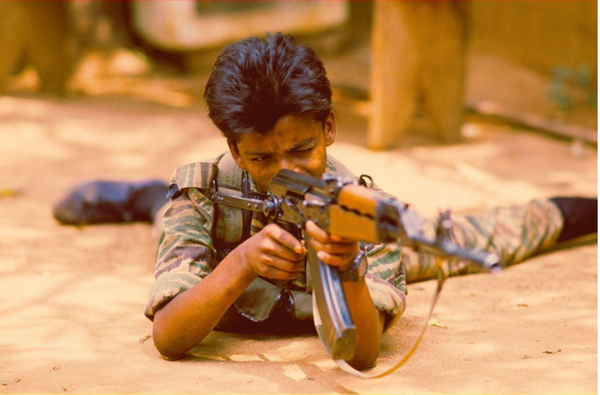
A large but mostly undocumented army of former guerrillas of the Liberation Tigers of Tamil Eelam (LTTE) now eke out a low-key existence in Sri Lanka, India, and several countries in the West, primarily in Canada and Europe. Their war may have ended, but not their trauma – severe in some cases.
Tamil sources say many of them, now in their 30s to 50s, suffer from post-traumatic stress disorder (PTSD) stemming from their involvement in the conflict, which ended in the bloodbath of 2009: the rout of the Tigers and the annihilation of much of their leadership, including their supreme leader, Velupillai Prabhakaran.
The situation is worse for those who fled Sri Lanka just before or in the immediate aftermath of the conflict, whose final months witnessed the deaths and maiming of many thousands in the island nation’s north.
Most Tigers and government soldiers witnessed hundreds of heart-wrenching deaths, including those of friends and fellow combatants who were blown up by landmines or killed in shelling, while thousands more lost limbs.
Unlike in Sri Lanka, where the government and military carried out an extensive, if not perfect, rehabilitation programme for former guerrillas, many of the combatants who fled abroad have largely been left to fend for themselves.
This, experts warn, is risky – both for the ex-Tigers themselves and the society in which they now live with guilt feelings, recurring nightmares, and a feeling of helplessness and bleak future.
Something like this happened on Saturday to Vaithilingam Puwaneswaran alias Kutti, a former LTTE member and the younger brother of senior LTTE commander Colonel Gopith.
Kutti was shot and killed by the French Police in the north-eastern Paris suburb of Bobigny after he allegedly stabbed two neighbours and then advanced with knives towards police officers who reached the scene.
The Tamil man was hit in the chest and hip. He succumbed to gunshot injuries.
His friends in Paris told Jaffna Monitor that although he was a quiet man, he appeared to struggle since the end of the conflict. Some suspect he may have been living with PTSD, though there has been no formal diagnosis.
Around 12,000 LTTE fighters surrendered to the military in Sri Lanka in 2008-09. Many were held in state custody for varying periods before undergoing rehabilitation programmes overseen by civilian and military officials
The programme addressed some of the issues arising from post-conflict stress, although it did not resolve all the problems faced by former fighters, many of whom continue to live in poverty in a country still grappling with the effects of a severe economic crisis.
Despite the rehabilitation, complications are aplenty.
A senior LTTE commander who later broke away is now burdened by alcoholism. “He has lost his earlier personality. From morning to night, he seems to drink liquor,” said a source who has met him.
The source added, “He is not the only one to have liquor as a companion. Many others are addicted to drinks and other substances. This is true even for many former LTTE members in the West.”
Another LTTE fighter who belonged to the famed Charles Antony Brigade and fought in Mannar for years now broods that he surrendered to the military while leader Prabhakaran ended up getting killed.
“I am alive, but we failed to save Annan (Prabhakaran). He gave up his life, but we did not bite the cyanide. He did not tell us to surrender, but we did,” the ex-guerrilla has told former buddies.
Tamil sources say that many ex-LTTE fighters lead a listless life. But because of acute poverty, their economic suffering has become a far bigger headache compared to war-related stresses.
One former LTTE guerrilla in Kilinochchi, who suffers from delusions, insists that he saw Indian soldiers alongside Sri Lankan troops when he surrendered.
“You won’t believe what I am saying, but turbaned Sikh soldiers were there in large numbers when we gave up,” the man in his 40s told Jaffna Monitor. “They kept saying chalo, chalo (move, move). We all knew that bit of Hindi because the Indians fought the LTTE earlier, too.”
The suffering of the erstwhile Tamil guerrillas living abroad, where none of them have been formally diagnosed and received treatment for PTSD, is much worse.
What works in their favour, however, is that they live within well-knit Tamil diaspora communities, doing whatever work they can and remaining far removed from the areas where the fighting raged for nearly a quarter of a century.
While some former combatants lead a relatively active life, almost everyone is hit by depression and trauma. The extent of suffering differs.
The ex-fighters in the West also suffer because they lack education as well as language skills, which come in the way of better economic deals.
A former non-LTTE Tamil militant now in the UK told Jaffna Monitor: "It would be wrong to generalise from the Paris incident that all ex-LTTE men in Europe are inherently dangerous. Most are broken in quieter ways. Some rebuilt their lives, some never did, and a few fell into crime, violence, alcohol, or mental collapse."
It keeps hitting many of them that while they almost gave up their lives fighting for an independent Tamil Eelam, tens of thousands of fellow Tamils who fled Sri Lanka have prospered in Western societies along with their families.
“Be it Sri Lanka or abroad, most militants have suffered a loss of power and prestige. When they were armed, they enjoyed respectability in the Tamil society, even if this came partly as a result of fear. All that is over now,” said a knowledgeable Tamil who has interacted with many ex-militants.
Just how many former LTTE fighters now live outside Sri Lanka? The estimates range from 5,000 to 8,000, almost all of them trained in the use of arms and explosives.
The first known figure came out in 1991 when Sathasivan Krishnakumar alias Kittu, the former Jaffna military commander who later shifted to the UK, said in the wake of the Rajiv Gandhi assassination that some 3,000 Tigers had quit the outfit until then.
The war raged for another 18 years, and guerrillas continued to leave the Tigers and Sri Lanka for greener pastures abroad with the help of relatives and friends. But in later years, the LTTE became very strict and would not allow its fighters to exit easily.
Issues related to PTSD have also traumatised one-time soldiers from the Sri Lankan armed forces. A retired military official complained that the problem was never addressed in an adequate manner by the military.
"This is why, he said, so many former soldiers, including deserters, have become involved in organised and violent crime. 'Knowing how to use a weapon has come in handy for those who wanted to get rich quick. They have lost their sense of discipline.'
The source, citing military hospital data, said that rising alcohol-related problems had contributed to aggression, domestic violence, and absenteeism among former soldiers.
They also suffer from suicidal behaviour, moral injury, trauma, financial stress, and unspoken guilt."