Kaniyan Pungundran

Kaniyan Pungundran

Kaniyan Pungundran, Editor-in-Chief of JM, writes under a name drawn from Sangam literature—symbolizing truth, kinship, and fearless journalism. A Jaffna-born journalist with global experience, he treats journalism as dharma, not profession.


The Black Day Delusion: How Political Opportunism Is Cannibalising the Tamil Future

The Black Day Delusion: How Political Opportunism Is Cannibalising the Tamil Future

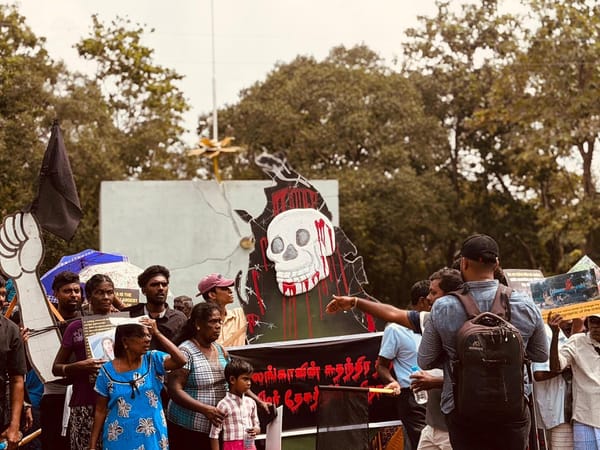
The Ritual of Self-Defeat Once again, on February 4th, as Sri Lanka marked its 78th year of independence from British rule, a familiar theatre of political spectacle unfolded across the North and East. Black flags were hoisted. Placards were raised. Slogans denouncing the Sri Lankan state echoed through the streets of Kilinochchi, Batticaloa, and Jaffna. Tamil political figures — some elected, others self-appointed — declared the day a “Black Day,” a day of mourning and defiance. To the uninit

Kaniyan Pungundran
Kaniyan Pungundran

This is Our Soil. And No One Can Take It From Us.

This is Our Soil. And No One Can Take It From Us.

Note: This editorial was originally published in the February 2025 issue of Jaffna Monitor to mark Sri Lanka’s 77th Independence Day. It is reproduced on the occasion of the 78th Independence Day. February 4th, Sri Lanka’s Independence Day, is a day of both celebration and contention. As the nation marked 77 years of sovereignty, some Tamils—whose lands remain militarily occupied and whose sons and daughters have vanished without a trace—chose to observe the day with symbolic defiance. For them


Kaniyan Pungundran

Kaniyan Pungundran

PSTA: When the Victims Rewrite the Law That Once Destroyed Them

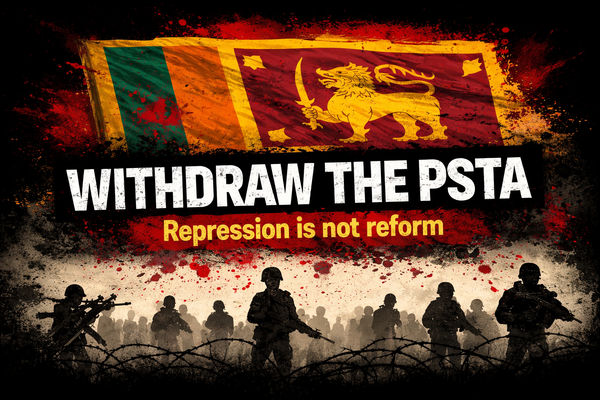
PSTA: When the Victims Rewrite the Law That Once Destroyed Them

There exists a particular species of political betrayal that cuts deeper than ordinary duplicity. It occurs when those who survived state terror become its architects, when victims of arbitrary detention design new systems of indefinite imprisonment, when revolutionaries who once faced torture codify powers enabling it. Sri Lanka stands at precisely such a moment. The National People’s Power government—led by the Janatha Vimukthi Peramuna, a party whose members were “disappeared,” tortured, and


Kaniyan Pungundran

Kaniyan Pungundran

Cyclone Ditwah and the NPP Government's Storm of Failure

Cyclone Ditwah and the NPP Government's Storm of Failure

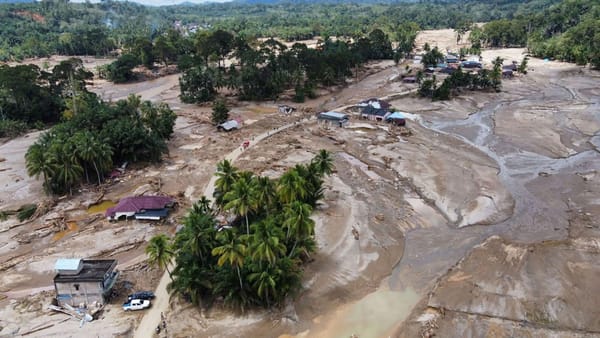
Nearly two weeks after Cyclone Ditwah claimed 644 lives and wreaked destruction on a scale larger than the 2004 tsunami, one question continues to demand an answer: how did a second-category storm—tracked for sixteen days in advance—become Sri Lanka’s deadliest weather disaster in recent memory? From Natural Disaster to Man-Made Tragedy Sri Lanka's encounter with Cyclone Ditwah has moved beyond natural disaster into man-made catastrophe. Official figures confirm 644 deaths, 183 people still m


Kaniyan Pungundran

Kaniyan Pungundran

Why Tamil Politics Cannot Be a Pensioner's Hobby
A cut-out portrait of Judge M. Ilancheliyan from his farewell ceremony.

Why Tamil Politics Cannot Be a Pensioner's Hobby

If you trace the arc of Tamil political leadership from Independence to today, one pattern repeats with stubborn persistence: our fate has been decided almost exclusively by lawyers. From Sir Ponnambalam Ramanathan and G.G. Ponnambalam to Thanthai Chelva and Amirthalingam, and now to Sumanthiran and Gajendrakumar—the legal profession has monopolized Tamil political space for more than a century. Nothing personal against lawyers. But their craft is built on argument, narrative construction, and


Kaniyan Pungundran

Kaniyan Pungundran

“Be it LTTE, Hamas, or ISIS — You Can’t Create a Country Through Terror”: UN Whistleblower Mukesh Kapila, Who Exposed the Darfur Genocide, Speaks to Jaffna Monitor
Prof. Mukesh Kapila

“Be it LTTE, Hamas, or ISIS — You Can’t Create a Country Through Terror”: UN Whistleblower Mukesh Kapila, Who Exposed the Darfur Genocide, Speaks to Jaffna Monitor

When Dr. Mukesh Kapila arrived in Khartoum in March 2003 as the United Nations Resident and Humanitarian Coordinator for Sudan — the UN’s most senior official in the country — he carried with him the weight of witness: Rwanda’s killing fields, Srebrenica’s mass graves, and the scarred landscapes of Afghanistan, Sierra Leone, Angola, and Myanmar. An Oxford-trained physician who once stitched wounds in Cambridge’s quiet wards, he had long since traded scalpels for cables, convinced that saving a s


Kaniyan Pungundran

Kaniyan Pungundran

The Roots of Sri Lanka’s Genocidal Mindset and Anti-Indian Sentiment Lie in the Mahavamsa: Writer N. Saravanan on His Bold New Translation
Writer N. Saravanan

The Roots of Sri Lanka’s Genocidal Mindset and Anti-Indian Sentiment Lie in the Mahavamsa: Writer N. Saravanan on His Bold New Translation

For nearly thirty-five years, N. Saravanan has been a steadfast voice in Tamil literary and journalistic circles. His journey began with Vidivu magazine, where his early writings reflected a deep commitment to social consciousness and cultural identity. He later served as one of the editors of Sarinihar, a publication renowned for its fearless engagement with issues of justice and human rights. In 2000, Saravanan migrated to Norway, where he continues to work as both a writer and activist, cont


Kaniyan Pungundran

Kaniyan Pungundran

WE ARE SORRY

WE ARE SORRY

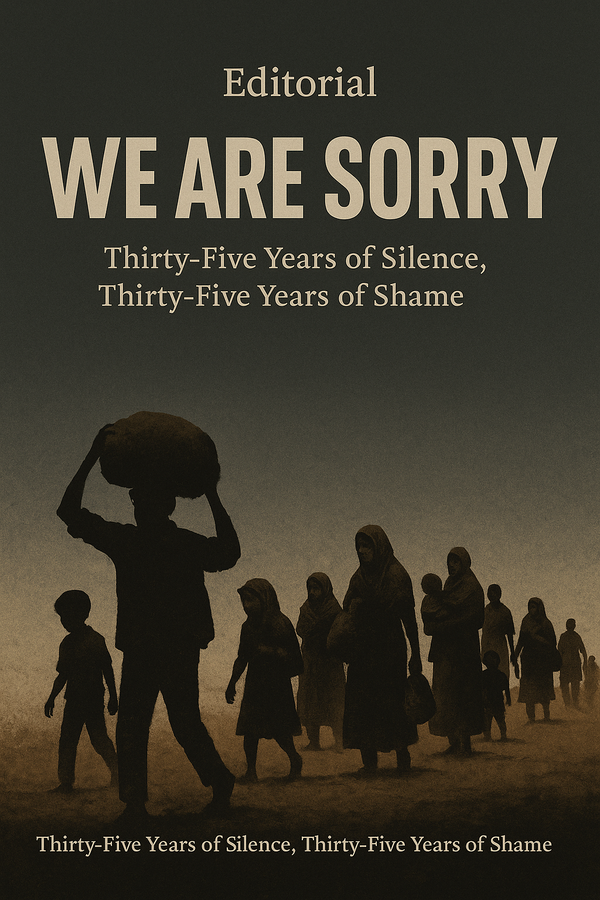
Editorial Thirty-Five Years of Silence, Thirty-Five Years of Shame On October 30, 1990 — thirty-five years ago — the Liberation Tigers of Tamil Eelam, with we Tamils as mute spectators, committed an atrocity that erased whatever moral or ethical ground our struggle once stood upon. In an orchestrated act of ethnic cleansing — not in scale, but in spirit comparable to the mass expulsion of the Rohingya from Myanmar; reminiscent of the 1948 Palestinian Nakba; echoing the forced displacement of


Kaniyan Pungundran

Kaniyan Pungundran