

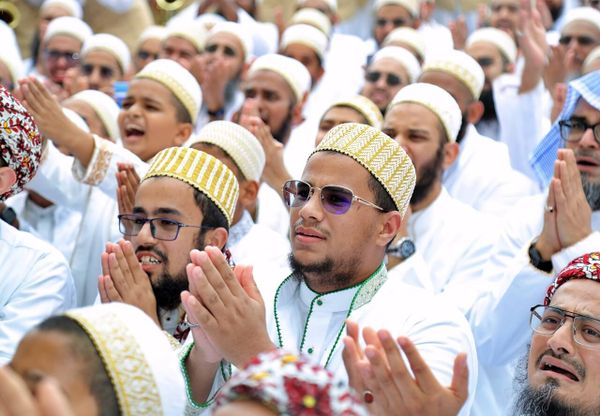
"Tell me something," said a dear friend of mine—an expert in security studies—as we spoke about the Dawoodi Bohras over coffee one evening. "Have you ever heard of a Bohra being involved in a bomb blast? A shooting? Any terrorist group claiming to defend Islam through violence that had Bohra links?" He paused. "No, right?"
"That's not a coincidence," he continued. "It's actually one of the most remarkable things about the Bohras—whether in Sri Lanka, South Asia or anywhere in the diaspora. While various Muslim communities worldwide have had to grapple with radicalization, sectarian tensions, and the politicization of religion, the Bohras have remained largely untouched by these challenges. Not because they've isolated themselves—but because of how their religious culture is structured."
"You see, this community is rooted in centralized authority, carefully guided interpretation, and a deeply spiritual reading of the Quran. That combination creates remarkable stability and resistance to extremist ideologies."
A Bohra scholar offered further insight into this phenomenon. Speaking to Jaffna Monitor, he explained: "I think the difference is simple, really. In many larger Muslim communities, there are countless leaders—each with their own interpretations, messages, and agendas. That opens the door to fragmentation and, sometimes, radical voices slipping through. But for us Bohras, there is only one voice. One leader. One Syedna. And we all listen to him."
This singular leadership creates deep cohesion and, crucially, responsibility. "Our Syedna has always preached that your first duty is to the country you live in. He's said this many times: whatever I teach, it must never conflict with the law of the land. A Bohra must first obey the laws of their nation. We follow him faithfully, and that's why extremism never finds space among us."
"This centralized model provides theological consistency," he continued, "and importantly, it creates a unified voice that has consistently emphasized love, peace, and coexistence. These values aren't just spoken from the pulpit—they cascade down from the top and shape the mindset of community members. That's a significant factor in why the community remains so peaceful."
While centralized religious authority has both advantages and potential limitations, in the Bohra case it appears to have served as an effective safeguard against radical interpretations gaining traction within the community.
Esoteric Interpretation: A Different Hermeneutical Approach
"The Dawoodi Bohras emphasize bāṭinī tafsir—esoteric interpretation—alongside the literal meaning of texts," a scholar explained. This approach allows Quranic verses to be understood on multiple levels—not only as legal injunctions but also as spiritual guidance aimed at inner transformation and ethical development.
To illustrate this, he referred to the often-debated “Verse of the Sword” from Surah At-Tawbah (9:5): “Then, when the sacred months have passed, kill the polytheists wherever you find them…”
While some interpretive traditions view this as a call to armed struggle, Bohra scholars, drawing on Fatimid-Ismaili hermeneutics, explore deeper meanings. As one scholar told Jaffna Monitor:
“In our esoteric reading, ‘polytheists’ can symbolize internal spiritual adversaries—such as pride, greed, hatred, or ego. And the command to ‘kill’ becomes a call to subdue these destructive traits within ourselves.”
This perspective highlights the importance of jihad al-nafs—the inner struggle for moral and spiritual refinement—as the primary form of jihad in Bohra teachings.
“The greatest battle a believer must fight,” the scholar added, “is against ignorance, arrogance, and the lower self.”
The Concept of Jihad: Multiple Dimensions
"The concept of jihad," he said, "is one of the most complex and contested ideas in Islamic discourse today." He pointed to a verse from Surah Al-Anfal (8:39) that illustrates different interpretive approaches:
"And fight them until there is no fitnah, and [until] the religion, all of it, is for Allah."
"Different Islamic traditions interpret this verse quite differently," he explained. "Some contemporary radical groups interpret fitnah broadly to justify ongoing conflict, while others understand it within its specific historical context—the persecution faced by early Muslims in Mecca when they were denied the right to practice their faith."
"The Bohras, following their interpretive tradition, tend to contextualize such verses historically while emphasizing the spiritual dimensions of struggle," he said. "Their religious discourse focuses heavily on jihad al-nafs: the struggle against ego, anger, and the impulse to dominate others."
The result is that Bohra religious spaces emphasize personal spiritual development and community harmony rather than political grievance or sectarian conflict.
Emphasis on Peace-Building Verses
“Bohras' religious education places significant emphasis on the Quran's peace-building and humanitarian verses,” a Bohra scholar explained.
One such verse frequently highlighted in Bohra teachings comes from Surah Al-Hujurat (49:13):
"O mankind, indeed We have created you from male and female and made you peoples and tribes that you may know one another."
“This verse is central to the Bohras' worldview,” he continued. “It teaches that human diversity is divinely intended—that differences in culture, ethnicity, and background are meant to foster mutual understanding, not conflict. This principle actively promotes intercultural respect and engagement.”
The Bohra community’s educational approach also contributes significantly to their peaceful orientation. When potentially controversial or complex verses are taught, they are presented within comprehensive historical, theological, and ethical contexts. Students learn about the circumstances of revelation, the Prophet’s own interpretation and application, and how each verse fits within broader Quranic themes of mercy, justice, and wisdom.
This educational methodology produces community members who understand that Islamic teachings must be interpreted holistically—not through isolated verses. The ultimate goals of the Quran, as taught in Bohra tradition, are spiritual development, social harmony, and human welfare—not conflict or domination.