
By Aruliniyan Mahalingam
A NAME FOR EVERY GUN
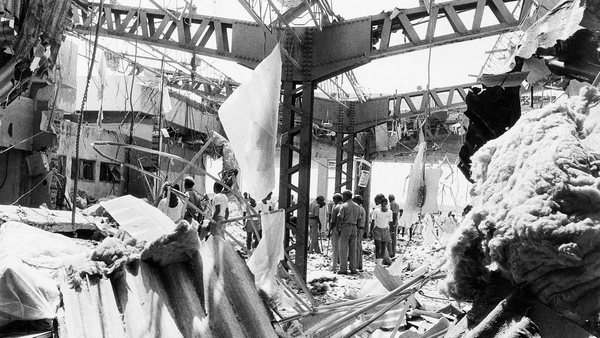
In an earlier article, we examined the story of Panagoda Maheswaran and the Tamil Eelam Army (TEA), the militant group responsible for the bombing at Madras's Meenambakkam Airport on Aug. 2, 1984. Although the attack was carried out by the TEA, it has long been attributed to the Liberation Tigers of Tamil Eelam (LTTE).
This article examines how responsibility for the Meenambakkam bombing came to be associated with the LTTE, and why that narrative endured despite evidence to the contrary.
When the suitcases exploded in the arrivals hall at Meenambakkam Airport on Aug. 2, 1984, killing 29 people and injuring dozens more, it was the deadliest bombing independent India had experienced up to that point. Suspicion fell almost immediately on the Liberation Tigers of Tamil Eelam (LTTE).
By the middle of 1984, if not earlier, the average person in Tamil Nadu knew little about the crowded and often fractious world of Sri Lankan Tamil militant organizations. To many, there was only one name for them all: Viduthalaip Puli (Liberation Tiger).
People who lived through that period told Jaffna Monitor that the label was applied indiscriminately. The Eelam People's Revolutionary Liberation Front (EPRLF) was often referred to as "EPRLF Viduthalaip Puli," the Tamil Eelam Liberation Organization (TELO) as "TELO Viduthalaip Puli," and the People's Liberation Organisation of Tamil Eelam (PLOTE) as "PLOTE Viduthalaip Puli." In the public imagination, the distinctions between the rival groups were largely blurred, and they were collectively remembered as Viduthalaip Puli—thanks in no small part to the sophisticated and highly effective public relations efforts of one man within the LTTE.
That man is Baby Subramaniyam.
He was the LTTE's political head in Tamil Nadu. He signed his correspondence as S. Subramaniyam, but almost everyone knew him simply as Baby Subramaniyam. Even those who worked closely with him could not explain how he acquired the nickname.
Before joining the LTTE, Baby was associated with the Tamil United Liberation Front (TULF) and was a close associate of its leader, Appapillai Amirthalingam. In that role, he frequently traveled to Tamil Nadu with TULF leaders, years before he became publicly identified with the LTTE. By then, he had already built relationships with many of Tamil Nadu's leading politicians, all of whom knew him simply as "Baby."
When he later took charge of the LTTE's political and public relations operations in Tamil Nadu, those connections proved invaluable. Former LTTE members credit him with building the organization's political network across the state and, in particular, with cultivating its close relationship with Chief Minister M.G. Ramachandran (MGR).
Several former LTTE members told Jaffna Monitor that, in the movement's early years, Prabhakaran admired both M. Karunanidhi and MGR. He was deeply drawn to Karunanidhi's command of the Tamil language and his oratory, while also being an ardent admirer of MGR and his films.
They said it was Baby Subramaniyam who persuaded the LTTE leadership that cultivating MGR, rather than Karunanidhi, would better serve the organization's long-term political interests. The LTTE gradually aligned itself with MGR and distanced itself from the DMK.
THE FACE OF THE STRUGGLE
Long before the Meenambakkam bombing, according to early members of the LTTE who spoke to Jaffna Monitor, Baby was convinced that the Sri Lankan Tamil armed struggle needed a single, recognizable face—and that face should be Prabhakaran. He set about building that image systematically, with Prabhakaran's approval. Several early LTTE members said Prabhakaran had long displayed a fondness for personal adulation and was receptive to efforts that elevated his public image.
One of the LTTE's earliest propaganda tools was a slim, 23-page booklet titled Arasa Bayangaravadhamum Aayudha Puratchiyum ("State Terrorism and Armed Revolution"), written by Anton Balasingham and published in April 1983, just months before the anti-Tamil pogrom of July that year. After the cover and publication details, readers encountered a striking full-page photograph of Prabhakaran holding a submachine gun, reportedly captured after the killing of Inspector Bastiampillai. The photograph was taken by Nadarajah Master of Madurai, who also designed the LTTE's tiger emblem.
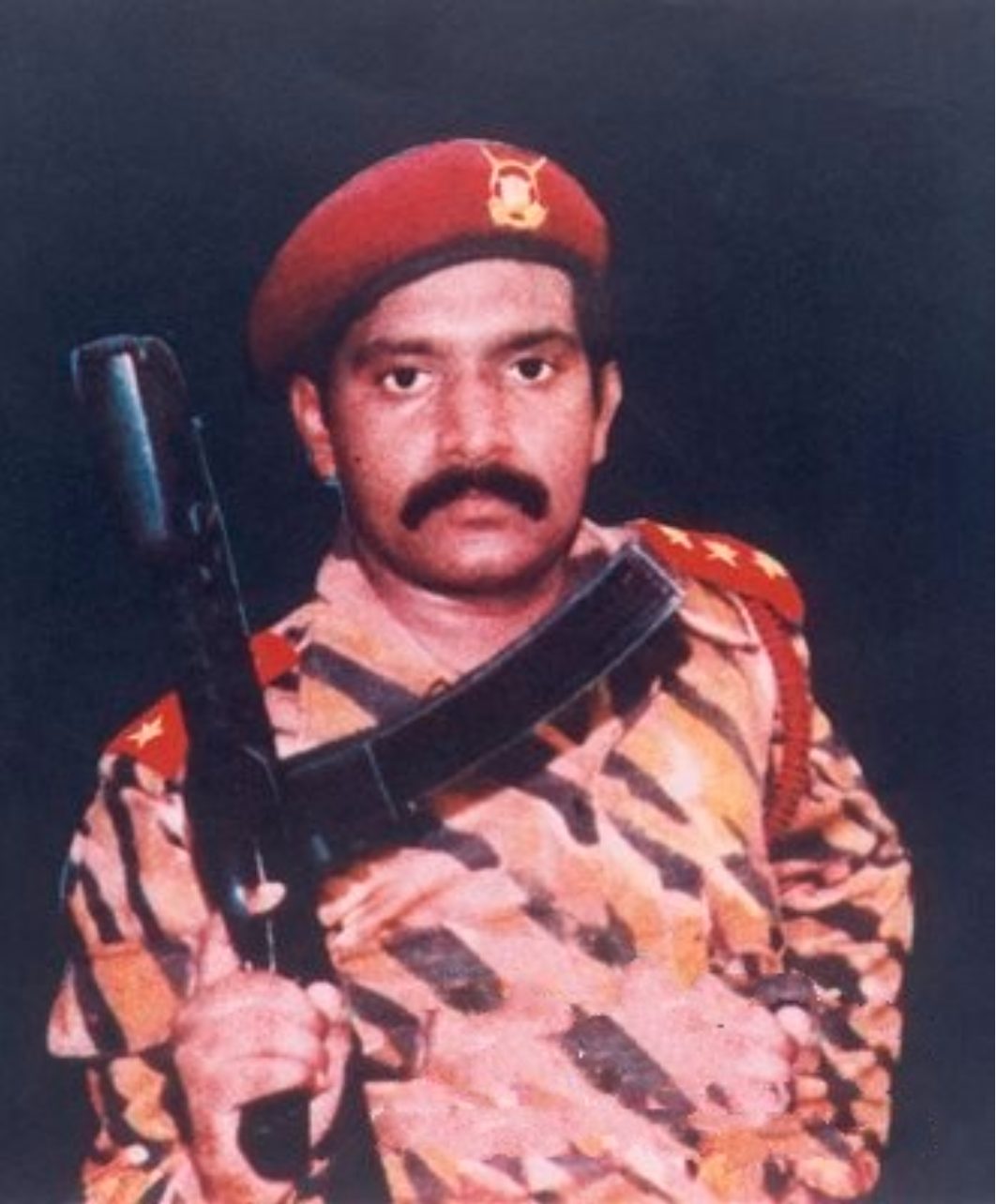
When the booklet was republished in 1991, however, the LTTE replaced the original photograph with another image of Prabhakaran taken during an LTTE training camp at Iruttumadu, Udayarkattu, in 1983, in which he is seen holding a German-made G3A3 battle rifle.
According to LTTE sources, the rifle had originally been issued to the Pakistan Army, for which the G3A3 served as the standard service weapon. They claim that it entered Bangladesh's illicit arms market in the aftermath of the 1971 Bangladesh Liberation War. From there, the rifle was allegedly procured in Calcutta with the assistance of an LTTE supporter known as Lawyer Kandasamy (Vakkeel Kandasamy) before being secretly transported to Sri Lanka by Sellakili, one of the LTTE's earliest fighters.
The same sources further claim that Prabhakaran later used that very rifle in the July 23, 1983, ambush of the Sri Lankan Army's Four Four Bravo patrol at Thirunelveli, the attack that triggered the anti-Tamil pogrom known as Black July. According to those accounts, Sellakili, the man who brought the rifle into Sri Lanka, was the LTTE's only fatality in the ambush.
An early LTTE member told Jaffna Monitor that by publishing the book written by Anton Balasingham, the LTTE's and Baby's objective was not merely to promote Balasingham's political ideas. Baby wanted Prabhakaran's image to reach Tamil Nadu. The booklet somehow achieved that goal.
The photograph was picture-perfect. Prabhakaran stood in a tailored military-style uniform reportedly fashioned from a Tamil Nadu police uniform and restitched with tiger-stripe insignia. A beret rested on his head. He held an unfamiliar submachine gun with the ease of someone entirely at home with it.
For many in Tamil Nadu, this was their first glimpse of Prabhakaran. The July 1983 violence had not yet taken place, and the Sri Lankan Tamil question had not yet entered the political mainstream of the state. Compared with the leaders of other militant groups—who, as one former militant put it, looked like "பஞ்சத்தில் அடிபட்டவர்கள்" (men beaten down by famine) rather than guerrilla leaders—Prabhakaran projected confidence, discipline, and quiet menace. The unfamiliar weapon in his hands only amplified the effect.
The rival organizations, according to many accounts, resented it. They dismissed the photograph as a "cinema pose," accusing the Tigers of staging a spectacle and trying to manufacture a hero out of a collective struggle.
CALENDAR AND CARAVAN
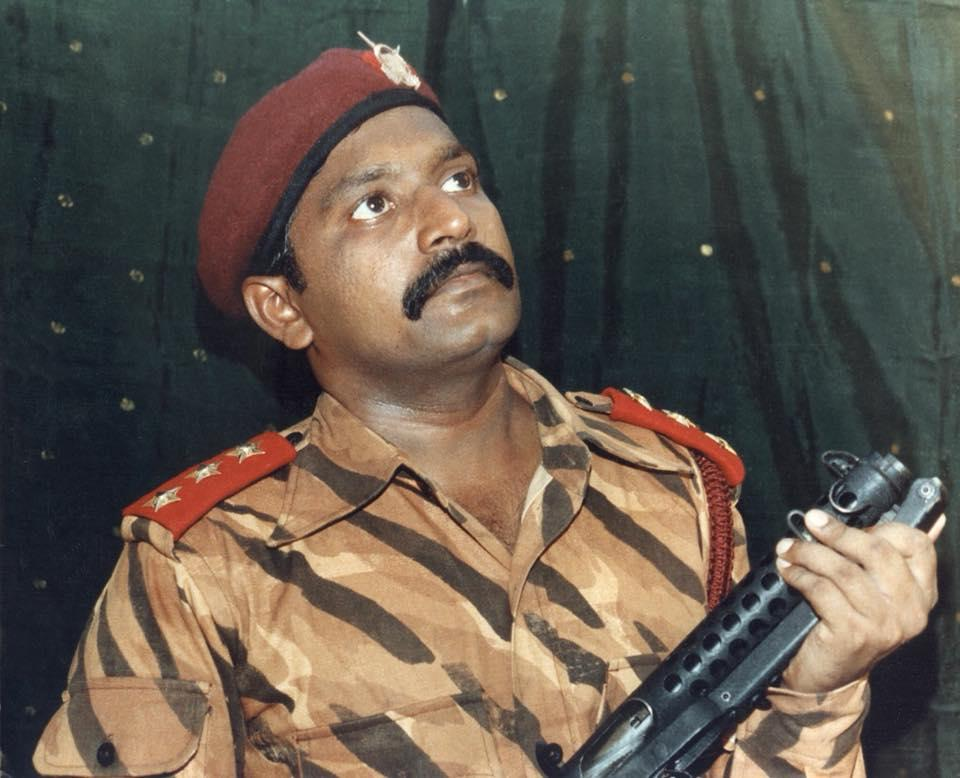
In January 1984, the LTTE published a wall calendar printed on high-quality art paper. It consisted of four leaves, each covering three months of the year. Once again, the cover featured Prabhakaran with a gun. By all accounts, the calendar sold remarkably well.
Beginning in 1983, the LTTE also organized a series of exhibitions across the major towns of Tamil Nadu, often with the support of the Dravidar Kazhagam. They were carefully curated, pairing photographs of atrocities committed against Sri Lankan Tamils with images of LTTE military operations and prominently displayed portraits of Prabhakaran. The exhibitions presented the suffering of the Tamils alongside the image of the man portrayed as their defender.
By the time the suitcases reached Meenambakkam, the groundwork had been laid over several years. In the minds of many in Tamil Nadu, Sri Lankan Tamil militancy had become virtually synonymous with the LTTE. When the bombs exploded, it was only natural that suspicion fell almost immediately on the Tigers.
THE BOMBING, AND ITS JUDGES
The bombing drew swift and near-universal condemnation across Tamil Nadu's political and public life. Yet it also produced a more uncomfortable reaction. In some quarters, there was a grudging admiration that whoever had carried out such a sophisticated operation was a force not to be underestimated.
More consequentially, the attack handed a powerful argument to those who had long viewed the Sri Lankan Tamil militant groups with suspicion. Their warning suddenly appeared vindicated: one day, they said, these men would turn their guns on India itself. Among the most vocal critics was the influential Thuglak, edited by Cho Ramaswamy, which published a series of editorials and articles denouncing the militant movement. The celebrated writer Jayakanthan also joined the chorus of condemnation.
For the LTTE, the bombing also created a different problem. Many of those killed were Sri Lankan civilians, including Sinhala workers travelling to the Middle East. Their deaths sat uneasily with the political line the LTTE was then projecting through Anton Balasingham, who argued that the movement's struggle was against the Sri Lankan state rather than the Sinhala people, and that Sinhala and Tamil workers shared common class interests. The Meenambakkam bombing contradicted that message and threatened to undermine the political image the organization had worked carefully to cultivate.
THE DENIAL, AND THE INVESTIGATION
Soon after the bombing, according to former LTTE members, Tamil Nadu Chief Minister M.G. Ramachandran summoned the movement's leaders and asked them directly whether they were responsible. They denied any involvement and, characteristically, went a step further: they promised to identify those who had carried out the attack and produce the evidence.
As explained in the previous article, the LTTE's nascent intelligence wing concluded, based on the evidence it had gathered, that the Tamil Eelam Army (TEA) was responsible.
According to former LTTE members, the Tigers presented their findings to MGR, who accepted their assessment and passed the information to the Tamil Nadu police. Veteran LTTE members still recount this episode with quiet pride. While the police, with all their resources, had failed to identify the perpetrators, the LTTE's five-member intelligence unit had traced the attack to the TEA. Several former members recalled that MGR privately expressed admiration for the efficiency of the LTTE's intelligence network.
ABSORBING THE DEFEATED
With the TEA leadership driven into hiding, the organization's remaining cadres sought help from the poet Kasi Ananthan, who was also from Batticaloa and who, according to former LTTE members, introduced them to Baby Subramaniyam.
Baby, they said, then lobbied Velupillai Prabhakaran to absorb the surviving TEA cadres into the LTTE. Prabhakaran agreed, and most of the remaining members subsequently joined the organization.
According to former LTTE members, Prabhakaran also quietly approved efforts to secure bail for Thampirasa, who had been named by investigators as one of the alleged masterminds of the Meenambakkam bombing. However, he instructed those involved that the LTTE's role must remain completely concealed. Under no circumstances, he warned, should the organization's name be linked to the bail process.
Former LTTE members said the bail was eventually secured through the late advocate TADA Dhanasekar, an LTTE sympathizer and long-time supporter.
THE PERCEPTION THAT WOULD NOT MOVE
The facts, in the end, changed very little. The LTTE consistently denied any involvement in the bombing and sought to distance itself from the attack. Yet in Tamil Nadu, responsibility remained firmly attached to the Tigers. Ironically, the misattribution cut both ways: it enhanced the LTTE's aura as a formidable militant organization while simultaneously damaging its carefully cultivated political image.
An LTTE cadre who worked in Madras during those months described the daily reality more simply. Wherever they went, he told Jaffna Monitor, people confronted them with the same question: "Why did you do it?" Time and again, they replied that the bombing had not been carried out by the LTTE but by the Tamil Eelam Army (TEA).
Few believed them. Some simply replied, "So it wasn't the LTTE—it was the TEA Viduthalaip Puli."