
By M.R. Narayan Swamy
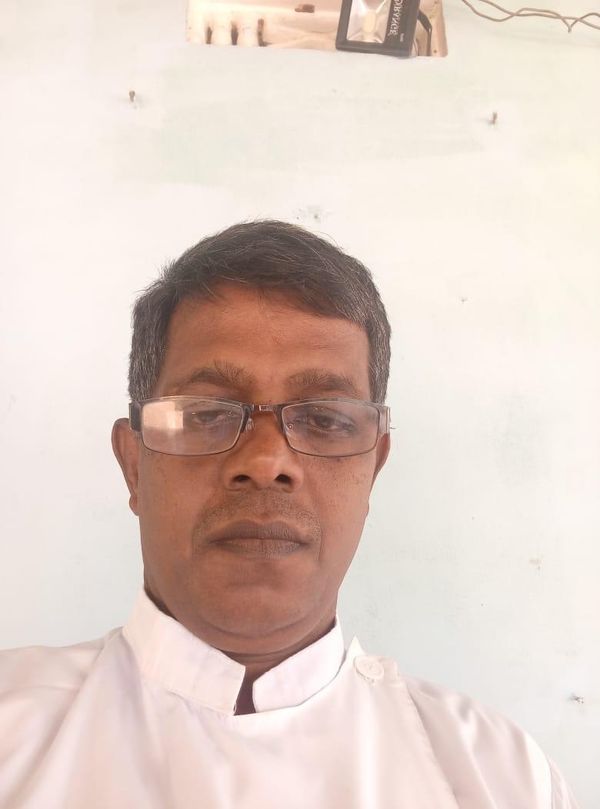
A Tamil pastor arrested in 2006 at age 30 in Sri Lanka spent over 16 agonizing years in prisons undergoing such severe torture that even today he walks with a distinct limp and suffers from multiple body pains, presiding over a family which is physically and mentally broken both by the war and his imprisonment.
Edward (Sam) Sivalingam was no Tamil Tiger sympathizer and led a mundane life far removed from a brutal war that raged between the Liberation Tigers of Tamil Eelam (LTTE) and government troops.
He was stopped on August 4, 2006, near the YMCA lodge at Vavuniya town before boarding a bus to Omanthai, which was an informal border between the Sri Lankan and the LTTE-held territory in the island nation’s north.
Sivalingam, from the Methodist Church, was returning home in Kilinochchi.
Security personnel were initially okay that he was from the clergy. That is when they seized from him a Travel Pass that the LTTE issued to all those living in its zone. It was in Tamil and valid for two years.
The Sinhalese-knowing soldiers behaved as if they had been hit by lightning when they spotted the LTTE insignia on the small document – a roaring tiger, its paws outstretched, and its face ringed by dozens of bullets and two rifles.
The soldiers refused to accept the pastor’s word that he had nothing to do with the Tigers, and this was a pass which everyone in the LTTE’s de facto state had to carry if they commuted to Sri Lankan territory.
The Travel Pass carried a passport-sized photograph. The soldiers mistook the black thread around the person's neck for the type of necklace worn by Tamil guerrillas to carry a cyanide capsule, as the cross hanging from the thread was not visible in the photograph.
Ignoring his cries that he was innocent, Sivalingam was dragged away and confined in an army camp in Vavuniya for two days before being handed over to the notorious Criminal Investigation Department (CID) in Colombo.
That is where the pastor learned what hell can be like.
For nine months, the frail Sivalingam — who could barely speak Sinhala — was subjected to relentless beatings and brutal torture, day after day.
His interrogators wanted him to confess to being a member of the LTTE — something he was not.
He would be blindfolded before the start of the interrogation – so that, if he survived, he would not be able to identify the men tormenting him.
“There would be at least three torturers every day,” Sivalingam told Jaffna Monitor on the telephone from Kilinochchi. “I couldn’t see them. But I counted the number of voices.”
Almost all his interrogators were from Sri Lanka’s majority Sinhalese community, and they appeared to treat all Tamils in their custody worse than animals.
The remaining but fewer interrogators were young Muslims who, traumatised by the way the LTTE had ousted the community en masse from the country’s north, seemed determined to teach a lesson no Tamil would forget.
Between them, they beat and tortured Sivalingam so severely — calmly ignoring his piercing screams — that he suffered three head wounds, a fractured hand, and the loss of two teeth.
The food served to him was of pathetic quality. He could hardly sleep at night. Such was the bodily pain.
The more he insisted he had nothing to do with the LTTE, the more he was traumatised. The interrogators did not care for the truth; they wanted a confession.
The men wanted to show their superiors that they had correctly netted a Tamil Tiger, under the draconian Prevention of Terrorism Act (PTA).
When Sivalingam could take it no more, he was asked to sign a document typed in Sinhala. The interrogators told him that he would be released if he affixed his signature, as he had indeed proved to be innocent.
Unable to read the language, he complied. It was only much later that he realized he had been tricked. The document stated that Sivalingam had confessed to being a member of the LTTE.
From CID custody, the pastor — who had by then begun to limp — was transferred to the high-security prison at Boosa, near the southern port city of Galle (incidentally, the city where Sivalingam was born). He remained there for about 6 to 7 months.
Sivalingam spent the remainder of his prison term at Colombo's Wellikada Prison, Sri Lanka's largest jail. His incarceration lasted a total of 16 years, two months, and 21 days, during which he counted each passing day and cursed his fate.
“The way I was tortured, I almost died,” Sivalingam recalled. “I repeatedly suffered all kinds of pain. I was repeatedly taken to the hospital. Believe it or not, I spent a total of four years over many visits on hospital beds.”
Despite the trauma he endured, Sivalingam was unable to convince the judiciary of the truth, as both the judges and his defence lawyers changed repeatedly throughout the proceedings.
When his elderly father passed away, the authorities refused to let him attend the Christian cremation.
It was finally a Muslim judge at the Colombo High Court who saw through the farce Sivalingam had been subjected to and gave him belated justice.
When the judge learnt that Sivalingam could not read the Sinhala language, he summoned the men who had obtained his signature and asked why they had made him sign a document he could not even understand.
The judge also berated the security men for failing to differentiate between an LTTE Travel Pass and an LTTE Identity Card.
On November 23, 2022 – more than 16 years after his needless and unlawful arrest and 13 years after the end of the civil war – the traumatised pastor breezed out of prison.
He was 47 years old and had to use crutches to walk – thanks to his torturers.
Sivalingam’s daughter was in nursery and his son in Class 1 when he was arrested. In his absence, the Church paid his family half his salary. That wasn’t enough, so the children underwent a painful, fatherless life.
Although now married, their lives are beset by perennial trauma.
Today, Sivalingam is back at work as a pastor but is broken within. He is a heart patient too. One of his nerves is affected. He cannot move his legs and hands freely.
The family was in the wrong place when the military crushed the Tamil Tigers in 2009. In the process, his wife suffered injuries to her head and leg, his daughter suffers from frequent ill health, and his son has unresolved liver issues.
Sivalingam recalls that of the 574 prisoners who were in Wellikada when he left, “99.9 percent were Tamils, falsely accused, like me, of being with the LTTE. Take it from me, perhaps only ten of them were really Tigers. The others were completely innocent.”
According to him, most prisoners came from economically battered families in Sri Lanka’s north and east, the war zone.
If a Tamil had money, he would secure bail – if the demands of the CID personnel could be met. The others simply suffered and suffered.
“Sir, I am half dead today,” Sivalingam says, speaking slowly — a living example of a man destroyed from within by a heartless Sri Lankan state and its draconian Prevention of Terrorism Act.