By M.R. Narayan Swamy
The Indian government has publicly raised a demand for early Provincial Council elections in Sri Lanka despite knowing that powerful interest groups in the country are arrayed against devolution of power.
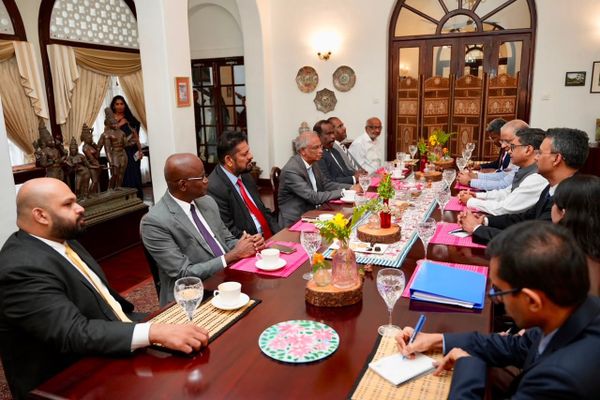
During a hectic day-long visit to Colombo on Wednesday, Indian Foreign Secretary Vikram Misri urged President Anura Dissanayake to hold the much-delayed balloting to the Provincial Councils “at the earliest”.
It is the closest India has come to saying that the elections, last held in 2014, should not be subject to repeated postponements for various reasons, including a plan to reserve seats for women.
Provincial Councils with limited autonomous powers came into being in all nine provinces of Sri Lanka as a result of the 1987 India-Sri Lanka Agreement, which sought to end Tamil separatism.
In the context of the Tamil-majority northern and multi-racial eastern provinces, where a war raged for an independent Tamil Eelam, the provincial bodies were conceptualised as a political alternative to Tamil separatism.
But both the Tamil Tigers, who were finally crushed militarily in 2009, and Sinhalese-Buddhist hardliners turned against the 1987 pact, which birthed the Provincial Councils after the 13th amendment to the Sri Lankan constitution.
While Sri Lanka’s dominant ruling party, the Janatha Vimukthi Peramuna (JVP), has shed its long-standing anti-India posture, not everyone in the Marxist outfit is comfortable with the idea of devolution of power, which is what Provincial Councils are all about.
The JVP is not alone in this respect, say Indian official circles with intimate knowledge of Sri Lankan affairs.
“Influential people in the Sri Lankan landscape are opposed to the Provincial Councils,” said one source, adding that the fear was that any power-sharing arrangement could dent the country’s unitary form of governance.
This was stated more than once, even after the Liberation Tigers of Tamil Eelam (LTTE) was routed when Mahinda Rajapakse was the president.
The perennial argument given to Indian officials was that while the Indian landmass perhaps needed states for administrative convenience, an island nation like Sri Lanka did not need its provinces to have councils, even with limited power on subjects such as education, health, and agriculture.
Indian officials would remind their Sri Lankan interlocutors that India was also a unitary state with a cozy federal structure and that the division of powers between a strong Centre and the states had worked reasonably well despite some irritants.
After the then-northeastern province was split into two in 2008, the last Provincial Council elections were held in the Northern Province in 2013 and in the Eastern Province in 2012.
In recent times, the JVP-led Sri Lankan government has been accused by the opposition of sidelining elected representatives in areas of local governance – a development not viewed favourably in New Delhi.
Seen alongside the failure of successive governments to hold Provincial Council elections, a feeling gained strength in India that the limited autonomy granted to the provinces, including Tamil-majority areas, should not be allowed to be stifled by political opportunism.
India is aware that, notwithstanding what the Tamil parties in Sri Lanka may desire, the Northern and Eastern Provinces are unlikely to be merged again, largely because of opposition from the Muslim community.
Of the three districts which constitute the Eastern Province, Tamils are in a majority – and convincingly -- only in Batticaloa. Muslims, who too speak Tamil but are counted as a separate ethnic group, form the single largest bloc in both Trincomalee and Amparai.
While Sri Lankan authorities did their best during the Tamil separatist war to cause fissures between Tamils and Muslims, the LTTE deepened the divide by massacring Muslim civilians in the East and forcibly expelling thousands of Muslims from the North. Muslim Home Guard units, for their part, were also implicated in grave atrocities against Tamil civilians in the East, including killings and massacres that further entrenched hostility between the two communities.
Although present-day Tamil and Muslim leaders have overcome the earlier bitterness between the two communities, Muslims have no desire to be ruled by Tamil politicians in any province where they live in substantial numbers.
The Indian foreign secretary made another important point, this time to Tamil leaders active in the north and the east.
He said that, on constitutional reforms, India could not advocate arrangements benefiting only a single ethnic community and would instead emphasise equality for all Sri Lankan citizens.
This amounted to an unstated affirmation that there was no stomach in India for issues like “federalism” and “internal self-determination” – concepts which are thrown up by Tamil leaders still tied to the Tamil Tiger ideology.
It was also noted that ahead of a meeting between Tamil and Muslim parties with President Dissanayake, a group called the North-East Civil Society raised the need for a federal set-up in Sri Lanka.
Indian officials are clear that federalism is a non-starter in Sri Lanka and that an overwhelming majority of the Sinhalese community view federalism as a dirty word, almost akin to separatism.
But sections of the Tamil diaspora linked to the erstwhile LTTE and some Tamil politicians in Sri Lanka with a similar view keep clamouring for federalism.
At times, they involve leaders in India’s Tamil Nadu state in their political machinations.
In his diplomatic style, Foreign Secretary Misri drew a red line for the Tamils as well — defining what India can support and what it cannot.