By M.R. Narayan Swamy
Is the Sri Lankan government preparing the ground to quietly do away with the provincial councils established under the 1987 India–Sri Lanka Accord? Signals from Colombo suggest this may be the case.
The vexed bilateral agreement, which sought to end Tamil separatism, envisaged elected councils for all nine provinces in Sri Lanka to devolve powers locally and promote more balanced regional development.
Although the chief objective of the provision was to encourage people in the then-united Tamil-majority North-Eastern Province to shun separatism, provincial councils were established across the entire island, giving rise to a new tier of political activity.
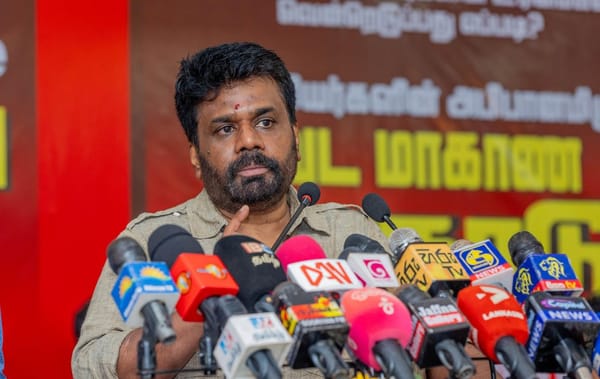
Sri Lanka’s ruling coalition, led by President Anura Dissanayake, promised in 2024 to hold fresh local government and provincial council elections within a year if it formed a government.
But despite being in office for more than a year, the pledge has not been acted upon, raising growing doubts about whether provincial polls will be held at all.
“If the government has the political will, they can hold the elections now,” Faiszer Musthapha, a former minister for sports and provincial councils, said in a telephonic interview.
He said successive governments over almost one decade had repeatedly postponed provincial elections across the country over one pretext or another, and were happy to control the councils through unelected governors appointed by them.
This is happening yet again.
Foreign Minister Vijitha Herath has now declared that a parliamentary panel, which was to submit an initial report in three months on the feasibility of holding provincial elections, will table only a preliminary report, indicating that further stages of the review will follow, with obviously no clear timeframe in sight.
The select committee will meet again on April 7 to consult the Attorney General and the Election Commission on both provincial elections and the full implementation of the India-backed 13th Amendment to the Constitution, which led to the devolution of power. But few expect any breakthrough.
Some opposition leaders, including Tamil politicians who place particular importance on the provincial councils, say this reinforces a long-held view that no government is truly committed to decentralising power, regardless of what it states publicly.
The Marxist Janatha Vimukthi Peramuna (JVP), or People’s Liberation Front, which heads the ruling coalition, has never supported provincial councils, having bitterly opposed the 1987 accord, which it viewed as an Indian imposition on Sri Lanka.
At the same time, as it sought to ride to power and win crucial Tamil votes, the JVP-led alliance promised to hold provincial elections. It was confident of winning them following the 2025 parliamentary contest.
That confidence suffered a rude jolt when the coalition lost some 1.8 million votes in local government elections held months after the general election last year.
“This is the main reason why the JVP is now running away from provincial council elections,” said a former government minister who did not want to be quoted by name.
“The government has been given to understand that they might lose as many as four to five of the nine provincial councils, including those in the (Tamil-majority) north and the (multi-racial) east,” he added. “The government cannot afford this. Any government which loses so massively even before reaching midway through the term will be considered dead for the remaining period.”
Senior Tamil politician M.A. Sumanthiran said a week ago in India that his Ilangai Tamil Arasu Katchi (ITAK), the main Tamil party, was confident of taking power in both the north and east in any provincial council election.
A Tamil political analyst, however, said the JVP seemed to be fundamentally opposed to provincial councils as its leftist ideology clashed with the concept that decentralization was needed to resolve Sri Lanka’s ethnic crisis.
Provincial councils can enact legislation on subjects such as health, education, and agriculture. With no elected councils in Sri Lanka since 2017–18, these powers are exercised by Colombo-appointed governors, undermining the very purpose for which these bodies were created through legislation decades earlier.
The first provincial elections in Sri Lanka took place in 1988, when the Indian army was deployed in the country’s northeast. The elected council in the north-eastern province was summarily dismissed in 1990. Subsequently, the north-eastern province was split to form separate administrative regions.
While the other seven provincial councils functioned until 2017–18, the Tamil-majority North went without elections for 23 years, while the Eastern Province saw no election for 18 years.
“That is why Tamils feel so perturbed,” said Tamil political analyst Shanthan K Thambiah, who is based in London. “If no elections are held, it will be a major blow to Tamil aspirations.”
He said Sri Lanka must understand that devolving even limited powers to the provinces would strengthen the country in the long term, as seen in the way different states in India contribute to that country’s progress.
Sri Lankan leaders argue that the massive infrastructure destruction and deaths caused by last year’s devastating cyclone, as well as the ongoing Gulf war and the resultant energy crisis, need to be tackled before any election can be organised.
While Indian officials insist that New Delhi has not softened its stance on the 13th Amendment and provincial council elections, a retired Sri Lankan diplomat said there is currently no pressure from India to hold the polls.
“Both India and the West are soft on the JVP government, fearing that any serious pressure from them would push it towards China,” he said, referring to a country with which the Marxist JVP has traditionally maintained close ties.
“There is no international pressure on this government,” the ex-diplomat added. “This suits the JVP. This is why (top JVP leader) Tilvin Silva has even said that provincial councils have not served their purpose.”
Silva, considered the real power behind President Dissanayake, made the statement without any elaboration after a brief visit to India this month.
According to him, the government did want to hold provincial elections this year, but legal barriers, the need for electoral delimitation, and damages caused by last year’s cyclone have come in the way.
Some political actors believe that signals from government leaders make it increasingly clear that provincial elections may not be held even in 2027.
Provincial councils have served as a springboard for many political figures who later rose to prominence at the national level. Among the most notable is Chandrika Kumaratunga, who served as Chief Minister of the Western Province — which includes Colombo — before ascending to national politics and eventually the presidency.
Editor’s Note: This article was originally published by The Federal and is reproduced here by Jaffna Monitor with permission, with due acknowledgment to the original publication.