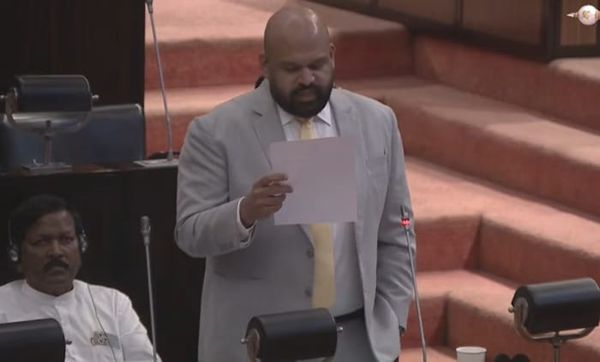
Shanakiyan Rasamanickam, the parliamentary group leader of the Ilankai Tamil Arasu Kachchi (ITAK), called on Sri Lanka's government to disclose to Parliament how much civilian land remains under military control in the country's north and east, saying the administration had been too slow to fulfill its election pledge to return the land and reduce the military's presence in the region.
Seventeen years after the end of Sri Lanka's civil war, Mr. Rasamanickam said, the continued occupation of private and state land was preventing displaced families from returning home, delaying the restoration of civilian administration, and hampering reconciliation between the island's Tamil-majority north and east and the Sinhalese-majority south.
“While the armed conflict ended seventeen years ago, the ethnic conflict remains unresolved,” Mr. Rasamanickam said, arguing that the military’s continued presence in civilian areas did nothing to address it.
He said he had asked the government — through the Ministerial Consultative Committee on Defence, which is chaired by President Anura Kumara Dissanayake in his capacity as defence minister — to disclose the total extent of private and state land held by the armed forces in each district of the Northern and Eastern Provinces, how much had been released since the administration took office, and a timetable for returning the rest.
The National People’s Power, the leftist coalition that swept to power in 2024, pledged during its campaign to expedite land releases and resettle displaced communities, and Mr. Dissanayake has said publicly that the land rightfully belongs to the people. Progress, Mr. Rasamanickam said, has not matched that promise.
He welcomed the recent handover of two military camps in Batticaloa, in the east, but said the overall pace of releases remained far too slow.
Among the cases he cited were about 556 acres near Myliddy Harbour belonging to roughly 700 families; a further 556 acres in the Palaly area belonging to about 300 families; and 59.5 acres in Keppapilavu, in Mullaitivu District. In Valikamam North, he said, sixteen Grama Niladhari divisions have not been fully released, and three remain entirely closed to their original owners.
He disputed the government’s account of Keppapilavu, where officials have said displaced residents were given alternative land. Only 44 families had been allocated temporary plots at Seniyarmottai, Mr. Rasamanickam said, and land belonging to a Hindu cemetery at Kurumbaichitty had still not been returned.
Also occupied, according to his statement, were land needed to expand the Karaichchi public library and the Iranamadu Agricultural Research Institute, along with churches, a Hindu temple, and two schools in Jaffna District that residents have been unable to access.
The land question has become a recurring flashpoint. Peaceful protests have continued for months across the region — in Palaly, Myliddy and Keppapilavu, among other places. Mr. Rasamanickam noted that voters backed the governing party in the elections largely because of its promise to return their land.
There was no immediate response from the Defence Ministry to Mr. Rasamanickam’s demands. The ministry said this month that the National Security Council would finalise the release of military-held land in Jaffna and the Palaly cantonment following a high-level meeting in Parliament.
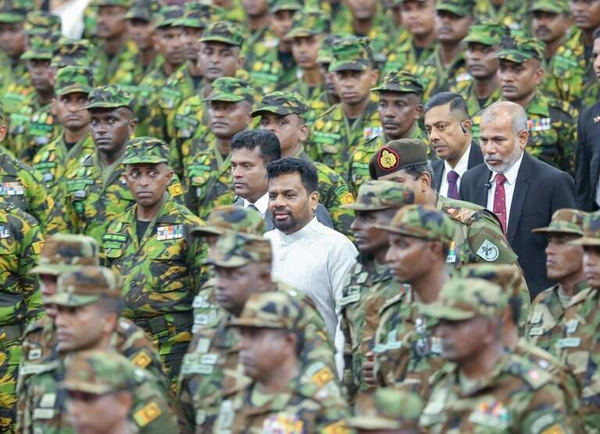
The war, which pitted government forces against the separatist Liberation Tigers of Tamil Eelam, ended in 2009 after more than a quarter-century of fighting. Successive governments have released tens of thousands of acres in stages, but large tracts — much of it around the sprawling Palaly cantonment on the Jaffna Peninsula, the military’s principal base in the north — remain under army, navy and air force control, an enduring grievance for Tamil families barred from their homes, farms, temples and churches since the 1990s.
“The affected communities have waited for seventeen years,” Mr. Rasamanickam said, referring to the period since the end of Sri Lanka's civil war. “They should not be made to wait any longer.”