

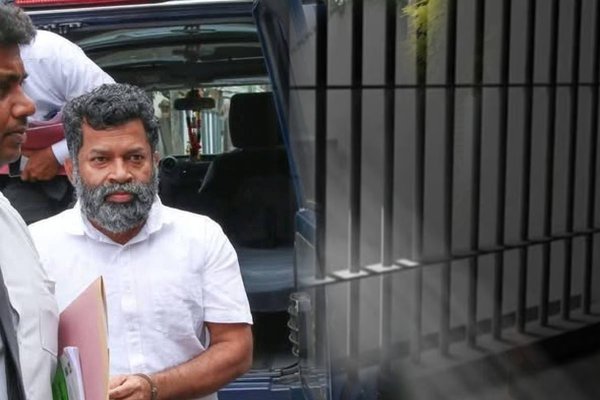
BATTICALOA, Sri Lanka — Sivanesathurai Chandrakanthan, the former state minister better known as Pillayan, was ordered held in custody on Tuesday over a separate series of killings dating to 2008, even as the terrorism investigation that has kept him imprisoned for more than a year over the 2019 Easter Sunday bombings has yet to produce a single criminal charge.
Mr. Chandrakanthan, a former chief minister of the Eastern Province and one-time commander of the breakaway Tamil Makkal Viduthalai Pulikal, was remanded until July 13 by the Batticaloa Magistrate’s Court after investigators named him a suspect in five murders committed across the Eastern Province in 2008.
It was his first appearance before a court in the Eastern Province since officers from the Criminal Investigation Department arrested him in Batticaloa in April 2025. Security was heavily reinforced in and around the courthouse.
Prosecutors told the court on June 15 that the five victims were killed with T-56 assault rifles in a series of attacks throughout 2008. According to investigators, two men — including a former police officer — were shot near the Murugan Temple in Kallady on Jan. 9. Two more were killed along a main road in Kattankudy on May 22, and another man was abducted before being shot in the Vavunathivu area on Aug. 20.
Two co-accused were remanded last month, while another suspect is believed to have fled the country.
Mr. Chandrakanthan was already being held at Welikada Prison in Colombo when the new case was filed. He remains in custody over the 2006 abduction and killing of Prof. S. Raveendranath, the vice chancellor of Eastern University, Sri Lanka.
Prof. Raveendranath disappeared after an administrative meeting on Dec. 15, 2006. The Criminal Investigation Department alleges that he was taken to a clandestine detention and torture site at Sevanapitiya, where he was killed and his body burned. Investigators have identified Mr. Chandrakanthan as the principal suspect in that case.
As the prison bus departed the courthouse on Tuesday, Mr. Chandrakanthan rejected the allegations, shouting to reporters in Tamil that the accusations were fabricated.
“Like Anura’s mouth,” he said, referring to President Anura Kumara Dissanayake, “all of them are false accusations.”
When the Criminal Investigation Department arrested Mr. Chandrakanthan at his party headquarters on April 8, 2025 — just days before the sixth anniversary of the Easter Sunday bombings that killed 269 people — the arrest immediately fueled speculation that investigators had uncovered evidence linking him to the deadliest terrorist attack in Sri Lanka's history.
Within 48 hours, Public Security Minister Ananda Wijepala told Parliament that investigators had obtained information connecting Mr. Chandrakanthan to the Easter bombings. In the months that followed, President Anura Kumara Dissanayake repeatedly cited the arrest as evidence that long-delayed justice was finally moving forward. By July, Mr. Wijepala went further, telling Parliament that Mr. Chandrakanthan had prior knowledge of the attacks and had met their leader, Zahran Hashim.
Yet when Mr. Chandrakanthan was finally produced before the Mount Lavinia Magistrate’s Court on April 2 this year, after spending 359 days in detention under the Prevention of Terrorism Act without appearing before a judge, prosecutors filed no charge related to the Easter attacks.
Instead, the proceedings focused exclusively on the 2006 killing of Prof. Raveendranath. Monday’s remand concerned an entirely separate set of killings from 2008.
More than a year after his arrest, no indictment or charge sheet has been filed linking Mr. Chandrakanthan to the Easter Sunday bombings.
The contrast has drawn increasing scrutiny from legal observers, who note that the government’s strongest assertions were made in Parliament, where lawmakers enjoy parliamentary privilege, while court proceedings have centered on unrelated criminal investigations.
“If the government possessed sufficient evidence linking him to the Easter attacks, as it repeatedly told Parliament and the public, why has it still not filed a single charge?” said one observer who has closely followed the proceedings.
Mr. Chandrakanthan’s supporters have consistently rejected the allegations. His former lawyer, Udaya Gammanpila, has argued that the accusation was implausible because Mr. Chandrakanthan was himself being held on remand when the Easter bombings took place in April 2019, leaving him, he said, no practical means of orchestrating the attacks.