COLOMBO —
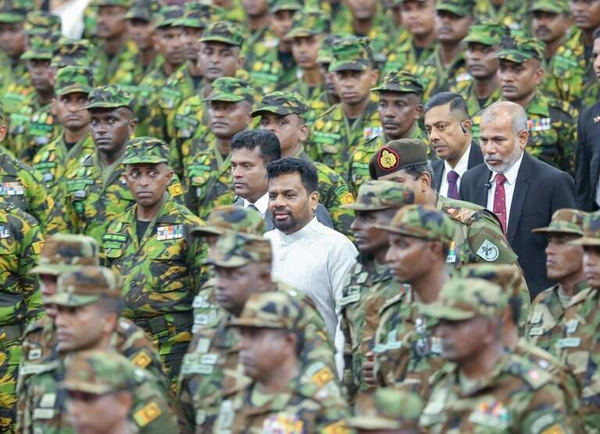
More than a thousand Sri Lankan soldiers and police officers are preparing to deploy to Haiti in August, the largest single contingent the country has ever sent abroad — and a return, after more than a decade, to the same Caribbean nation where its peacekeepers were once documented running a child sex ring that went unpunished.
The deployment, announced by the government, comprises 900 army personnel drawn from several regiments, 189 officers of the Police Special Task Force, and, for the first time, 43 female soldiers trained in demining and explosive ordnance disposal — a total of 1,132. The battalion will travel with armoured vehicles, locally manufactured Uni Buffel troop carriers, and two bulletproof vehicles supplied by the Presidential Security Division. Human rights organisations tracking the mission have referred to a force of roughly 900 soldiers and 140 police, and say an advance team was expected in Port-au-Prince within days.
The personnel will join the Gang Suppression Force, or G.S.F., a U.S.-backed multinational mission authorised by the U.N. Security Council to help Haitian security forces claw back territory from the armed groups that control much of Port-au-Prince. Although the Council mandated it, the force is not a U.N. peacekeeping operation; troop contributions are coordinated by a U.S.-led Standing Group of Partners, with logistical support from a new U.N. office in Haiti. Fifteen countries have pledged more than 11,500 personnel for a force of 5,500.
On June 26, President Anura Kumara Dissanayake told departing peacekeepers they represented an armed force committed to "the protection, democracy and human rights of oppressed people wherever they may be" — a lofty description of an institution that has spent decades facing allegations of enforced disappearances, torture, extrajudicial killings and attacks on journalists at home.
A call to halt the deployment
On June 25, fourteen rights and advocacy groups — among them the International Truth and Justice Project, the Sri Lanka Campaign for Peace and Justice, and People for Equality and Relief in Lanka — issued a joint statement addressed to the United Nations, the Haitian government, and the partners overseeing the force.
They demanded that the deployment be suspended until an independent, credible vetting mechanism is established, with meaningful participation by the Office of the U.N. High Commissioner for Human Rights and full access to relevant U.N. records.
“No individual should be deployed without an independent assessment of involvement in past violations,” the groups said. They argued that any official whose own conduct or command role created an actual or perceived conflict of interest should play no part in supervising, certifying, or approving the screening.
The organisations also pressed the U.N. and the G.S.F. to retain the names, photographs, and DNA records of every deploying officer before departure, so that any allegation of sexual violence or paternity could later be investigated, and to establish a confidential, victim-accessible complaints mechanism inside Haiti.
The Legacy of Abuse
The coalition’s alarm is rooted in what happened the last time Sri Lankan troops served in Haiti. Between 2004 and 2007, under the U.N. Stabilisation Mission in Haiti, a confidential investigation by the U.N.’s Office of Internal Oversight Services found that at least 134 Sri Lankan peacekeepers, spread across six battalions, had sexually exploited and abused Haitian children. The findings were made public in 2017 by an Associated Press investigation that obtained the internal report.
Nine children were identified as victims, some as young as eight. Investigators documented a sustained ring in which children were passed from soldier to soldier in exchange for food, small sums of cash — sometimes only $3 to $5 — cookies, juice, or a mobile phone.
One girl told investigators she was first raped at twelve, before, in her words, her body had begun to change. A boy known in the report as Victim No. 9 said that over three years, he had been abused by more than a hundred Sri Lankan peacekeepers, on some days four in a single day. The U.N. concluded the abuse was systematic, occurred across multiple sites, and that some commanding officers were aware of it, and in certain cases involved themselves.
Of the roughly 950-member contingent, 114 peacekeepers were sent home. Not one was ever imprisoned. Because the United Nations holds no criminal jurisdiction over national troops, prosecution was left to Sri Lanka, which never charged a single soldier with sexual assault or misconduct committed on a peacekeeping mission.
An inquiry that cleared its own
Sri Lanka’s own response did little to reassure investigators. A team dispatched to Haiti in late 2007 interviewed only about two dozen soldiers out of more than 900 in the country and concluded that just a handful had any contact with victims. Years later, the government said it had examined the cases of only 18 personnel, and that the U.N. Secretariat had, as of September 2014, considered the matter closed. In 2016, the state made a one-time ex gratia payment to a single victim and her child.
A subsequent abuse complaint in 2013 was investigated for the army by Maj. Gen. Jagath Dias, who cleared the accused soldier without interviewing the complainant or the medical staff who had examined her. Dias himself stood accused of atrocities during Sri Lanka’s civil war; he was nonetheless later promoted to army chief of staff. Rights advocates note that the commanders of all six battalions implicated in the original sex ring went on to rise through the ranks.
A vetting process advocates do not trust
Sri Lanka’s government says it is developing a National Human Rights Vetting Mechanism for all troops bound for U.N. field missions, and a delegation led by the defence secretary, Air Vice Marshal (Retd.) Sampath Thuyacontha discussed screening requirements with U.N. officials in New York in April. The State Department, which is overseeing the assembly of the force, says it condemns “any and all acts of sexual exploitation and abuse,” that contributing countries operate under strict guidelines, and that it has found no evidence of prior violations by the incoming Sri Lankan personnel. It added that the U.N. human rights office had conducted its own vetting.
The coalition disputes this. The current process, it argues, leans too heavily on self-certification and diplomatic consultation — falling short of the independence international standards require. The groups say at least one proposed candidate has already been rejected by the U.S. embassy, which they contend shows the danger of letting the Sri Lankan military screen its own. If red-flagged individuals are being put forward at all, they argue, a process built on good faith has already failed.
Frances Harrison, director of the London-based International Truth and Justice Project, said advocates seeking information on who is being screened had been passed between U.N. departments and given no clarity on accountability for the past allegations. “When everyone has a mandate, but no one owns responsibility, accountability disappears,” she said. She noted that among those seeing the soldiers off in Sri Lanka was a man who had been deputy commander of one of the six battalions implicated in the original abuse, and who has since risen in the military.
Impunity that begins at home
For the coalition, Haiti is the downstream symptom of a deeper problem: a military that has never been held to account for the conduct of its own war. During the final months of the armed conflict against the Liberation Tigers of Tamil Eelam in 2009, tens of thousands of Tamil civilians were killed in the Mullivaikkal pocket of the north-east. A 2015 U.N. investigation found evidence of conduct that, if proven, would amount to war crimes and crimes against humanity — indiscriminate shelling, the bombing of hospitals, enforced disappearances, torture, sexual violence, and the execution of surrendering combatants. No senior figure has ever been prosecuted in Sri Lanka.
In February 2020, the United States barred Lt. Gen. Shavendra Silva — commander of the army’s 58th Division in 2009 and later Chief of Defence Staff — and his family from entry, citing “gross violations of human rights.” In December 2021 Washington designated Sunil Ratnayake, convicted of murdering eight Tamil civilians at Mirusuvil, and a naval intelligence officer.
In January 2023, Canada sanctioned former presidents Mahinda and Gotabaya Rajapaksa. And in March 2025, the United Kingdom imposed asset freezes and travel bans on three former commanders — Silva, the former navy chief Wasantha Karannagoda, and the former army commander Jagath Jayasuriya — along with the ex-paramilitary leader Vinayagamoorthy Muralitharan, known as Karuna Amman.
Successive governments have rejected those measures as unwarranted interference, and the present administration has been no exception. Colombo called the British sanctions a “unilateral action” that would complicate reconciliation, insisting that past violations be addressed through domestic mechanisms.
President Dissanayake, elected in 2024 on a reformist platform, has pursued corruption cases vigorously but declined to move against those implicated in wartime atrocities, and has continued to meet senior officers, including some who remain under sanction.
Another lesson learned too late
The concerns are not hypothetical. The force the Sri Lankans are joining already carries a fresh stain: a recent U.N. report implicated members of the earlier Kenya-led mission in at least four cases of sexual violence, including the alleged rape of a 12-year-old girl, in the same Artibonite region where the Sri Lankan contingent is expected to operate. Kenya rejected the findings, though its own inquiry, the Miami Herald reported, was conducted by investigators who spoke neither Creole nor French.
The coalition has been careful to say it is not arguing that Sri Lanka can never contribute to peacekeeping. Its objection is narrower and, it argues, more fundamental: that a contingent drawn from a military with a documented record of abuse in Haiti, and a structural pattern of impunity at home, is being sent back without a transparent, independently verifiable screening in place.
“Haiti cannot afford another lesson learned too late,” Harrison said. Survivors, she added, deserve justice, and accountability and credible vetting must come before deployment — not after.