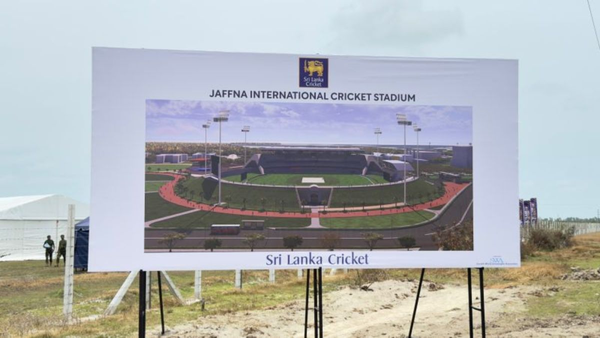
JAFFNA, Sri Lanka — Sri Lanka Cricket will build a cricket ground in this northern city, but has abandoned the international stadium it once promised, saying it cannot afford a venue of international standard.
The retreat scales back what had been billed as a landmark for the country’s war-scarred north, where cricket commands the same devotion as in the rest of the island but where world-class facilities have never existed.
The governing body has concluded that the project it originally approved — an international cricket stadium, a sports city, and a housing development — lies beyond its means, its honorary secretary, Prakash Schaffter, said.
“We have to review the final scope of the project that we want to have, because our review of the originally approved project is that it is beyond the scope of S.L.C.,” Mr. Schaffter said. “We do not have the current financial strength to complete it.” He declined to give figures.
Mr. Schaffter said the board remained committed to cricket in the north but would narrow its ambitions. “We are committed to having a cricket ground in Jaffna,” he said. “I do not think we have the funds at this point of time to invest in an international cricket stadium in Jaffna.” In its place, he said, will come a modest ground.
The decision marks an abrupt turn for a venture that had carried unusual political and emotional weight.
President Anura Kumara Dissanayake laid the foundation stone on Sept. 1, 2025, on Mandaitivu, an island off the Jaffna coast, predicting that the first match could be played within months and the first international fixture within three years. The plan envisioned a 138-acre “sports city,” with the ground built in phases.
But the project soon ran into difficulty. In February, the Central Environmental Authority ordered the suspension of construction because no environmental impact assessment had been carried out. The Wildlife and Nature Protection Society had warned that Mandaitivu — a low-lying flood-retention zone fringed with mangroves, seagrass beds, and salt marsh — was unsuited to large-scale building.
An ecologist who spoke to Jaffna Monitor said the environmental objections were not insurmountable, and could be managed with careful siting, drainage, and planning rather than abandonment of the site.
The funding retreat lands almost exactly a year after the project’s most prominent champion took the idea to the highest level.
During a state visit in April 2025, Sanath Jayasuriya, the former opening batsman who now coaches the national side, appealed to Prime Minister Narendra Modi of India to help build an international stadium in Jaffna, raising it as members of Sri Lanka’s victorious 1996 World Cup squad gathered to welcome the Indian leader in Colombo.
Mr. Modi listened and was warm, but made no commitment. He called the appeal “a very strong thought” and said his team would try to do everything possible.
In the months since, an Indian diplomatic source in Colombo told Jaffna Monitor that New Delhi did not intend to finance the stadium, taking the view that such projects were properly the business of cash-rich cricket boards rather than foreign governments.
Even so, Mr. Jayasuriya’s gesture resonated in the north. For many Tamils, the sight of one of Sri Lanka’s most celebrated cricketers pressing for a world-class ground in Jaffna, a region long starved of investment after a three-decade civil war, was a rare act of recognition, and it won him admirers across the peninsula.
That is partly why the latest announcement has landed so heavily. In a city where cricket runs through school rivalries more than a century old, the prospect of hosting international fixtures had been a source of pride. Its withdrawal has left players, officials, and supporters in Jaffna dismayed. Whether the scaled-down ground eventually becomes the foundation for a larger stadium remains uncertain.