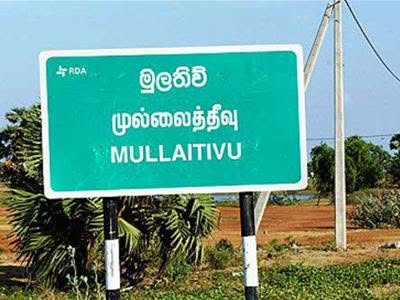
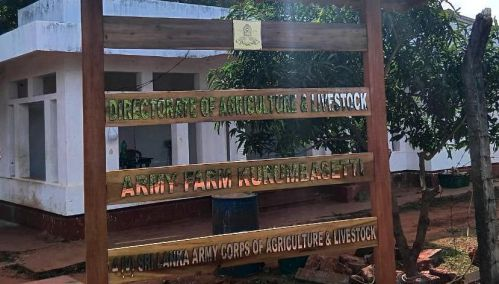
JAFFNA, Sri Lanka — The Sri Lankan Army has installed a signboard formally designating a military agricultural farm on privately owned Tamil land within the Valikamam North High Security Zone, underscoring the military's continued presence despite repeated government assurances that private land would be returned to its displaced owners.
The signboard appeared as the Ministry of Defence prepared to discuss land release in Valikamam North at a high-level meeting expected on Thursday. Many landowners had hoped the meeting would produce at least some tangible progress toward the return of their properties. Instead, residents who have spent more than three decades petitioning for their land said the installation of the new signboard sent a starkly different message.
The military has occupied private land in Valikamam North for more than three decades, since the High Security Zone was established during the armed conflict, and thousands of Tamil families were displaced in June 1990. The army has farmed the Kurumbasiddy fields for years; what is new, residents say, is the move to formalize that occupation with a permanent name board — an act they read not as housekeeping but as a statement of intent to stay.
The dispute cuts to a promise that helped bring President Anura Kumara Dissanayake to power. Dissanayake and the National People's Power campaigned on a pledge to release lands held under the High Security Zone designation, and a large share of the Tamil vote in the north in 2024 turned on the expectation that historical injustices, the land question chief among them, would at last be addressed. Earlier this year, the fisheries minister, Ramalingam Chandrasekar, announced a phased programme of releases, citing "extraordinary circumstances" during the war as the reason private land had been retained. The vast majority of it remains occupied.
More than 6,000 families from Valikamam North remain displaced, with over 2,700 acres still held by the military under the High Security Zone designation. For months, affected residents have gathered every Friday outside the commander's bungalow in Myliddy to demand the return of some 651 acres of their land, a vigil that by mid-June had run for eight consecutive weeks and culminated in a larger demonstration on 15 June marking thirty-six years since the 1990 displacement.
The signboard is not the only development unsettling residents. The chairman of the Valikamam North Pradeshiya Sabha has written to the Jaffna District military commander seeking the immediate suspension of construction on a military hospital in Vasavilan and a military-run refreshment outlet along the Point Pedro–Keerimalai Road, both on privately owned Tamil land.
The Pradeshiya Sabha has also issued a legal notice over the hospital, arguing that it is being built on privately owned civilian land outside the existing High Security Zone boundary. Local officials and residents say construction has continued despite the objections.
"There has been no LTTE since 2009. Continuing to invoke national security to justify holding on to Tamil-owned land amounts to theft," said K. Mayilvaganam, a resident whose family has waited decades for the return of its property.
Another resident, who requested anonymity for fear of repercussions, questioned the military's rationale. "The Army defeated one of the world's most formidable insurgent groups. If the authorities believe there is still a security risk, they can address it through intelligence and surveillance. They do not need to occupy our land indefinitely," he said.
The prolonged occupation has deepened frustration in Jaffna, where many residents say they initially believed President Anura Kumara Dissanayake's repeated promises to return private land. Some now question whether the government is either unable or unwilling to compel the military to relinquish territory it has held for more than three decades.
Others voice a more cynical view. "Sometimes it feels like a carefully choreographed performance," one resident said. "The government says it wants to return the land, while the military appears to resist. In the end, nothing changes, and we are still waiting."