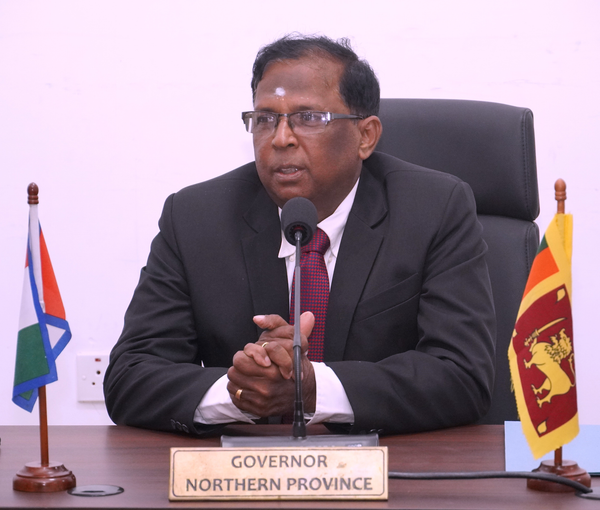
JAFFNA, Sri Lanka — The governor of Sri Lanka’s Northern Province has removed two elected local officials from office by executive order, an extraordinary use of administrative power that has reignited a constitutional dispute over how far an unelected official may go in unseating elected representatives in the country’s Tamil-majority north.
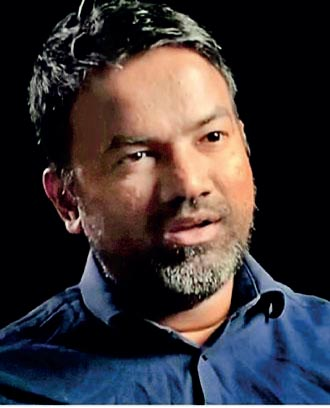
In a notification published in the government’s official Gazette, Governor Nagalingam Vethanayahan declared that Sundaralingam Kandeepan, elected mayor of the Vavuniya Municipal Council barely a year ago, was no longer fit to hold the post, and stripped him of both the mayoralty and his seat on the council with effect from June 24. The order was issued under Section 277 of the Municipal Councils Ordinance of 1947, read with the Provincial Councils (Consequential Provisions) Act of 1989, the law that transferred to appointed governors a range of powers once exercised by central government ministers.
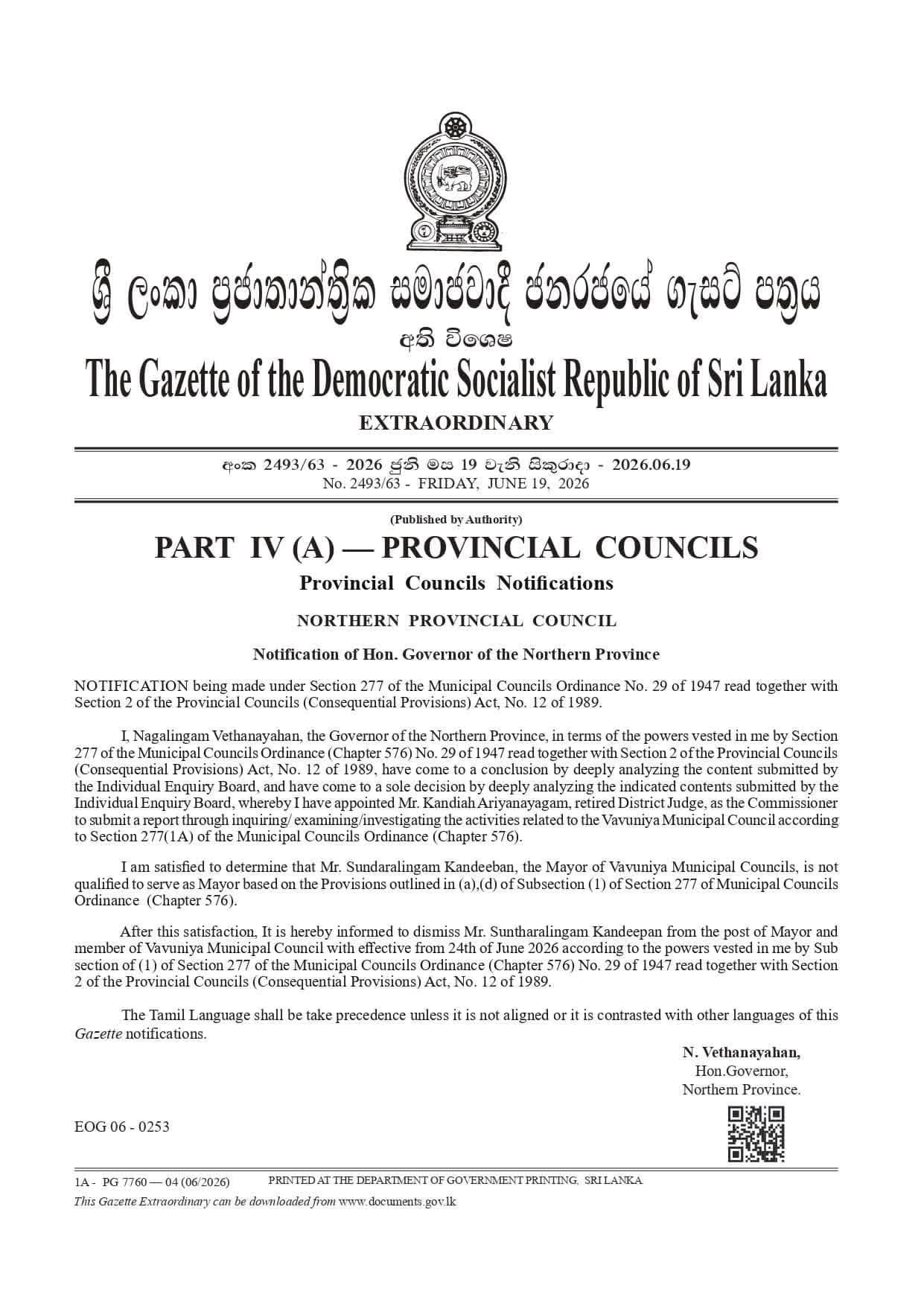
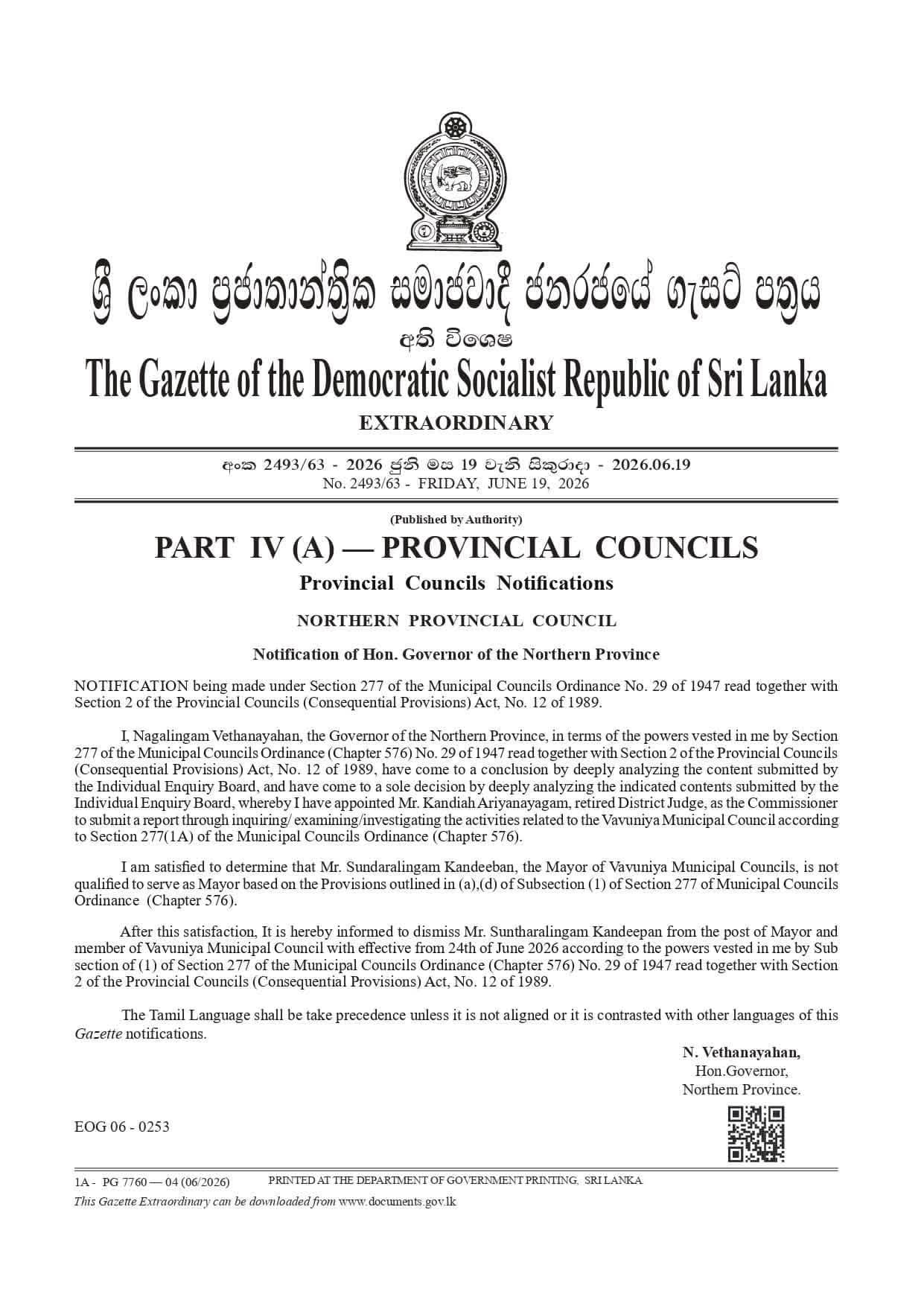
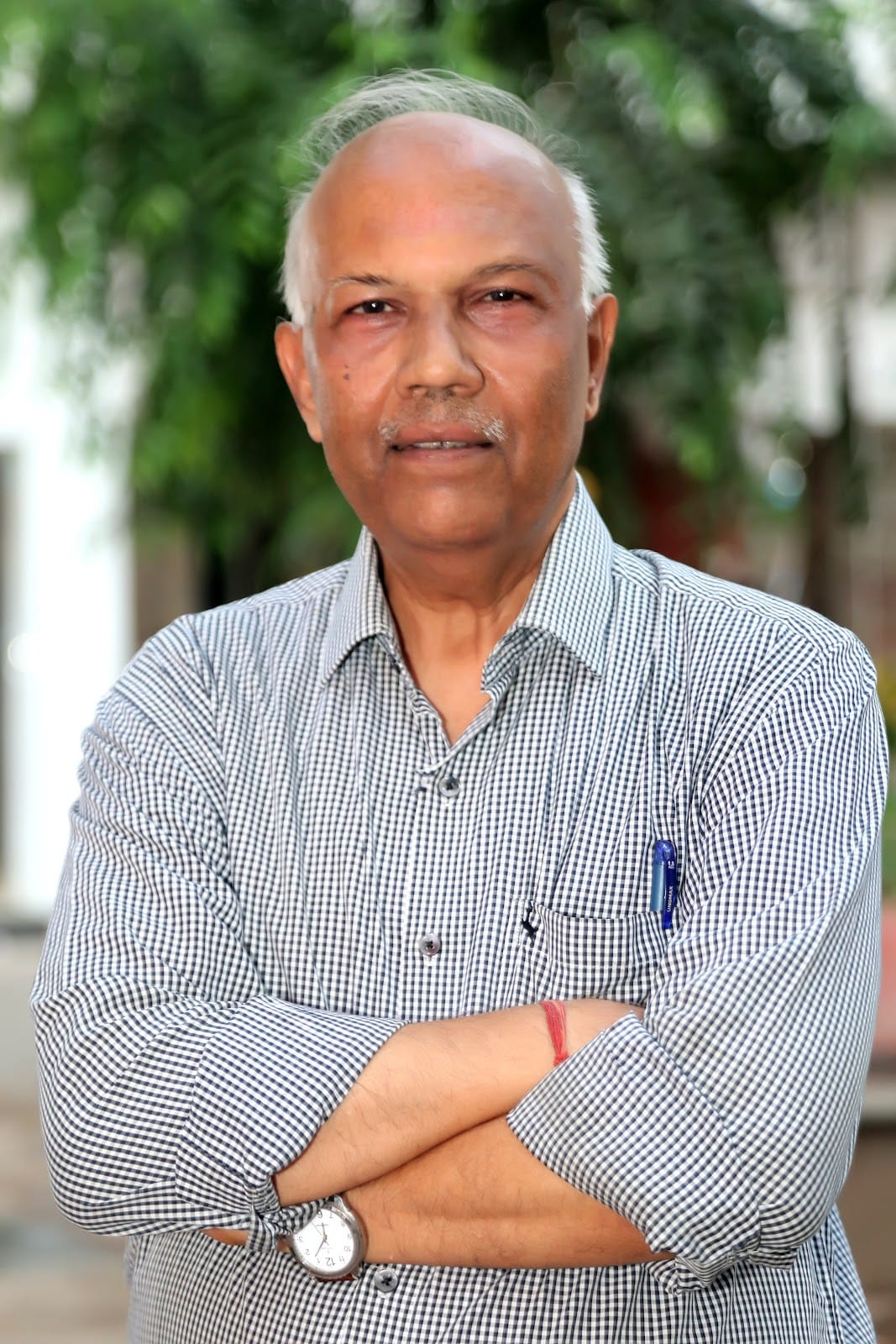
In a companion notification, the governor also removed Gnanapragasam Kishor, the deputy chairman of the Chavakachcheri Urban Council, under a parallel provision of the Urban Councils Ordinance. Both dismissals followed inquiries conducted by a retired district judge, Kandiah Ariyanayagam, whom the governor had appointed as commissioner to examine the affairs of the two councils.
The removals have drawn swift condemnation from opposition politicians and constitutional lawyers, who cast them as an unprecedented assertion of executive authority over institutions whose members are chosen by voters.
Only three weeks earlier, the Supreme Court had lifted an injunction against Mr. Kandeepan and allowed him to resume office, with the bench observing that a body elected by the people could not be kept paralyzed indefinitely. The governor’s order has now accomplished by administrative fiat what the apex court had declined to do.
A contested mayoralty
The Vavuniya mayoralty has been contested almost since Mr. Kandeepan took office. A candidate of the Democratic Tamil National Alliance, he was elected mayor in June 2025 by a single vote, 11 to 10, defeating the nominee of the governing National People's Power. The deputy mayor, also backed by the alliance, was elected by the same narrow margin.
The elections were subsequently challenged in the Court of Appeal by a National People's Power councillor and an independent councillor. The petition argued that the deputy mayor was ineligible to hold office because he resided outside the council's jurisdiction, and sought to invalidate both the mayoral and deputy mayoral elections.
In October, the Court of Appeal issued interim orders preventing both officeholders from exercising their functions pending a final determination of the case. Earlier this month, however, the Supreme Court lifted the restriction on the mayor and allowed the Municipal Council to resume functioning, while leaving the interim order against the deputy mayor in place. The Court of Appeal has yet to rule on the underlying petition.
The governor's decision removes Mr. Kandeepan from office through a separate statutory process under the Municipal Councils Ordinance, independent of the litigation that remains pending before the courts.
Critics describe the move as a form of "political backdooring." The mayoralty rests on fragile arithmetic. In the 21-member Vavuniya Municipal Council, where the Democratic Tamil National Alliance holds only four seats, Mr. Kandeepan secured the mayoralty by assembling an 11-vote majority from a coalition of Tamil parties and independent councillors, defeating the governing National People's Power candidate by a single vote.
If the governor's order ultimately results in the mayoralty becoming vacant, the council would be required to elect a new mayor from among its members. Although the alliance can fill Mr. Kandeepan's vacated seat with a nominee of its own, critics argue that such a vote could still reopen the delicate political arithmetic that produced the original result, giving the National People's Power another opportunity to assemble the 11-vote majority it narrowly failed to secure in June. They contend that the executive action could ultimately reshape control of the council without the original electoral outcome ever being set aside by a court.
A council seat lost over a discarded circular
The grounds for the second removal have drawn particular disbelief. Mr. Kishore, the deputy chairman of the Chavakachcheri Urban Council, was dismissed — according to accounts of the proceedings — after he criticized a circular issued by the Commissioner of Local Government during a council meeting and tossed a copy of it aside while speaking. On that basis, the governor stripped him not only of the deputy chairmanship but also of his elected seat on the council altogether.
A province the governing party could not win
The Vavuniya Municipal Council is one of many local bodies across Sri Lanka's Northern and Eastern Provinces that the National People's Power (N.P.P.) failed to win in the 2025 local government elections. The polls marked a broad resurgence of Tamil nationalist parties, while the governing N.P.P. — which had surprised observers with significant gains in the region a year earlier — came first in only a handful of the Northern Province's local councils, winning four, most of them in the ethnically mixed Vavuniya district.
Opposition politicians contend that the Northern Province governor, an appointee of President Anura Kumara Dissanayake, is being used as an instrument of the central government to exert control over local authorities governed by Tamil nationalist parties that the N.P.P. was unable to defeat at the ballot box.
Some opposition politicians have gone further, alleging that Governor Vethanayahan is acting on the instructions of government ministers rather than exercising independent judgment. The governor's office has maintained that the removals rested solely on independent inquiries and fell squarely within the powers the law confers on him.
Condemnation across party lines
The dismissals have drawn criticism well beyond the Tamil nationalist parties that control the affected councils.
Namal Rajapaksa, the national organizer of the Sri Lanka Podujana Peramuna, described the removal as a "clear abuse of power" and "a grave assault on democratic principles."
The criticism also reached the governing National People's Power. Karunananthan Ilankumaran, an N.P.P. member of Parliament representing the Jaffna District, wrote on Facebook that stripping an elected official of office for exercising freedom of expression was "entirely contrary to democratic principles and wholly unacceptable."
Some commentators argued that the Governor's actions marked an unprecedented expansion of executive authority in the north. One political commentator said, "Even the Sinhalese who served as military officers and were later appointed as governors of the Northern Province were not such fanatical agents of the government."
What the Constitution says
Under the 13th Amendment to Sri Lanka’s Constitution, a provincial governor is appointed by the president and holds office at the president’s pleasure. The Constitution also provides that provincial executive power is exercised by the governor, either directly or through the provincial board of ministers. But it also envisages a board of ministers, headed by an elected chief minister, to aid and advise the governor in the exercise of his functions.
The Municipal Councils Ordinance gives the relevant authority power, after an inquiry by a retired judicial officer, to remove a mayor or councillor by Gazette order. It also states that when a mayor is removed under Section 277, he ceases to be a councillor.
But lawyers say that such a power is exceptional and must be exercised strictly within the law. In a leading case involving the dissolution of the Jaffna Municipal Council under Section 277, the Privy Council held that the authority exercising the power was bound to observe natural justice, including the right to be heard.
Critics say the concern is compounded by the prolonged absence of elected provincial councils. Provincial council elections have not been held for years, leaving the Northern Provincial Council without elected members or a board of ministers.
In a functioning devolved system, critics argue, oversight of local government would be politically accountable through an elected provincial administration. In its absence, those powers are being exercised by an appointed governor alone — an arrangement they say allows an unelected official to wield authority without the democratic check the devolution framework was meant to provide.
They also argue that the Gazette notification falls short of the standard expected for such a drastic step. It records that the governor was “satisfied” that Mr. Kandeepan was unfit to continue, citing two subparagraphs of Section 277, but does not set out in detail the conduct or findings said to justify the removal.
A governor already under scrutiny
The episode also deepens a controversy that has trailed Governor Vethanayahan for weeks. In late May, the abrupt transfer of a Jaffna High Court judge, A.G. Alexraja, barely a month after his appointment, prompted the Jaffna Bar Association to write to President Anura Kumara Dissanayake, expressing alarm at what it described as possible executive interference in the judiciary. Lawyers linked the transfer to interim orders the judge had issued in a writ petition that named the governor as a respondent. The governor’s secretariat denied any connection.
That petition, lawyers familiar with it have said, arose from precisely the kind of action now taken in Vavuniya and Chavakachcheri: a provincial inquiry initiated by the governor into the decisions of an elected council — in that case, the Point Pedro Urban Council.
The judge had briefly halted the inquiry before later dismissing the challenge. Weeks later, he was transferred to Badulla, about 350 kilometers from Jaffna.
Critics say the latest dismissals reinforce what they see as a broader pattern: the inquiry-and-removal provisions of Sri Lanka's local government laws are being used against elected councils in the Tamil-majority north, where the NPP failed to win control in the 2025 local elections.