By M.R. Narayan Swamy
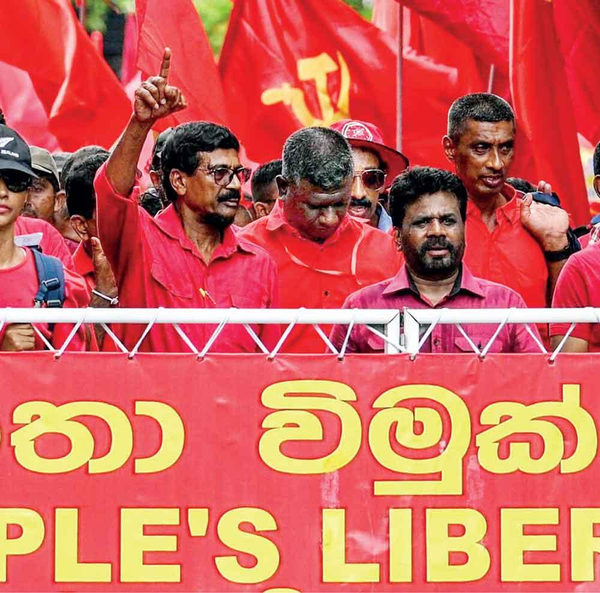
Despite ideological U-turns since taking power in 2024, Sri Lanka’s dominant ruling Marxist party remains a united political force, although it is most likely to lose if fresh elections were to take place now, experts and insiders say.
Most people spoken to insist that President Anura Dissanayake remains personally far more popular than his own Janatha Vimukthi Peramuna (JVP) or the National People’s Power (NPP) coalition, which he leads.
Dharman Wickramaratne, an acknowledged expert on the left-wing JVP, says the majority of the party’s hardcore supporters are disillusioned with the ideological compromises it has made after forming a government.
But they still support the administration because they have no choice, he said in response to questions.
The JVP, born in 1965, was for decades on the fringes of Sri Lankan politics before mass protests sparked by an unprecedented economic collapse catapulted Dissanayake to the presidency. He then led the JVP-headed NPP combine to a sweeping win in parliament, stunning friends and foes alike.
Since then, the JVP has come under widespread attack on a variety of issues, including for continuing with the IMF-suggested economic reforms and failing to improve the economic lot of those hard hit by the 2022 fiscal crisis.
The JVP surprised everyone by shaking hands with its immediate neighbour, India — a country it once vocally denounced as “expansionist.”
How will the JVP, one of Sri Lanka’s best-organised parties, fare if fresh elections were to be held now? Can it secure another two-thirds majority in the 225-seat parliament?
“If a general election is held now, the opposition groups will come to power. But if a presidential election is held first, AKD will win,” Wickramaratne said, referring to the president the way many Sri Lankans address him.
Political analyst Dayan Jayatilleka, a former diplomat and a keen student of Left politics in Sri Lanka and beyond, was equally certain that the JVP and NPP cannot win an election now.
“The JVP-NPP will lose rather like the Sirimavo Bandaranaike-led United Front lost in a landslide defeat in 1977,” he said, referring to the world’s first woman prime minister who took power for a second term in 1970 with the backing of Marxist allies.
Jayatilleka said the JVP was aware of the public mood, and this was why the government was not holding the much-delayed elections to Provincial Councils across all nine provinces.
“If there had been a chance of winning, the JVP-NPP would have held elections and picked up several Provincial Councils and chief ministerships to augment its power.
“The reason the JVP-NPP will lose by a landslide is the drastic deterioration of the material conditions of life of the majority of citizenry on its watch,” he added.
Although a recent survey by the Centre for Policy Alternatives (CPA) has said that Dissanayake and his government enjoy high popularity rankings, it warned that economic hardships faced by the people were real and painful. This, many argue, is bound to impact a future electoral outcome.
Jayatilleka said poverty had increased and not decreased since the JVP-NPP embraced power. He quoted economist Sirimal Abeyaratne as saying that Sri Lanka has gone back a quarter century vis-à-vis poverty and poverty alleviation in recent years.
However, both Wickremaratne and Jayatilleka asserted that the JVP, one of the best-organised parties in the country, remained united at the top despite murmurs at different levels over ideological compromises.
Wickremaratne, who has authored five books on armed insurrections by the JVP in the 1970s and 80s, said there were no differences between Dissanayake and the JVP strongman Tilvin Silva. “These are stories created by the media.”
Jayatilleka too said that there was no evidence of any tussle within the JVP leadership.
“Anura is the undisputed leader, but not like (JVP founder Rohana) Wijeweera or (Tamil Tigers leader Velupillai) Prabhakaran, because it is a duumvirate with Tilvin Silva,” he said. Silva is widely seen as the real power in the government.
“Tilvin and Anura are on the same page,” he went on. (But) Anura doesn’t defer to Tilvin.”
But some political sources insist that there are differences between the two top men.
An opposition MP who did not want to be quoted by name said he heard about a recent spat between Dissanayake and Tilvin Silva from various people he knew.
“Of course, I don’t have any evidence, but there is a buzz that all is not well between them,” he said.
JVP leaders have consistently dismissed allegations of a power struggle between the president and Tilvin Silva as propaganda by a disgruntled and divided opposition.
But a Sri Lankan source in a European city with access to the JVP leadership also said that there were differences in perception on some issues between Dissanayake, 57, and Tilvin Silva, 69.
“Differences have always existed in the JVP over the decades, in particular between its political and (earlier) armed wings,” the source said. “This does not mean the party is going to break up or anything like that.”
Both in 1970-71 and in 1987-89, the JVP staged two bloody armed insurrections in a bid to capture state power. It failed on both occasions, and the resultant violence and counter-violence left tens of thousands dead.
It was later that the JVP decided to pursue parliamentary politics. Even then, it slogged for a long time before striking gold in 2024.
Can the JVP return to its ‘revolutionary’ past if it were to lose power?
“Certainly not,” said Jayatilleka. “However, it can return even while in power, to violence – rather like a Latin American cartel would.”
On a different subject, Wickramaratne said the government would find it difficult to defeat the Tamil parties in Provincial Council elections in the Tamil-majority north despite winning most parliamentary seats there in 2024.
“No matter what concessions are given to the North, they will vote against the Sinhalese parties of the South. But if the JVP contests, it will win a few seats,” said the former editor of the Sinhalese-language Silumina weekly.
Tamil sources agree with this assessment, pointing out that the JVP-NPP combine did come on top in civil body polls in the Tamil-speaking areas in 2025 but lost millions of votes compared to the parliamentary battle a year earlier.