

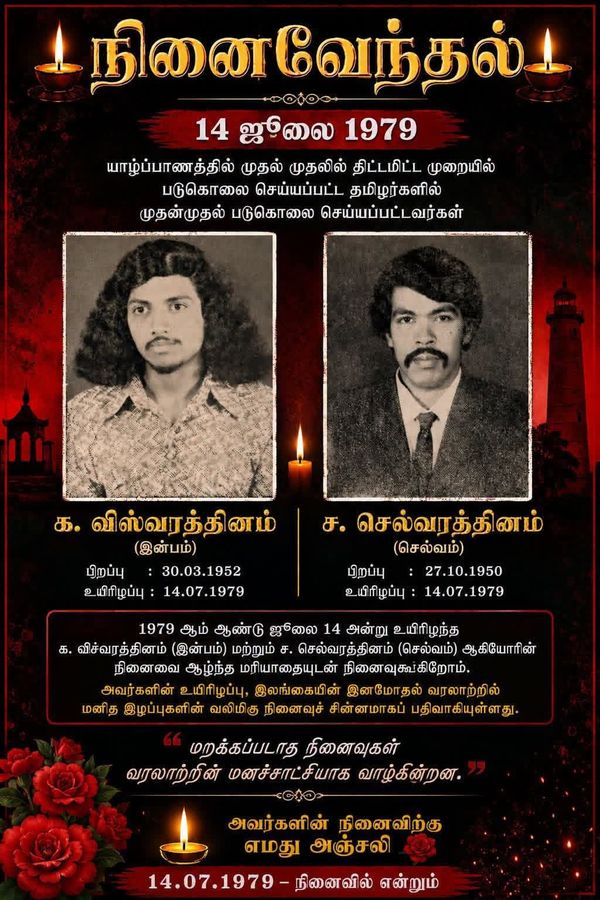
JAFFNA, Sri Lanka — In July 1979, as the government armed itself with sweeping new powers to confront a growing Tamil militancy in the north, two men disappeared into the custody of the security forces. Their bodies were later found near the Pannai causeway, the narrow stretch that links the islands west of Jaffna to the city.
They were K. Viswaratnam and S. Selvaratnam, better known as Inpam and Selvam.
Nearly half a century later, their deaths remain lodged in the political memory of the north. Tamil accounts have long tied the killings to the birth of the Prevention of Terrorism Act, the emergency-era law passed that same month and still on the books 47 years later.
The two men were not prosecuted or formally detained under the PTA, which was certified on July 20, 1979. They were killed during the security crackdown that surrounded its introduction. But for many Tamils, their deaths came to mark the beginning of what the law would represent: arrest stripped of ordinary safeguards, long detention, torture, disappearance — and a hardening conviction among Tamil youth that the law did not protect them equally.
The anniversary arrives as President Anura Kumara Dissanayake’s government has again promised repeal, this time before the end of 2026.
“For many years, people struggled to secure the repeal of the PTA,” Mr. Dissanayake told Parliament on June 25, adding that final discussions on a replacement law had concluded. His own party, the JVP, was brutally suppressed under the same act during its second insurrection in the late 1980s.
Similar pledges have been made and broken by this government and its predecessors, and the skepticism in the north is well-earned.
For families there, the PTA has never been contained in the text of a statute. It is remembered through names. Among the earliest are Inpam and Selvam.
A Crackdown in the North
By July 1979, President J.R. Jayewardene’s government was confronting the beginnings of an armed Tamil insurgency. Emergency powers were extended in the north, and Brigadier Tissa Weeratunga, a relative of the president, was sent to Jaffna with instructions to wipe out what the government called terrorism by the end of the year. It was a significant expansion of the military’s role in the Tamil-majority north.
Inpam had been an early Tamil militant, arrested in connection with the assassination of Alfred Duraiappah, the former mayor of Jaffna, and later released. Selvam was his relative. The two men had married sisters and lived in the Kalviyankadu area of Jaffna. Their bodies, bearing signs of violence, were left near Ilanthaiyadi.
The Tamil writer Shobasakthi, who grew up nearby, has described how the news moved through his village. One morning, he recalled, people walked fearfully along the causeway until they reached the place where the bodies lay. Adults kept the children back. The children listened while the adults talked.
That is how a generation of Tamil children first encountered the state’s expanding security apparatus — as a story told over their heads.
A Law Written in Days
The Prevention of Terrorism (Temporary Provisions) Act was presented, debated, and passed with extraordinary speed. Introduced as a temporary measure, it outlived the conflict for which it was written and remained in force long after the war ended in 2009.
The act handed the authorities broad powers of arrest and detention and thinned the protections available to suspects under ordinary criminal law. Rights organisations have since documented arbitrary detention, torture, and the use of coerced confessions in cases brought under it.
International jurists raised the alarm almost immediately. Virginia Leary, who visited Sri Lanka for the International Commission of Jurists in 1981, compared its provisions to South Africa’s apartheid-era terrorism legislation. Paul Sieghart, who later examined the country’s legal system, found the powers it granted extraordinarily broad, with few parallels in any democratic state.
What the Crackdown Made
The operation was meant to crush a small militant movement. It did the opposite. The excesses carried out under Weeratunga, with Jayewardene’s blessing, deepened an anger already taking hold among Tamil youth. For many, the disappearances of 1979 confirmed that democratic politics and the ordinary protections of the law had nothing left to offer them. Four years later came the anti-Tamil violence of 1983, and scattered groups of young men, many driven at first by little more than rage and revenge, became a war.
No straight line runs from any single killing to any of this. The roots of the conflict lay deeper — in decades of political discrimination, communal violence, failed agreements, and the steady erosion of Tamil faith in Parliament.
But the episodes mattered. They were the evidence a generation cited: that the normal rules could be suspended when the suspect was Tamil, and that detention could end not in a courtroom but beside a road.
Forty-seven years on, the country is again debating the end of the law born in that month. If the government keeps its word, the Prevention of Terrorism Act may finally leave the statute books.
The memories attached to its beginning will be harder to repeal.