For 26 years, the Colombo Book Fair—organized by the Sri Lanka Book Publishers’ Association (SLBPA)—has transformed Colombo into a hub of books, bustle, and festivity. What began as a trade fair has grown into a cultural carnival, drawing thousands from every corner of the island and earning its place as one of Colombo’s most anticipated annual events.
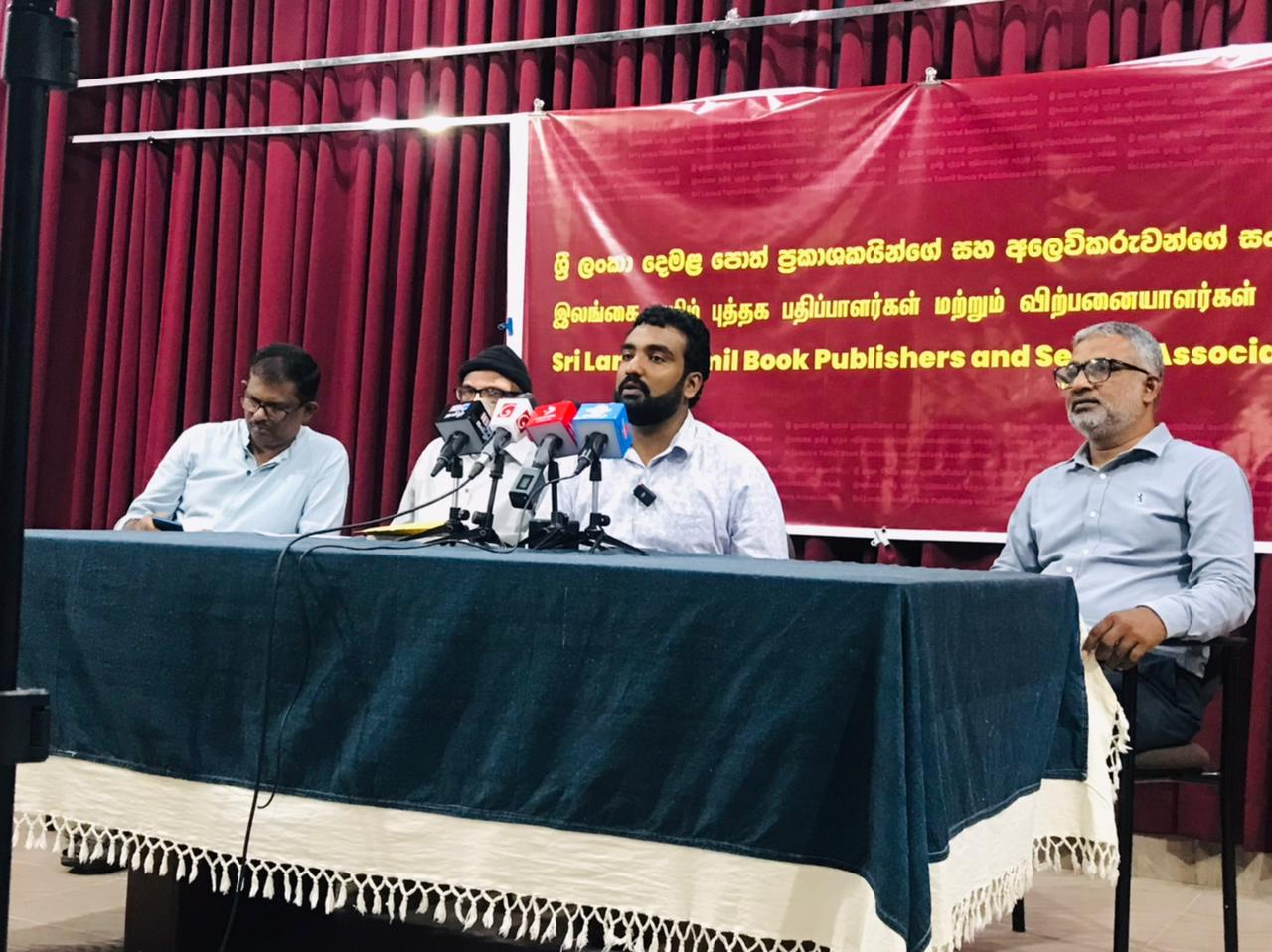
But behind the festive atmosphere, Tamil publishers allege that they have been systematically sidelined, with their repeated requests for stalls ignored year after year. In response, they have come together to form a new body—the Sri Lanka Tamil Book Publishers and Sellers Association—which recently held a press conference in Colombo to voice their grievances openly.
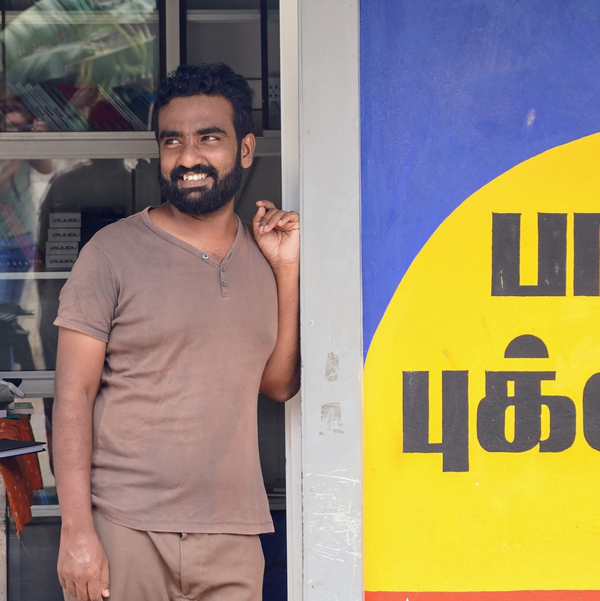
To better understand the issue, Jaffna Monitor spoke with the Association’s coordinator, Muhammad Sabry, who is also the owner of Fathima Book Centre in Eravur and the East-based Tamil publishing house, Gazal Publications.
This is our interview with him.
The Colombo International Book Fair is one of Sri Lanka’s largest cultural events. Could you explain what the problem is from the perspective of Tamil publishers?
On the surface, the Colombo International Book Fair—which attracts lakhs of visitors—may appear inclusive. But in reality, we Tamil publishers have been sidelined for years. Out of nearly 450 stalls, only three are allocated to Tamil books. That is less than 1% representation, which we regard as a grave injustice.
Have you and other Tamil publishers tried to raise this issue formally?
Since 2022, we have been formally requesting stalls every year. We have written to the SLBPA repeatedly and even visited their office in Borella at least six or seven times. Each time, we were promised space. But just a week before the fair, they would inform us that the stalls were “already full” and assure us that next year we would definitely get one. This has now become a pattern—and it has happened four years in a row.
What about the existing Tamil stalls—don’t they serve the purpose?
Kumaran Book House, Islamic Book House, and Poobalasingam Bookshop are allocated stalls. I have nothing negative to say about them, and they do sell Tamil literature and novels, but only in very limited quantities. Instead, the focus is largely on schoolbooks, motivational works, or religious texts. Even then, the discounts offered are minimal, and prices remain higher compared to other stalls. This is not the kind of representation that Tamil readers or writers deserve.
Do you believe this is a matter of structural bias?
Absolutely. If you look at the SLBPA itself, its Board of Directors has seven members, the Director Board has eleven, and the Advisory Board has six. None of them are Tamil or Muslim; all are Sinhala. Even their official website is available only in Sinhala and English—there is no Tamil section at all. Yet they call themselves the “Sri Lanka Book Publishers’ Association.” In practice, they function more like a Sinhala-only publishers’ association, which is deeply unfair. Large Sinhala publishers like Sarasavi Bookshop or Jeya Book Centre are given multiple stalls. Even stationery companies that sponsor the event are given vast space. But when it comes to Tamil publishers, we are told there is “no place.” Clearly, it’s not a matter of space but of priority.
In your opinion, what is the actual problem? Is it simply a matter of limited space for Tamil publishers, or do you suspect a racist mindset behind this exclusion?
I don’t believe it is primarily racism. The real issue lies in the way the Sri Lanka Book Publishers’ Association (SLBPA) has become a highly corporate setup. They rely heavily on sponsorships—platinum, gold, and silver categories. If a publication sponsors them at a high level, it automatically receives multiple stalls. There is no public transparency in how these allocations or the finances are handled.
They also claim that priority is given to members of their organization. But there is no way for us to join the association. In 2022, we formally applied to become members, but our request was rejected with the explanation that new memberships had been closed after COVID. The irony is, during that same period, Tamil publishers from Sri Lanka were able to participate in the Chennai International Book Fair in India—but not in our own country’s fair.
Again in 2023, we wrote to the SLBPA, but there was no response. When we personally visited their office, they repeated the same line—that all new memberships had been closed since the pandemic. Yet when we ask for exhibition space, they say stalls are reserved only for members. So for four years, we have been caught in this loop: we cannot become members, and without membership we cannot get stalls.
I also learned that this is not an issue faced by Tamil publishers alone. Even some small-scale Sinhala publishers have been treated in the same way—promised stalls at first, then rejected at the last moment. It shows the problem is structural and linked to money and sponsorship, rather than purely ethnic bias.
On what basis do you believe there is no racist reason behind this?
Honestly, I wish that is the case. I don’t want racism to enter the world of publications or literature. Books and literature should be about inclusivity, not exclusion.
So do you believe the issue is economic—for example, that Tamil publishers cannot afford sponsorships, or that Tamil books do not sell in large quantities?
That can only be determined if Tamil publishers are actually given enough space in the exhibition. It’s true that Tamil books do not sell in very high volumes in Sri Lanka compared to Sinhala publications. And yes, if we set up stalls, we might face losses for a few years because of the costs involved in transporting books from the North and East, employing 10–12 staff, and covering food and lodging expenses.
But this is not just about profit or loss. For us, it is about encouraging the reading habit among Tamil people in this digital age. Even if the immediate sales are modest, the cultural value is immense.
At present, many Sinhala publishers treat the exhibition as an opportunity for stock clearance, offering 40–50% discounts. That competition benefits their readers. But the three existing Tamil stalls don’t provide such discounts. If more Tamil publishers were allowed in, there would be healthy competition, leading to better discounts and more access for Tamil readers.
Moreover, the exhibition could attract diaspora Tamils. I have personally seen how many diaspora Tamils travel to the Chennai Book Fair. If Tamil publishers are given fair space in Colombo, the same thing will happen here. It would create a platform for Tamil writers and publishers to connect, for translation projects to emerge, and for book launches and discussions with Indian Tamil writers.
For Sinhala readers, the Colombo Book Fair has already become an intellectual festival. If Tamil publishers are properly included, it can also become a true intellectual festival for the Tamil community—something that reflects the full diversity of Sri Lanka.
Why don’t all the Tamil publishers of Sri Lanka come together and organize a separate exhibition, instead of depending on the Colombo International Book Fair?
We don’t have the financial capacity to do this on the same scale. For example, renting the BMICH for even a single day costs a huge amount, which we simply cannot afford. Moreover, the Colombo International Book Fair has evolved into a carnival, with food stalls, play areas for children, and a festive atmosphere. People come for the experience and end up buying books as part of it. Recreating that kind of environment independently would require enormous investment.
That said, in the future we are planning to organize a Tamil book exhibition in Colombo at a different venue. However, our priority is to work with the SLBPA. That would not only benefit us but also strengthen the fair itself by making it more inclusive.
What role do you think the government should play in this issue?
Technically, this is not a government event—it is a private exhibition organized by the SLBPA. However, the government still lends it legitimacy. Last year, the fair was inaugurated by President Anura Kumara Dissanayake himself. This year, since he was in Japan, the Minister of Health and Mass Media, Dr. Nalinda Jayatissa, officiated the opening. So while I don’t place direct blame on the government for our exclusion, I believe that if the government insists on fair space allocation for Tamil publishers, the SLBPA will have no choice but to comply.
We already met with the State Minister for Official Languages, Muneer Mulaffer, and explained our situation. He immediately called the SLBPA chairman and raised the issue. I learned that the chairman promised the minister that our association would be registered and stalls would be allocated to us next year. Whether that promise is kept remains to be seen.
What is your immediate request from the organizers?
At the very least, they should allocate 10 stalls for Tamil publications at the next exhibition. Right now, Tamil books are priced exorbitantly in Sri Lanka. For example, an Indian Tamil book that costs INR 100 is sold here for around LKR 660. This calculation was based on the exchange rate during the economic crisis, when 1 INR was roughly equal to 5 LKR. But even after the economy stabilized and the rate adjusted to about 1 INR = 3.5 LKR, the same inflated pricing continues. That is simply not fair.
If more Tamil publishers are allowed into the exhibition, healthy competition will emerge. And with competition, prices will naturally come down—making books more affordable and accessible for Tamil readers.
Will the Sri Lanka Tamil Book Publishers and Sellers Association continue as a functioning organization in the future?
Yes, absolutely. Though we initially started this association to address the issue of exclusion at the Colombo International Book Fair, it is now growing into something larger. We already have around 22 publishers with us. After our recent press conference, many more contacted us expressing their willingness to join. I understand there are over 100 Tamil publishers in Sri Lanka, and our goal is to be the collective voice for all of them. This association will not be temporary—we will continue to represent Tamil publishers and push for fair opportunities in the years ahead.