

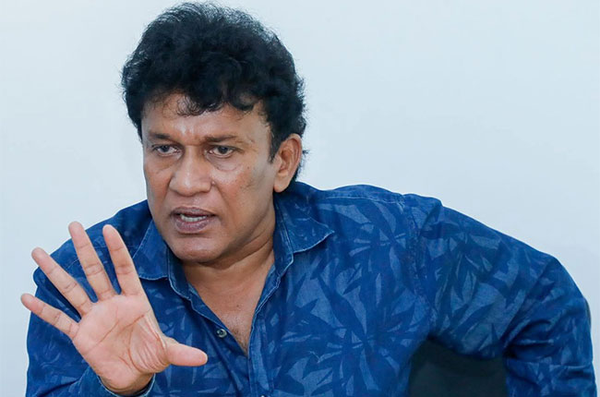
COLOMBO, Sri Lanka — Mano Ganesan, leader of the Democratic People’s Front and a member of Sri Lanka’s opposition, has asked Parliament’s chief financial oversight committee to investigate whether funds allocated for long-delayed Provincial Council elections were diverted to post-cyclone reconstruction efforts without legislative approval.
In a letter sent Monday to Dr. Harsha de Silva, chairman of Parliament’s Committee on Public Finance (COPF), Mr. Ganesan requested an inquiry into remarks attributed to Tilvin Silva, general secretary of the Janatha Vimukthi Peramuna (JVP), the dominant party within the governing National People’s Power coalition.
Mr. Ganesan said he was acting on reports that Mr. Silva had stated that money set aside for Provincial Council elections had been used instead for disaster-relief and reconstruction work following Cyclone Ditwah.
“To the best of my knowledge, Parliament has not approved any transfer or reallocation of funds earmarked for Provincial Council Elections to any other expenditure head or purpose,” Mr. Ganesan wrote. He asked the committee to determine whether any transfer, reallocation, or expenditure of election-related funds had occurred “in a manner inconsistent with parliamentary approval and financial regulations.”
The request follows comments Mr. Silva reportedly made during the opening of an NPP district office in Jaffna, where he said Provincial Council elections would not be held this year because funds budgeted for the polls had been redirected to relief and rebuilding efforts after Cyclone Ditwah.
The remarks have since exposed apparent inconsistencies within the government’s own messaging.
Cabinet spokesman Dr. Nalinda Jayatissa later told reporters that funding was not the obstacle preventing the elections from being held, arguing that the principal issue remained unresolved electoral legislation. Separately, NPP General Secretary Dr. Nihal Abeysinghe said the necessary financial provisions for the elections had already been allocated and that the polls could proceed once ongoing electoral reform discussions were concluded.
Those explanations stand in contrast to Mr. Silva’s assertion that election funds had been redirected, creating uncertainty over whether any such transfer occurred and, if so, under what legal authority.
At the center of the dispute is Parliament’s constitutional authority over public expenditure. Under Sri Lanka’s public finance framework, money appropriated for one purpose cannot generally be spent on another without parliamentary authorization through approved financial procedures. Mr. Ganesan argued that even if funds were used for a legitimate public purpose, such as disaster recovery, Parliament’s approval would still be required before they could be redirected.
The issue also touches on the increasingly contentious question of Provincial Council elections.
The elections have not been held since 2014, and all nine Provincial Councils have remained without elected representatives since their terms expired between 2017 and 2018. Successive governments have attributed the delays to unresolved legal and electoral reforms, while opposition parties and civil society groups have accused political leaders of lacking the will to restore the provincial institutions.
The Committee on Public Finance had not publicly indicated whether it would take up Mr. Ganesan's request by the time of publication.