JAFFNA — A resolution passed by a local government council in Sri Lanka’s Northern Province endorsing what it described as the United States’ efforts to “maintain world peace” has triggered political controversy, exposing what critics describe as a stark contradiction within the Ilankai Tamil Arasu Kachchi (ITAK) — a party that has long framed its politics around civilian protection and human rights.
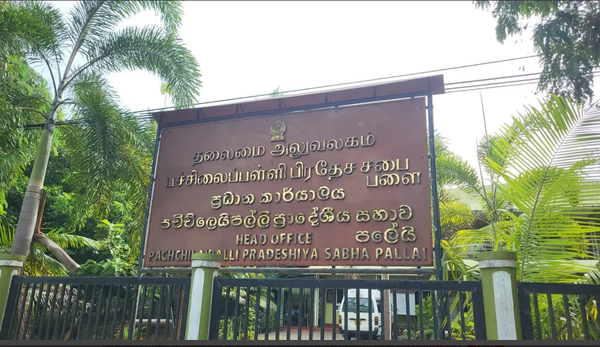
According to documents reviewed by Jaffna Monitor, the Pachchilaipalli Pradeshiya Sabha adopted a resolution authorizing its chairman to send a formal letter to the United States Ambassador expressing support for what the council described as American efforts to maintain world peace.
The resolution was adopted on March 10 at the council’s monthly general meeting in Pallai, Kilinochchi District, under Council Decision No. 01.
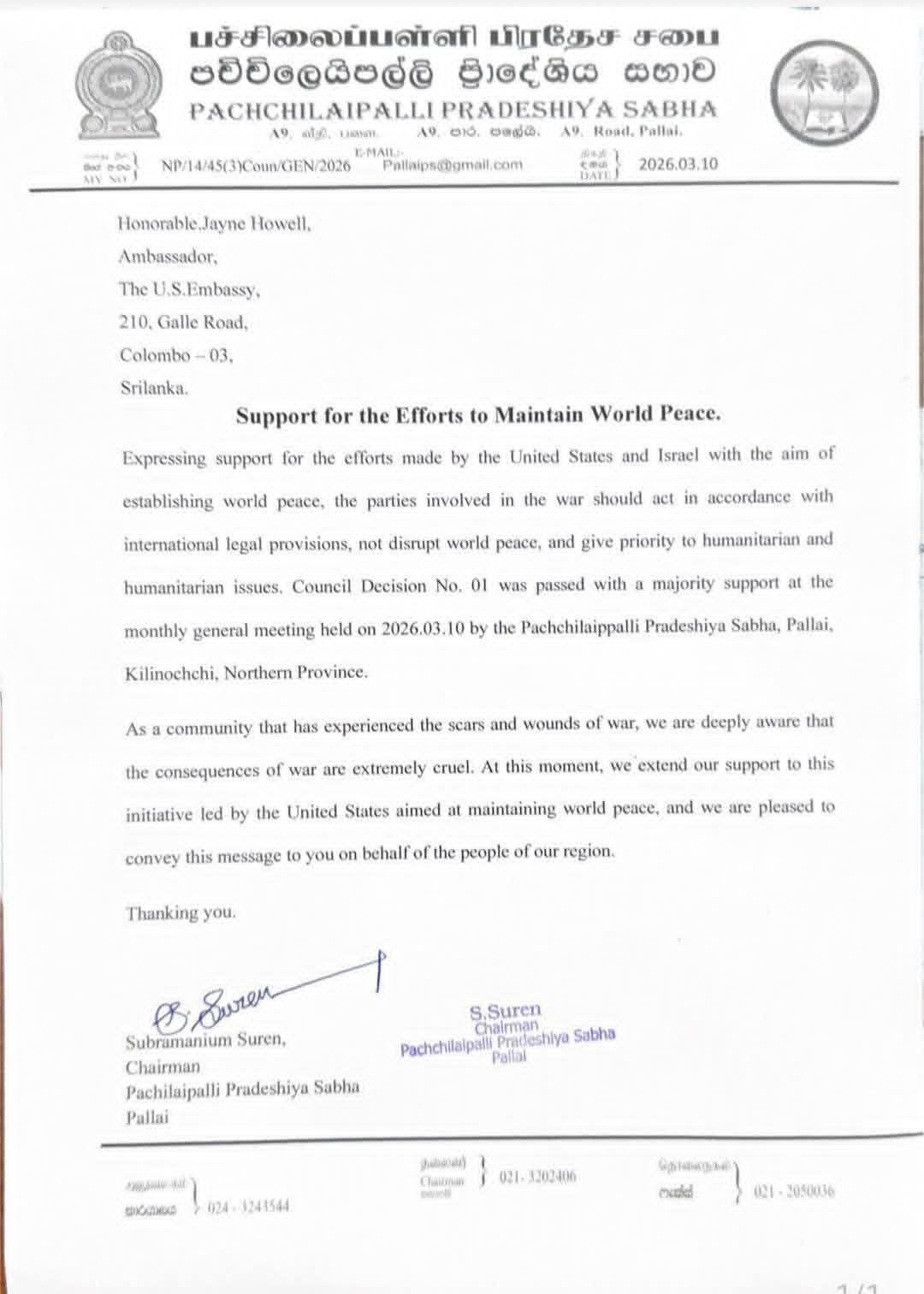
A copy of the letter sent following the resolution shows that the council conveyed its support for what it described as the efforts made by the United States and Israel aimed at establishing world peace. The letter also calls on parties involved in the conflict to act in accordance with international law and to prioritize humanitarian concerns.
The letter, signed by council chairman Subramaniyam Suren, states that the council is “pleased to convey this message” of support to the U.S. Embassy and frames the initiative as being expressed on behalf of the people of the region.
For many observers in the North, however, the language of the resolution raises an uncomfortable political question: how can a party that has spent decades condemning civilian suffering and appealing to the international community over human rights violations now appear to endorse a military campaign elsewhere that has resulted in large numbers of civilian casualties?
The Pachchilaipalli Pradeshiya Sabha is widely regarded as a political stronghold of the ITAK faction loyal to parliamentarian Sivagnanam Sritharan, placing the party under scrutiny over whether the resolution reflects a broader political position or the initiative of a local leadership faction.
They also appear to have gotten another detail wrong. The letter addresses Chargé d’Affaires ad interim Jayne Howell as “Ambassador,” although she is currently serving as the acting head of the U.S. mission. The designated U.S. ambassador to Sri Lanka, Eric Meyer, has yet to arrive to assume his duties.
A Local Council Entering Global Geopolitics
Even before the political implications are examined, the resolution raises a basic legal and procedural question.
The Pradeshiya Sabhas Act No. 15 of 1987, which governs local government bodies such as the Pachchilaipalli Pradeshiya Sabha, defines their responsibilities primarily in terms of local administration — roads, sanitation, markets, public health, local infrastructure, and community welfare.
Matters of international conflict or foreign policy fall far outside the normal mandate of a Pradeshiya Sabha.
In effect, a village-level administrative body established to manage local governance has now taken a political position on a major international military conflict.
Political observers say that fact alone raises a pointed question: why was such a resolution brought before the council in the first place?
Since such resolutions carry no administrative authority or legal consequence, their purpose appears, observers say, to be signalling rather than governance.
Cross-Party Support
According to sources familiar with the council proceedings, the resolution was not supported by ITAK members alone.
At least one member of the Tamil National People’s Front (TNPF)—a party that frequently portrays itself as a champion of uncompromising Tamil nationalism—and a representative linked to the Democratic Tamil National Alliance (DTNA) also reportedly backed the motion.
None of the parties involved have so far issued any public explanation for their support.
Sritharan’s Remarks Two Days Earlier
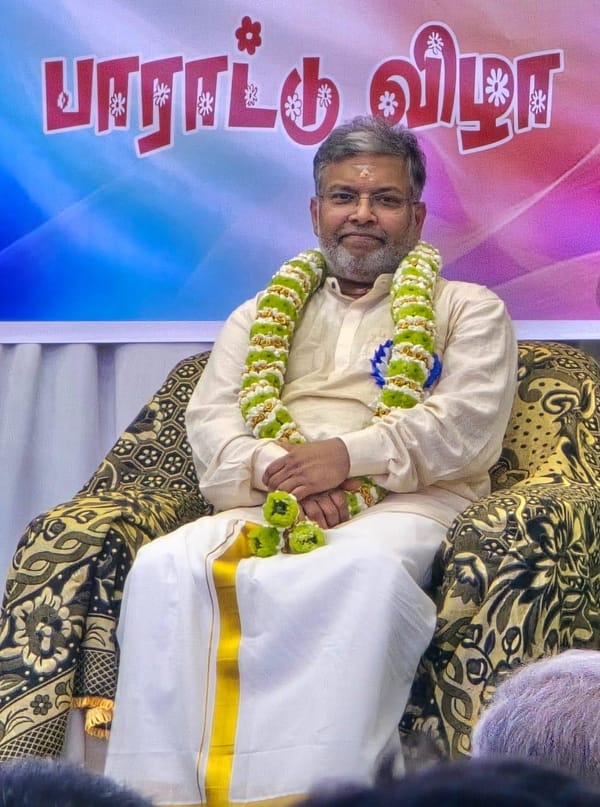
According to attendees, ITAK parliamentarian Sivagnanam Sritharan made remarks at a Women’s Day event on March 8, held at a cooperative society hall in the North, that were interpreted as expressing support for Washington’s role in the Middle East conflict.
A parliamentarian publicly voicing support for the United States’ conduct in a war that has reportedly resulted in large numbers of civilian casualties—including children—was followed just two days later by a formal resolution from a local council widely viewed as being dominated by his political loyalists.
For many observers, the timing raises obvious questions. Was the resolution a spontaneous initiative by local councillors—or part of a broader political signal?
A Contradiction That Cuts Deep
For decades the party has appealed to the international community using the language of civilian protection, minority rights, and accountability for military conduct.
Those arguments were rooted in the experience of Sri Lanka’s Tamil population during the country’s civil war, when the party repeatedly urged foreign governments and international institutions to recognize the suffering of civilians caught in military operations.
The Pachchilaipalli resolution now appears to place the party—at least at the local level—on the opposite side of that moral argument.
“It raises a fundamental question,” one northern political analyst said.
Is supporting controversial military actions abroad — including those that reportedly killed more than 165 people, most of them schoolgirls, at the Shajareh Tayyebeh Girls’ Elementary School in Minab, Iran — now part of ITAK’s political position, or is this the initiative of a particular faction acting without the party’s consent?
Silence From ITAK Leadership
So far, the leadership of Ilankai Tamil Arasu Kachchi, Sri Lanka’s largest Tamil political party, has remained silent.
Neither party president C. V. K. Sivagnanam nor acting general secretary M. A. Sumanthiran has issued a statement clarifying whether the Pachchilaipalli resolution reflects the party's official policy.
The absence of clarification has only intensified speculation within northern political circles.
A Party Already Under Strain
The controversy arrives at a time when ITAK is already navigating visible internal tensions between competing factions.
Disagreements over political strategy, alliances and leadership direction have surfaced repeatedly in recent years, exposing fractures within what was once Sri Lanka’s most influential Tamil political party.
The Pachchilaipalli resolution may have been passed by a local council, but the party leadership’s failure to distance itself from the move — or even explain it — means the political consequences may extend well beyond the boundaries of a rural administrative body.
Several questions now remain unanswered.
Why did a village-level council in the Northern Province suddenly decide to endorse the military conduct of a global superpower? Who initiated the resolution — and whose political interests does it ultimately serve?
More broadly, what does this episode reveal about the political consistency of ITAK?
For decades, the party has appealed to the international community to investigate alleged war crimes committed during Sri Lanka’s civil war under the administration of former President Mahinda Rajapaksa, whose government described the final military offensive against the LTTE as a “Humanitarian Operation.”
Against that history, critics say the Pachchilaipalli resolution places the party — or at least factions aligned with it — in an uncomfortable position: appearing to endorse military actions abroad that have themselves generated widespread international concern over civilian casualties.
Until the party leadership offers a clear explanation, the Pachchilaipalli resolution will continue to raise difficult questions — not only about who authorized it, but about the political principles guiding ITAK, the traditional political party of the Tamil people.