Hmm! These are supposed to be great men!
But their deeds are not that of great men. Otherwise, they would not do as they please… evidently, they are big thugs. But who do they show their thuggery to. To the poor who have nothing.
She was a young woman.
My blood boils when I think of what she has to put up with this in this world from the day she was born to this day.
She grew up with no one to lend a hand. Now they take exception to her morality.
Whether she ekes out a living or not, once these bigwigs pass judgement, there is no appeal.
If four blind men cast an accusation, another ten ignorant men believe what they hear.
After all, what sin did she commit?
These bigwigs resort to all sorts of trickery to gain their wealth. But they cannot stand what she had to do to quell her hunger.
They talk about equality. What is the point of talking about something that will not put food on the plate?
No… no.
They turned everything to suit their needs.
At the end, equality bears the brunt. They said she was a young, unmarried girl.
They bend over backwards to serve the whims of the big wigs and the faso. But they have no patience with her.
What could she do?
Is she the only young, unmarried woman in the village? The chairman’s daughter is also young and unmarried!
But they are blind to all that.
They have the entire range of honorary titles to give the cover—the hājiyār, the justice of the piece, the maraikkār.
Yes, she is young and unmarried. But don’t the young and unmarried get hunger pangs?
The first thing they should have done is to remove her hunger before deigning to pass judgement on her behavior. How is this justice?
What petty crime did she commit to induce these bigwigs into throwing their weight around?
Do they know what justice is? If they knew, would they do what they did?
Every evening, the chairman’s daughter also parades through this street.
That was a sight to behold. Subhanallah! Her back is bare like the stem of a banana tree. From the front, her nipples are struggling to break free. She struts around exposing her bare belly that looks like a cucumber. These lords and masters are blind to all this.
Yet, they are thought to be mumin, true believers. But —
They could not tolerate the fact that she was struggling to put food on her plate without begging anyone else for support.
Scoundrels!
Apparently, she committed the sin of wearing a tunṭuppuṭavai, a short shawl worn on top of a blouse.
Vatti Moosa hājiyār’s wife complained yesterday.
Just last week, I saw her going to the carnival, wearing a nylon saree, advertising all her wares.
This is all a show of hoor al-Ayn—the heavenly virgins—for the pious bigwigs!
But when this girl went out wearing only a tunṭuppuṭavai in order to earn a living to support herself and her poor mother, they complain about harām.
A fine job with harām and halāl! It was the injustice meted out yesterday by Mustafa hājiyār.
But did you know that last month, his own son was caught with a Sinhala girl in Colombo. They beat him and broke his hand.
But people in the village were told that the hājiyār’s son broke his hand playing ball.
In a way, that is true. He did play ball.
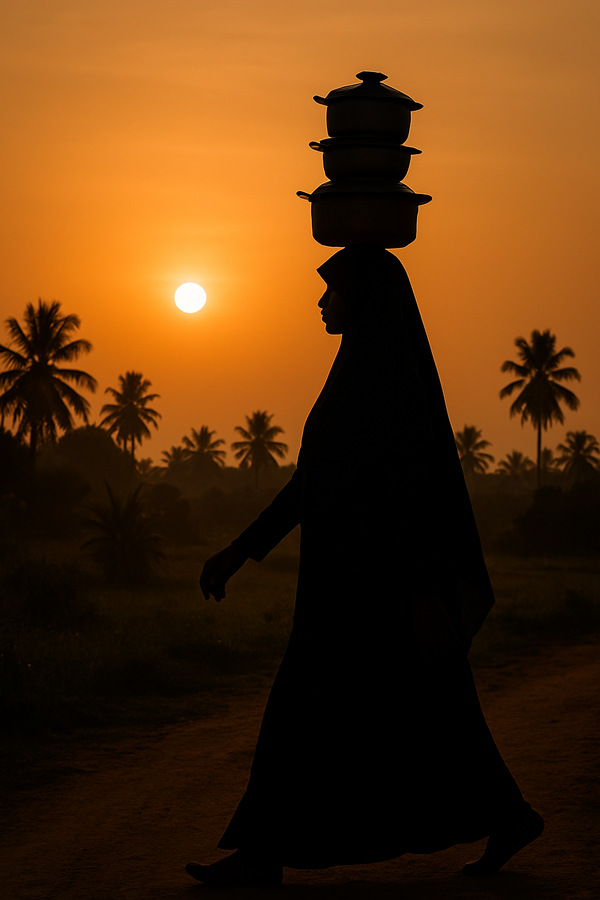
Yesterday, the devout hājiyār who had made a pilgrimage to Mecca, the right-hand man of the member of parliament, saw it fit to break up all the pots and pans the girl was carrying on her head.
He grabbed her by the hair and twisted it until she screamed in pain.
Chī! What a disgrace!
You woman! In the guise of selling clay pots and pans, you are going to corrupt all our innocent young men. Let us smash your pots and pans!
This is heresy! That too, from the mouth of that fatso, a hājiyār who had made the pilgrimage to Mecca. It is embarrassing even to talk about it. But for all this, during the last election campaign, his elder sister’s sons were gallivanting around with girls in short skirts.
How they cover up their own stink!
The poor have no justice. Today, she did not even come to the market.
Yes, two souls will go hungry today.
The bigwigs do not care about this tragedy.
May they rot in hell!
1968
Translated from the original Tamil short story caṉmārkkam (சன்மார்க்கம்) from S.L.M. Hanifa’s 1992 collection of short stories. The original collection is available at noolaham.org. If you have any questions, please contact ez.iniyavan@gmail.com. Co-translators: eḻuttukkiṉiyavaṉ and Fasmila Raviraj.