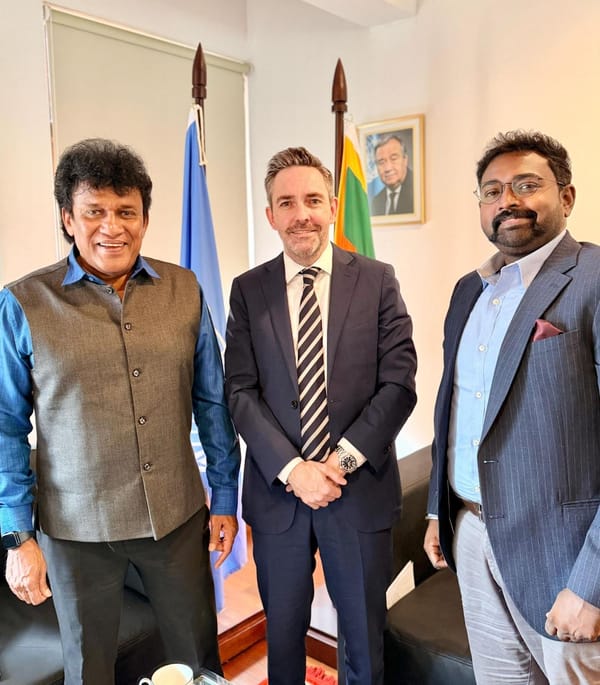

The Swiss Embassy in Colombo is set to convene Tamil political parties on Feb. 19 in an effort to encourage a unified position on Sri Lanka’s long-running constitutional question. But even before the meeting takes place, observers across the island are questioning whether the initiative reflects the country’s political realities.
The gathering comes at a time when prospects for sweeping constitutional reform appear distant. The current government has offered no indication that it intends to pursue a comprehensive overhaul, and few analysts believe parliamentary arithmetic exists to sustain one.
For decades, Tamil political leaders have argued that a durable settlement to Sri Lanka’s ethnic conflict must include maximum devolution of power, the merger of the Northern and Eastern Provinces, and structural guarantees consistent with federal principles. That position, reiterated in Parliament and in international forums, is expected to be restated at the Feb. 19 meeting.
Yet translating that aspiration into law would require either a two-thirds majority in Parliament or approval at a national referendum — thresholds widely seen as unattainable without significant support from the Sinhalese majority. Federalism, in particular, continues to evoke suspicion among many Sinhalese voters, who associate it with territorial fragmentation. Sections of the Muslim community, especially in the Eastern Province, have also expressed reservations about a North–East merger.
Against this backdrop, several constitutional observers question whether the Swiss initiative risks mistaking advocacy for political viability.
Several political observers in the North argue that the Embassy has relied heavily on a narrow group of Tamil nationalist voices, potentially conflating those perspectives with the broader spectrum of Tamil political opinion. Tamil society, they note, is not monolithic. Electoral outcomes in recent years reflect a range of positions — from nationalist formations to parties that advocate incremental reform within the existing constitutional framework.
Critics say that if the stated aim is to forge a genuinely common position among the people of the North and East, engagement must extend beyond a limited circle of political actors. Muslim representatives from the East, parties with demonstrated grassroots support, and independent civil society figures have not always been central to such discussions.
Diplomatic outreach on federal models is not new. In September 2025, Tamil political representatives, including members of the NPP, participated in discussions in Switzerland on comparative constitutional structures. Participants described the exchanges as constructive. But analysts caution that international dialogue cannot substitute for domestic coalition-building.
Sri Lanka’s recent history underscores that point. Ambitious constitutional reform attempts in 2000 and again between 2015 and 2019 generated extensive drafting and international encouragement, yet ultimately collapsed amid political opposition and majoritarian resistance. The lesson, analysts say, is that constitutional settlements are secured through broad-based domestic consensus — not elite-level discussions detached from electoral realities.
The geopolitical context further complicates matters. India has consistently emphasized implementation of the 13th Amendment, which provides for Provincial Councils and limited devolution, and has expressed interest in long-delayed Provincial Council elections. At the same time, the United Nations Human Rights Council and several Western governments continue to monitor Sri Lanka’s progress on constitutional reform and reconciliation.
Tamil parties thus face a strategic calculation: whether to prioritize incremental devolution aligned with India’s emphasis on the 13th Amendment, or to continue advocating for a new constitutional framework that resonates more strongly with Western diplomatic actors but appears politically unattainable in the short term.
Ultimately, observers say, initiatives that focus on maximal constitutional end-states without first securing cross-ethnic trust risk creating the appearance of momentum without the numbers to sustain it. In Sri Lanka’s polarized political landscape, what sounds persuasive in diplomatic settings must still survive the scrutiny of Parliament — and the electorate.
Whether the Feb. 19 meeting broadens the conversation or merely reaffirms established positions will become clearer in the weeks ahead. For now, skepticism persists that constitutional transformation can be advanced without a wider, more inclusive political groundwork at home.