

Senior religious figures from the Tamil community have now lent their moral weight to a controversial and arguably ill-judged plan by Jaffna University students to observe Sri Lanka’s Independence Day on February 4 as a “Black Day” in the Northern and Eastern provinces.
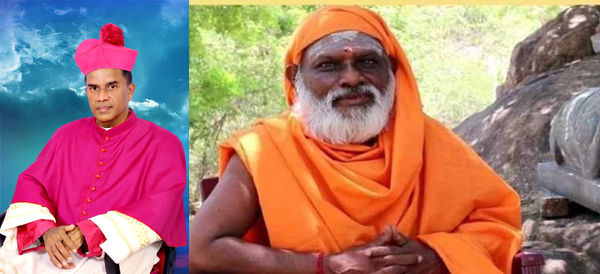
The Jaffna University Students’ Union has announced that it will stage demonstrations and mark February 4 — Sri Lanka’s Independence Day — as a Black Day and a day of protest. In preparation, student representatives recently paid a courtesy call on Bishop Noel Emmanuel of the Trincomalee Diocese and the Chief of the Thenkailai Aatheenam, Agathiyar Adikal, seeking blessings and what appears to be a touch of divine legitimacy for their campaign.
Religious Leaders Find a Cause
Speaking after the meeting, Bishop Emmanuel said that many Tamil grievances remain unresolved or systematically ignored by successive governments. He stressed that broad-based public participation would be necessary for the protest to effectively highlight these issues.
The Chief Priest of the Then Kailai Adheenam argued that while Sri Lanka achieved independence from British rule in 1948, the Tamil community has endured decades of marginalisation and suffering since. He portrayed the student initiative as an outpouring of youthful frustration and urged Tamils at home and abroad to rally behind the campaign.
Political Risks of Symbolic Rejection
The planned protest has already triggered sharp debate over its wisdom and likely consequences. Critics warn that branding Independence Day a “Black Day” risks deepening ethnic polarisation rather than advancing serious political dialogue.
Speaking to Jaffna Monitor, a political observer who wished to remain anonymous due to threats from diaspora elements acknowledged the reality of Tamil grievances but questioned the chosen method.
“While the grievances of the Tamil people are real and longstanding, declaring Sri Lanka’s Independence Day a ‘Black Day’ is politically unwise and potentially dangerous,” the observer said. “It is the kind of gesture that looks bold on posters but shrinks under political scrutiny.”
The concern is how such symbolism may be exploited by Sinhala nationalist forces.
“This approach is likely to strengthen narratives portraying Tamil political activism as anti-national or separatist, thereby weakening legitimate demands for equality, justice, and reconciliation,” the observer added. “Instead of helping the Tamil cause, it risks gifting rhetorical ammunition to hardliners who already oppose devolution and minority rights.”
He further noted that, while Tamils as a minority certainly face their own problems in Sri Lanka, denouncing the country would only weaken an already vulnerable Tamil community. He said that thirty years of separatist war achieved nothing and that, whether one likes it or not, Sri Lanka is their country. Tamils, he added, should therefore fight for their rights and for devolution within the framework of the state, and in that context, he described the move to brand Independence Day as a “Black Day” as ill-conceived and counterproductive.