
By Sidhartha Thamby
Somewhere in the ledgers of Sri Lanka's Cabinet Office, between the fiscal crisis minutes and the debt-restructuring files, sits a two-paragraph decision that will reshape rivers, forests, and livelihoods across Vavuniya, Mullaitivu, and the wider northern dry zone. Approved quietly in January 2026, it revived the Kivul Oya Reservoir Project — suspended only two years earlier because the country had run out of money — at a cost of Rs. 23,456 million. That figure is not a typo. In 2011, the same project was approved at Rs. 4,170 million. The price has risen more than fivefold. Not one rupee of benefit has so far been recorded.
The project sits inside what officials call Mahaweli System L, a vast administrative zone carved from northern dry-zone land over four decades — gazetted at roughly 199,000 hectares, formally part of Sri Lanka's celebrated Mahaweli development programme. But System L conceals a troubling gap at its centre. Of all that land, only 980 hectares have ever been formally brought under irrigation. Settlement ran decades ahead of water. Communities were moved in, promises were made, and the water never followed.
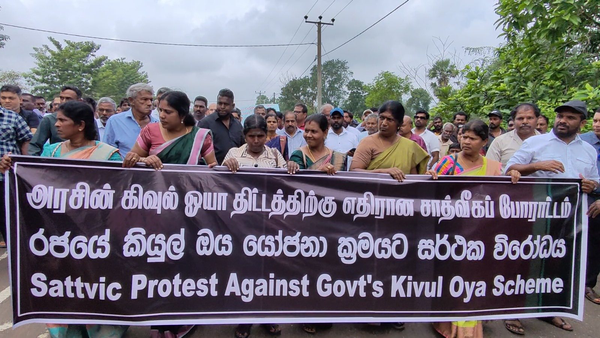
Kivul Oya, its proponents say, is the answer. A dam on the Ma Oya/Kivul Oya river in Mahaweli System L will irrigate 2,400 hectares, supply drinking water to 50,000 people, and lift 6,000 farming families out of poverty. On paper, those are serious development goals. On the ground, a growing body of evidence suggests the project is being revived on stale assumptions, incomplete law, and suppressed dissent — and that the communities most affected, many of them Tamil, have never had a meaningful say.
THE WATER THAT ISN'T THERE
The first question any reservoir must answer is simple: where does the water come from? In the case of Kivul Oya, the answer has quietly changed — and almost no one in the public has been told.
When the project was first conceived, the plan was to supply System L through the North Central Province Canal (NCPCP), which forms the northern trunk of the Asian Development Bank-funded Mahaweli Water Security Investment Program (MWSIP). Mahaweli River water, the logic went, would flow from the Moragahakanda reservoir complex northward through a network of tunnels and canals, filling the dry-zone tanks and irrigation systems that the colonial and post-independence state had long promised to the north.
But recent water-balance studies found that Moragahakanda's water supply is insufficient for the anticipated command area. The Centre for Environmental Justice (CEJ), which reviewed the Kivul Oya Environmental Impact Assessment, quotes the EIA itself admitting this: the original plan was to supply water through the NCPCP, but updated modelling showed the water simply was not there. Planners were forced to turn to the local Kivul Oya catchment instead.
That shift matters enormously. It means Kivul Oya cannot borrow the political grandeur of Mahaweli to justify its existence. It must stand on its own basin — its own rainfall record, its own runoff coefficients, its own dry-season yields. None of that updated hydrology is in the public domain. The government has not published the water balance studies. The ADB has not disclosed the System L supply modelling. The public, including the farming communities expected to benefit, cannot verify whether the promised water exists.
THE AUDIT THAT SHOULD HAVE STOPPED EVERYTHING
Kivul Oya is not the only northern water project in crisis. The wider MWSIP programme — the ADB-financed backbone of Sri Lanka's dry-zone water ambition — is in serious trouble, and the country's own Auditor General has documented it in detail.
As of December 2024, MWSIP Tranches 1, 2, and 3 together showed physical progress of 19.6 percent against an expected 91 percent. That is not a delay. It is a collapse. Contracts have been cancelled. Procurement has been challenged. Land acquisition has stalled. A tunnel-boring machine working on the Bowatenna–Wemedilla connector cracked concrete rings and generated Rs. 4,543 million in expenses that the Auditor General said remained unexplained. Commitment charges — fees paid to lenders for funds that were borrowed but not spent — had already reached Rs. 232.9 million by the end of 2024.
The significance of these failures goes beyond accounting. MWSIP is the infrastructure spine that was supposed to eventually connect Mahaweli water to System L. If that spine is incomplete, delayed, and technically troubled, the premise of Kivul Oya — already weakened by the water-balance problem — becomes even harder to defend. Yet the government is pressing ahead with local funding for Kivul Oya, at more than five times the original estimate, while the larger programme it was meant to complement remains a fragment.
1,615 ACRES AND A MEMORANDUM THE GOVERNMENT IGNORED
In 2019, a group of Tamil residents submitted a formal memorandum to authorities alleging that 1,615 acres of paddy land belonging to their communities had been confiscated for the Kivul Oya project and for the expansion of Mahaweli System L. The memorandum named twelve localities: Kokkuthoduvai, Kokkilai, Karunatkerni, Uththarayankulam, Nelunkulam, Amayan Kulam, Kiribanweva, Kulavadukkulam, Adayakaruththaankulam, Nayadichchamurippu, Sivanthamurippukulam, Thattamlai, Kunjukkulam, Tikiriweva, and Sagalaatruveli.
The memorandum is not proof of title. It does not attach deeds, permit numbers, cadastral survey sheets, or compensation records. But it is primary evidence that a serious grievance was raised — and, critically, that it was raised years before the 2026 recommencement decision. There is no public record of any response.
The Northern Province Governor's office has separately recorded a meeting on what it called 'civilian lands under the L-Zone of the Mahaweli Development Authority.' The record states that Tamil people had lived in these areas until 1984, that their lands were absorbed into System L during the displacement of the civil war years, and that returnees attempting to reclaim their land in 2012 found it was being offered to others. That is official acknowledgment of the dispute — not from civil society or diaspora activists, but from a provincial government body.
The government's standard response is to point to System L's administrative land-alienation records: 14,774 lots gazetted, 7,025 grants and leases issued. But administrative issuance is not the same as lawful acquisition. It shows what the Mahaweli Authority gave out. It does not show what was there before, who held prior rights, whether those rights were extinguished through due process, and whether anyone was compensated. Until those lot-level records are published — in Sinhala, Tamil, and English — the land question cannot be resolved, only suppressed.
THE EIA THAT MAY NOT EXIST IN TAMIL
Sri Lanka's 1993 Environmental Impact Assessment regulations are clear. An EIA must be publicly noticed in all three languages. It must be available for inspection. Affected communities must be able to read it and respond to it. Their comments must be recorded. The project proponent must reply. Only then can the Central Environmental Authority issue approval.
CEJ's formal submission on the Kivul Oya EIA, made in 2020, alleged that Sinhala and Tamil versions of the EIA were not available on the CEA website. Only the archaeological impact assessment existed in Sinhala. The full technical document was in English only.
For a project affecting Tamil-speaking communities in Vavuniya and Mullaitivu — communities with limited English literacy, communities that had already submitted a land-rights memorandum that went unanswered — an English-only EIA is not a procedural technicality. It is a denial of participation. The 1993 regulations exist precisely because technical decisions affecting communities must be understandable to those communities.
The CEA's 2021 Annual Report lists Kivul Oya as an approved EIA project. But the public record contains no approval letter, no approval conditions, no trilingual notice log, no comment-response matrix, and — critically — no record of a fresh or supplementary EIA following the project's suspension from December 2023 and recommencement in January 2026. A project that has been suspended for two years, revised in cost by Rs. 19 billion, and restarted under new conditions may require new environmental review. No such review is publicly recorded.
THE FORESTS, THE ELEPHANTS, AND THE ANCIENT MONASTERY
The environmental stakes are not abstract. The Kivul Oya EIA, as reported at the time of its submission, projected the loss of approximately 2,500 hectares of forest and 1,500 hectares of elephant habitat. CEJ identified 47 archaeological sites within the project area, including ancient tank structures and a monastery at Vediwettukallu South that would need to be dismantled and relocated — into an elephant corridor.
Sri Lanka's human-elephant conflict is already among the most acute in Asia. CEJ's formal comments noted that the government's standard response — electric fencing — has consistently failed at the national level, and that building a large reservoir in core elephant movement territory, then fencing the affected communities in, is not a mitigation measure. It is a transfer of the conflict to future generations.
The EIA also did not adequately address reservoir methane emissions, forest-carbon loss, downstream flow changes to Kokilai Lagoon, or climate-scenario analysis. These are not optional refinements. In an era of accelerating drought cycles and intensifying rainfall variability, a reservoir that cannot account for its own dry-year yield, its downstream effects, or its contribution to atmospheric warming is not a climate solution. It is a climate risk.
RIVER FOR JAFFNA: DREAM, SLOGAN, OR VIABLE PLAN?
While Kivul Oya moves toward construction in the south of the northern dry zone, a different water vision dominates political rhetoric in Jaffna itself. The concept known as 'River for Jaffna' envisions channelling seasonal freshwater from the Kanagarayan Aru and other Vanni streams into Elephant Pass Lagoon, and from there into the Vadamarachchi and Upparu lagoon systems, to reduce salinity, recharge the limestone aquifer, and support agriculture and domestic water security across the peninsula.
President Ranil Wickremesinghe announced the immediate initiation of River for Jaffna in 2024, while simultaneously opening the Thalaiyady seawater desalination plant. The political optics were generous. The technical substance was thin. There is no public EIA for River for Jaffna. There is no hydrodynamic model in the public domain. There is no costed feasibility study. The ADB, which evaluated the concept while planning Jaffna's water supply, assessed it as unproven and environmentally uncertain, and chose desalination instead.
Jaffna's water problem is structurally different from the dry-zone irrigation deficit. The peninsula has no perennial rivers. Its limestone aquifer is shallow, over-extracted, and increasingly saline. The Iranamadu reservoir to the south, once proposed as a drinking-water source for Jaffna, became socially unavailable when farmers in Kilinochchi mounted sustained resistance to water sharing — a reminder that water allocation is a social and political question before it is a technical one.
River for Jaffna, Kivul Oya, MWSIP, and the Jaffna desalination plant are not one connected system. They are parallel responses to parallel crises, being managed by different agencies with different budgets, different lenders, and different political sponsors. None of them has been assessed against the others. None of them has been evaluated for double-counting of water sources, beneficiary populations, or downstream effects. This is the core failure this investigation documents.
WHAT THE NORTH ACTUALLY NEEDS
The argument of this investigation is not that Kivul Oya should be cancelled. It is that Kivul Oya cannot be responsibly recommended in its current state — with a stale EIA, suppressed land claims, unverified hydrology, a fivefold cost increase, and no published plan showing how it fits with the broader northern water portfolio.
There are alternatives. Sri Lanka's ancient tank-cascade systems — minor interconnected reservoirs managing seasonal runoff at village scale — represent centuries of distributed water knowledge. Many have fallen into disrepair. Rehabilitating them would cost less, displace fewer people, destroy less forest, and build resilience from the ground up. They are not romantic nostalgia. They are infrastructure.
A serious northern water programme would assess Kivul Oya against at least five alternatives: a smaller or phased reservoir, tank-cascade rehabilitation, conjunctive groundwater recharge, MWSIP completion and future extension where the hydrology supports it, and hybrid packages combining targeted storage with demand management and productivity investment. None of that comparison has happened. None of it is in the public record.
The Mahaweli Authority, the Irrigation Department, the Central Environmental Authority, the ADB, the Cabinet Office, and the Northern Provincial Council all hold fragments of the evidence needed to assess the northern water question fairly. None of them has assembled those fragments into a single, accountable, trilingual public account. Until they do, the communities most affected — Tamil farmers and fishing families in Vavuniya, Mullaitivu, Mannar, Kilinochchi, and Jaffna — will continue to be planned for rather than planned with.
WHAT MUST HAPPEN BEFORE THE SPADE TURNS
The minimum standard for a project of this scale is not complicated. The government must publish the complete Kivul Oya EIA approval file — the terms of reference, public notices, the Sinhala and Tamil versions of the report, the inspection-location records, the comment register, the proponent's responses to objections, the CEA concurrence, the approval letter, the approval conditions, and any post-suspension renewal or supplementary assessment. If those documents exist, produce them. If they do not, the approval chain is legally exposed.
The government must publish a lot-level land ledger for Kivul Oya and System L — not aggregate alienation statistics, but parcel-by-parcel records identifying each affected person, their legal status, their prior claim, the compensation offered, and the outcome of any dispute. Affected communities must be able to check their own names and plots.
The government must publish the updated water-balance studies that led planners to abandon the NCPCP supply premise for System L. Those studies are the foundation of the revised project. They belong in the public domain.
No irreversible construction — no land acquisition, no forest clearance, no dam foundation work, no inundation of any inhabited or cultivated area — should proceed until those three things are in place. Surveys, modelling, consultation, and procurement preparation can continue. But the point of no return must not be crossed on the basis of a 2020 EIA, a 2011 cost estimate scaled up by five, and a land dispute that has been officially recognised but never officially resolved.
A FINAL NOTE ON ACCOUNTABILITY
This investigation draws on official Cabinet decisions, Auditor General reports, ADB project documentation, Mahaweli Authority statistical publications, CEA guidance, CEJ formal submissions, community memoranda, and Northern Province Governor records. Every factual claim is grounded in those sources. Where the record is incomplete — where documents have not been published, where approvals cannot be traced, where claims remain at the level of allegation — this investigation says so explicitly. The gaps are as important as the evidence.
What the available record proves is this: a project worth Rs. 23 billion is being restarted in a post-conflict, water-stressed, Tamil-majority area on the basis of a procedurally vulnerable EIA, unresolved land disputes that have been raised through official channels and not answered, unverified hydrology, and no published plan showing how it fits with the rest of Sri Lanka's northern water infrastructure. That is not development. That is a decision waiting to become a crisis.
Sri Lanka has an opportunity to do this differently. The North has waited long enough — for water, for land justice, for honest accounting, and for plans that are built with communities rather than imposed upon them. The question is whether the institutions that hold the evidence will choose transparency before irreversibility, or silence until the concrete is poured.
Editor’s Note: This article is an opinion and investigative analysis by the author. The views expressed are those of the writer and do not necessarily reflect the editorial position of Jaffna Monitor. Jaffna Monitor remains committed to fostering informed public discourse and welcomes diverse perspectives, counterarguments, and evidence-based debate on matters of public importance.