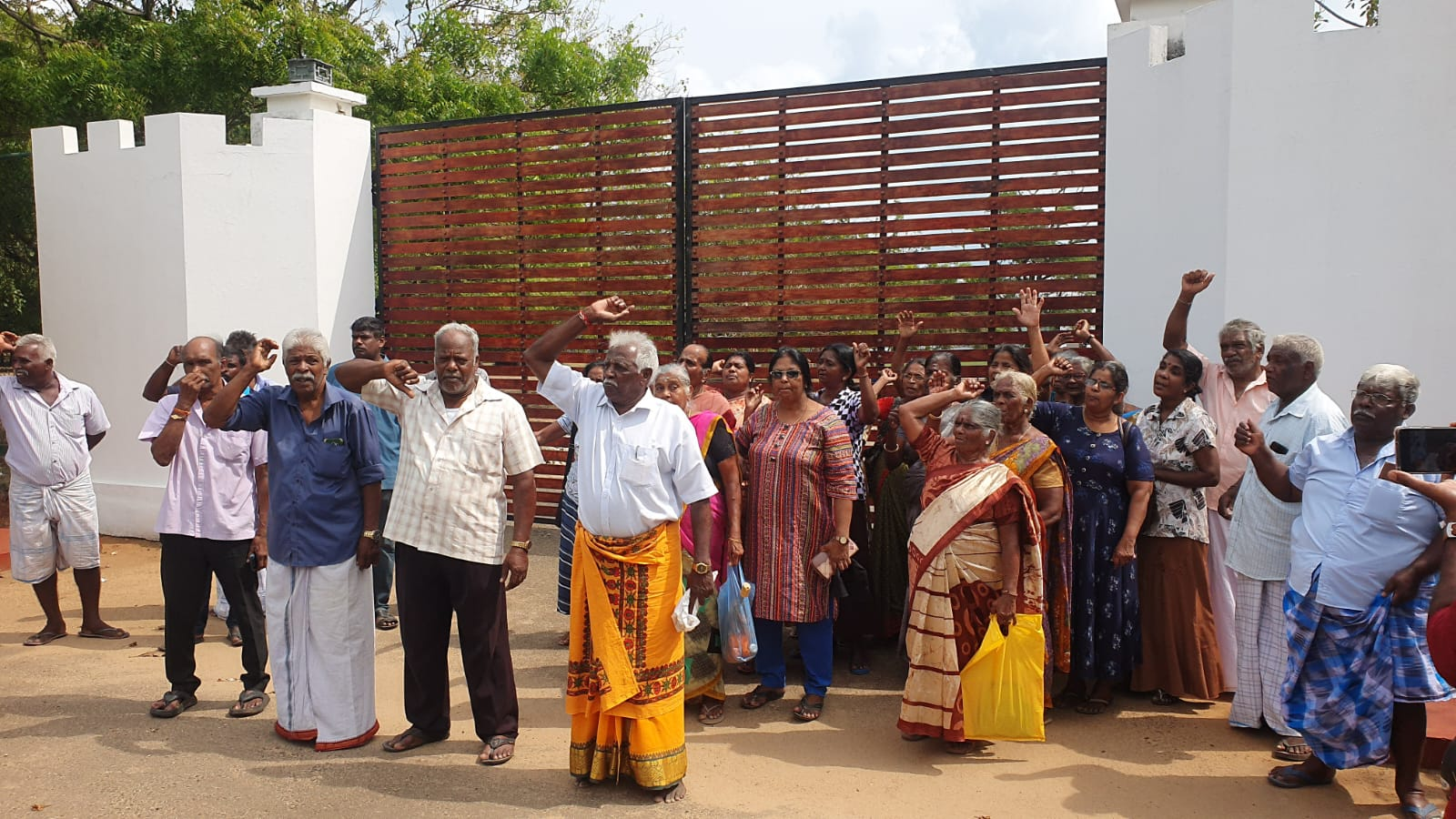
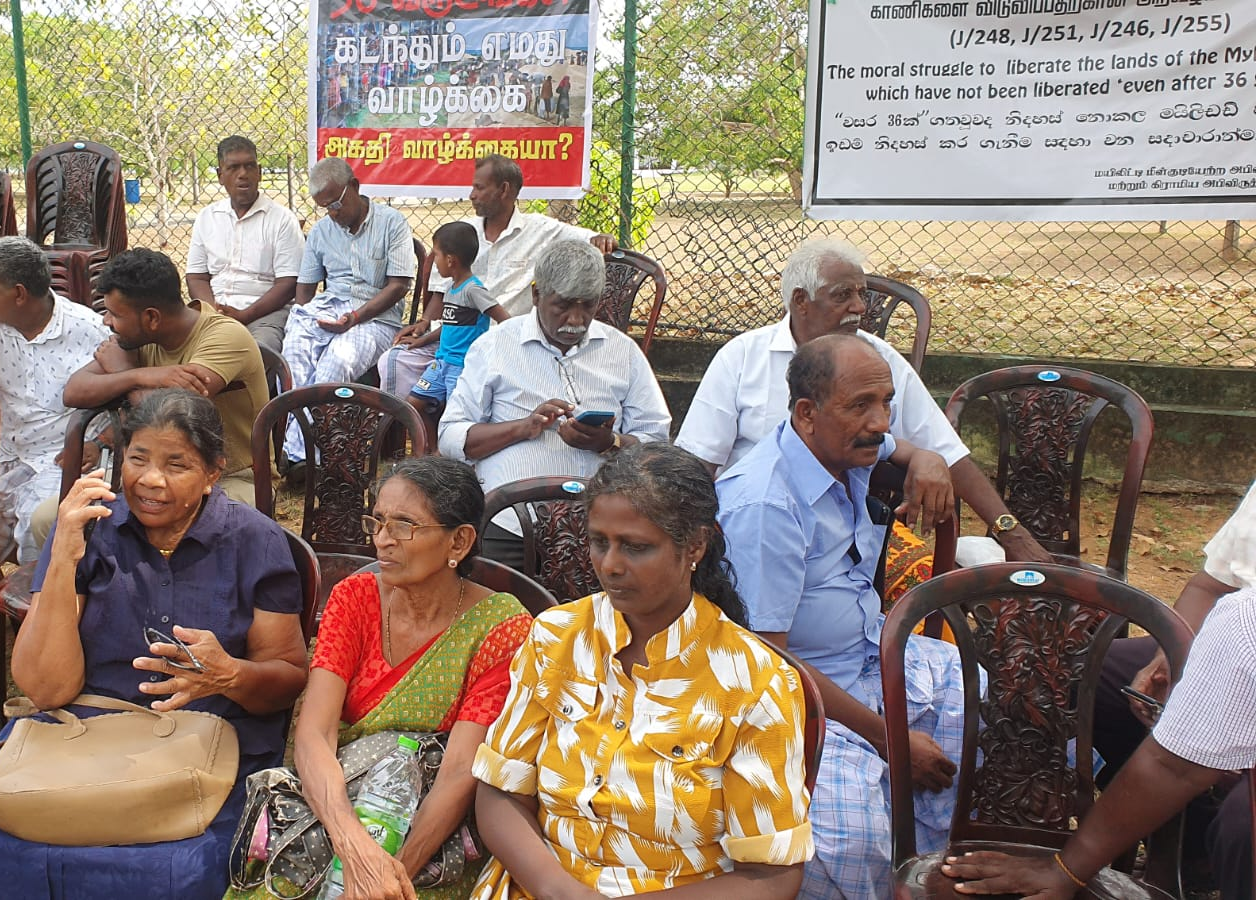
JAFFNA, Sri Lanka — Holding faded land deeds — some preserved for more than three decades as the last legal proof of ownership — displaced Tamil residents of Valikamam North gathered Friday outside the gates of the military’s Commando bungalow in Sri Lanka’s Jaffna Peninsula, demanding the return of ancestral lands they have been barred from entering since their forced displacement in June 1990.
The demonstration, organized by landowners and their families, marked the start of what participants said would become a sustained weekly protest every Friday until the government takes meaningful steps toward land release.
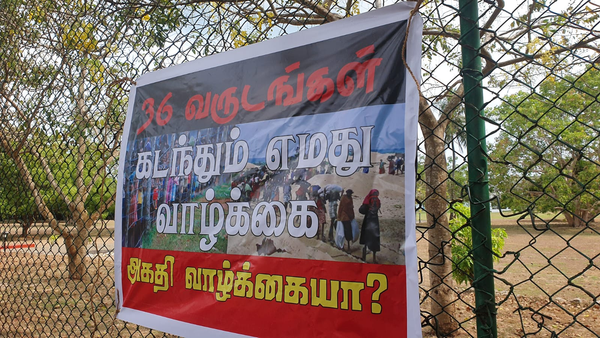
At the edge of a barbed-wire-enclosed High Security Zone, residents raised property documents, family records and placards as symbols of both ownership and endurance, confronting the military boundaries that for nearly 36 years have kept them from homes, farmland and religious sites once central to their communities.
Tamil National People’s Front Member of Parliament Gajendrakumar Ponnambalam joined the protest, expressed support for the displaced families and pledged to elevate their demands to national leadership, as frustration deepens over the prolonged failure of successive governments to fully resolve one of post-war northern Sri Lanka’s most enduring land disputes.
“We want our land back,” protesters chanted outside the compound. “Enough of 36 years of occupation.”
The Valikamam North Land Release Committee has noted that nearly 2,900 acres remain unreleased despite five presidential changes and four parliaments since the war's end — and eight presidents since the original displacement in 1990.
The government of President Dissanayake, elected in late 2024 on a platform of systemic accountability and pledges to resolve longstanding ethnic grievances, has announced fresh land releases. Tamil politicians and displaced residents say the releases, measured against the full scale of what remains occupied, amount to far less than what is being claimed.
The High Security Zone and How It Was Created
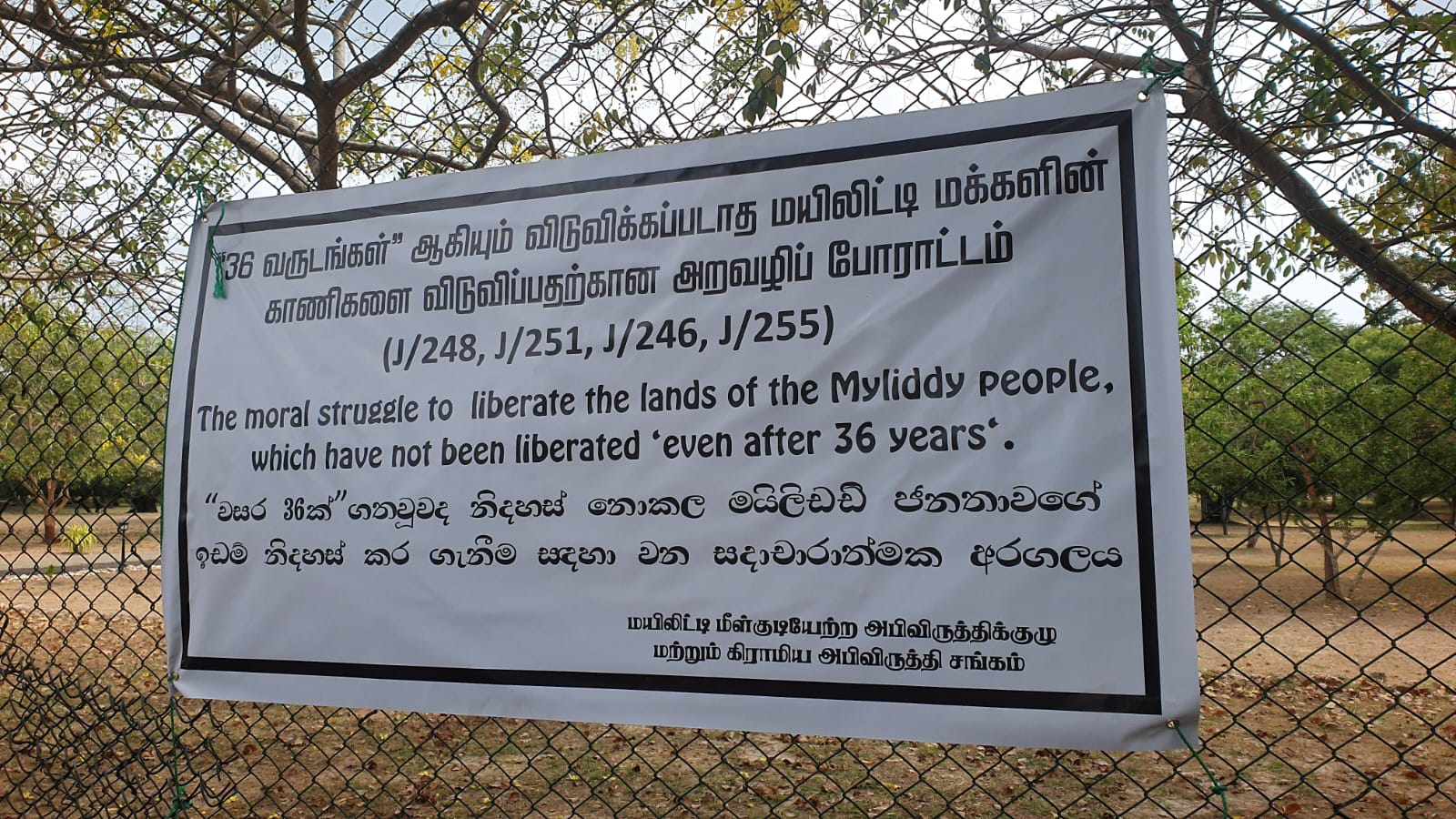
In June 1990, as Sri Lanka’s civil war intensified, the Sri Lankan military expanded operations around the Palaly airbase and Kankesanthurai harbor on the northern tip of the Jaffna Peninsula. Thousands of Tamil families from thirteen Grama Niladhari divisions under the Valikamam North Divisional Secretariat were ordered to leave their homes, displaced by the expansion of the Palaly military base and the shelling of surrounding villages. The area was subsequently declared a High Security Zone under emergency security regulations and placed entirely under military administration. Entire villages were cleared. Homes, agricultural fields, fishing grounds, schools, temples, churches, and community halls were absorbed into the zone.
The zone, at its peak, encompassed approximately 30 villages. Of those originally displaced in 1990, villages including Myliddy, Palaly, Vasavilan, Katkovalam, Kurumbasiddy, Urani, Tholakaddy, Keerimalai, Kankesanthurai and Thaiyiddy remain fully or substantially under military control as of 2025, according to a parliamentary statement by M.P. Sivagnanam Shritharan and accounts from affected residents. Some areas, including parts of Maviddapuram, were formally returned following a 2011 ceremony, though civil society organisations document continued military encroachments even in nominally released zones.
The war ended in May 2009. The High Security Zone did not. More than 6,000 families from Valikamam North remain displaced, scattered across other parts of the Northern Province and abroad, according to figures cited by civil society organizations and local representatives. The barbed-wire fences remain in place.
“Although 16 years have passed since the end of the war, our lands remain under the control of the Sri Lankan military under the continuing pretext of a High Security Zone,” said Velautham, a displaced resident of Valikamam North, speaking to Jaffna Monitor.
What the Government Says It Has Done
The administration of President Dissanayake has identified land release in the Northern Province as a priority. In a defense advisory committee meeting in Parliament, the President stated that the government had taken steps to release approximately 1,000 acres of private land in the North during 2025 alone.
In early April, Deputy Defense Minister Major General (Retired) Arun Jayasekara provided more specific figures to Parliament. According to his submission, a total of 672.24 acres had been released between January 1 and October 2025, comprising 86.24 acres of private land and 586 acres of state land previously used by the military. He also cited the release in March of two acres in Jaffna’s Vasavilan area, noting that those acres had been under military control for 36 years.
Jayasekara told reporters that land release would not pose any threat to national security and that special attention was being given to lands belonging to religious institutions. Fisheries Minister Ramalingam Chandrasekar, in a separate announcement earlier this year, said a phased program had been initiated to return privately owned lands in Valikamam North to their rightful owners, in line with directives from the President.
The Gap Between Announcements and Delivery
Tamil political representatives and displaced residents dispute the government’s framing of the situation.
In Valikamam North alone, residents and Tamil representatives say approximately 2,200 acres of agricultural land remain unreleased, despite repeated promises from successive governments. “Every government announces land releases, but the vast majority of our occupied lands remain unchanged,” said Murugupillai, 72, a displaced resident, speaking to Jaffna Monitor. “We can see that this government is continuing the same pattern.”
Beyond Valikamam: A Dispute That Spans the Entire North and East
The land occupation that brought residents to the gates of the Commando bungalow on Friday is not a problem confined to Valikamam North. From the lagoons of Mullaitivu to the naval coastline of Mannar to the fishing villages of Trincomalee, military occupation of civilian land is a condition that Tamil communities across the North and East have lived under for decades.
Keppapulavu, Mullaitivu
In Keppapulavu, a village in Mullaitivu District, residents fled their homes in December 2008 as the final phase of the civil war engulfed the area. The Sri Lankan Army and Air Force subsequently established camps on more than 200 hectares of Tamil-owned residential land. The military did not leave when the war ended in May 2009. Tamil National Alliance MP Thurairasa Ravikaran has stated that approximately 160 acres remain under military occupation as of 2025, disrupting access to Nandikadal Lagoon — the body of water adjacent to Mullivaikkal, site of the war's final battle — and cutting off fishing families from livelihoods tied to the lagoon for generations.
In December 2017, following sustained pressure, the Army released a portion of the land it had occupied. But the centre of the village, including homes, a school, a primary health centre, places of worship, and a community hall belonging to the original residents, remained inside the military perimeter.
Families who had spent years in the Menik Farm displacement camp were transported in September 2012 to Sooripuram, a plot of land adjacent to but not on their original properties, according to Human Rights Watch documentation of the resettlement process.
The families of Keppapulavu began a continuous day-and-night protest on March 1, 2017, outside the military headquarters in Mullaitivu — a demonstration that lasted more than 700 days and was described at the time as the longest community-led continuous protest for land in Sri Lanka.
In April 2025, residents who attended a meeting at the Presidential Secretariat in Colombo were told by officials that the government had no information about their land issue.
In November 2024, residents presented a petition directly to Prime Minister Harini Amarasuriya at a National People's Power event in the area. Amarasuriya received the petition but made no public commitment on it.
Mullikulam, Mannar
In Mullikulam, a Tamil Catholic village on the Mannar coastline bordering Wilpattu National Park, the Sri Lanka Navy evacuated approximately 307 families in September 2007 and told them they would be permitted to return within three days. They were not permitted to return in full. The Navy subsequently established its North Western Command Headquarters — SLNS Barana — on the land.
Before the Navy arrived, Mullikulam was a self-sufficient village with paddy fields, four streams, sea and shore fishing grounds, a school, a post office, a cooperative outlet, and the Church of Our Lady of Assumption. All of that now sits inside a naval base. The 307 displaced families are currently scattered across at least three separate locations — Kayakkuli, Malankaadu, and Mannar town — having reluctantly accepted alternate housing built by the Navy that residents say has already begun to deteriorate.
The Catholic Diocese of Mannar owns a substantial portion of Mullikulam's land. In December 2012, the Bishop of Mannar met with then-Defense Secretary Gotabaya Rajapaksa at a meeting also attended by Cardinal Malcolm Ranjith, and received a commitment that land within 750 meters of the church would be returned. That commitment was not honoured. In July 2018, President Sirisena made a public commitment at Madhu Shrine to expedite land release in Mullikulam. That commitment was not honoured either.
Those who remain in temporary settlements near Mullikulam are required to obtain a pass from the Navy to fish in waters they once used without restriction.
Sampur, Trincomalee
In Sampur, a coastal Tamil village in Trincomalee District, the Sri Lanka Navy established Camp Vidura on land from which Tamil families had been displaced. According to villagers' testimonies, the Navy occupied at least 176 acres of residential and agricultural land, as well as over 1,000 acres of coastal area traditionally used for fishing. Paddy fields and water tanks were enclosed within naval property. Fishing families lost direct access to the coast.
A partial release occurred under President Sirisena, with 818 acres handed over to original residents in August 2015 and a further 177 acres in March 2016, according to Human Rights Watch. When Human Rights Watch visited in August 2017, multiple disputes remained unresolved. Some returning families found plots occupied or boundaries shifted. The Navy still occupies 207.52 acres of land belonging to approximately 110 families in Sampur, according to a petition submitted by displaced residents to the Governor of the Eastern Province in April 2025.
The land question in Sampur took a new turn on April 4, 2025, when President Dissanayake and visiting Indian Prime Minister Narendra Modi jointly inaugurated the Sampur Solar Power Plant — a 120-megawatt joint project between India's NTPC and Sri Lanka's Ceylon Electricity Board built on approximately 500 acres of land in Sampur.
Tamil residents of Sampur West, Sampur East, and Katakaraichenai staged a protest the same day, timed to coincide with Modi's arrival. In a petition submitted to the Governor of the Eastern Province, the displaced residents demanded the return of 1,658 acres of land expropriated without legal process by successive governments.
The Scale of the Problem
The Human Rights Watch report "Why Can't We Go Home?", published in 2018 and still cited by Tamil civil society, documented military land occupation across Jaffna, Kilinochchi, Mullaitivu, Mannar, Vavuniya, and Trincomalee. It found that in multiple cases, the military occupied civilian land for agriculture, tourism, and commercial purposes while blocking the return of original owners under the stated justification of national security.
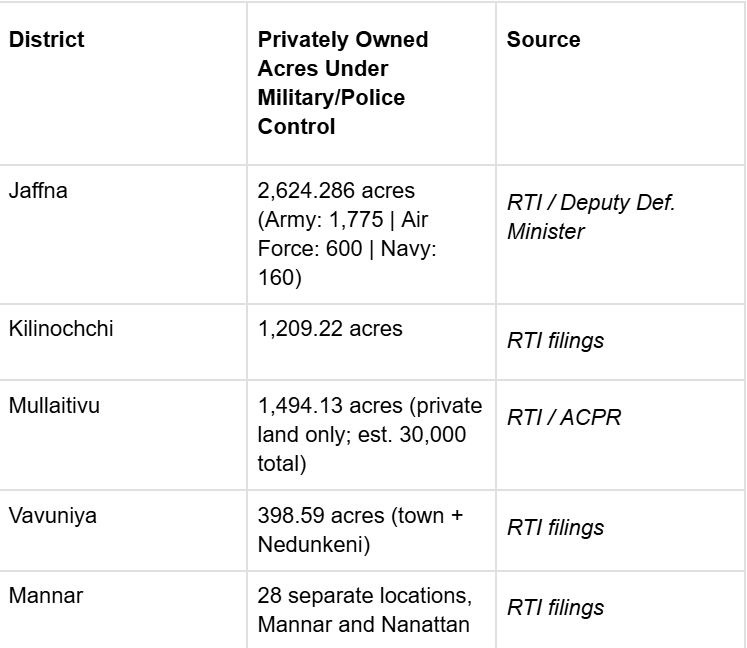
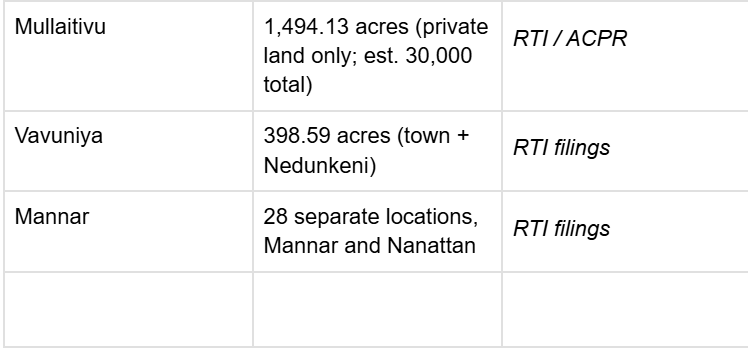
Right to Information data for four Northern Province districts — Jaffna, Kilinochchi, Mullaitivu, and Vavuniya — documents more than 5,700 acres of privately owned land under military or police control. Mannar District has a further 28 separate military, naval, and police-occupied locations for which total acreage has not been made public.
Although the government of President Dissanayake claims that approximately 1,000 acres of private land were released in the Northern Province during 2025, Tamil representatives say significant uncertainty remains over where and when those releases occurred.
The Scale of Military Land Occupation: RTI Data
Data obtained through Sri Lanka’s Right to Information Act provides a district-by-district accounting of privately owned land across the Northern Province that remains under the control of the military and police:
What Happens on Occupied Land
Land rights activists and affected residents say the military does not merely occupy civilian property but derives economic benefit from it. Vivekananthan Indradevi, a landowner from Keppapulavu in Mullaitivu district who has been pressing separately for the release of her land, described the situation in terms that were echoed by Valikamam North residents on Friday.
“The military is benefiting from my land,” she told journalists. “They are cultivating our lands, but I, the rightful owner, cannot even enter my own home.”
Sources familiar with land use patterns in Valikamam North told Jaffna Monitor that military personnel have established agricultural operations on substantial portions of the occupied lands within the High Security Zone, with additional areas reportedly converted into recreational and commercial facilities, including shops and playgrounds.
Residents and land rights advocates allege that produce cultivated on these privately owned civilian lands is subsequently sold in local Tamil-majority markets, creating what many displaced families describe as the deeply painful reality of original landowners being forced to purchase goods grown on their own confiscated property.
Rathinasingam Muralitharan, leader of the Northern Province People’s Organization for Land Rights, said the prolonged occupation of civilian lands in the North and East increasingly extends beyond conventional security justifications.
“While lands in other parts of the country may be acquired in the name of development, in the North and East Tamil lands continue to be seized under the pretext of security,” he said, arguing that state institutions, including archaeology and coastal conservation authorities, have at times been used to reinforce or legitimize land control that might otherwise be subject to civilian return.
“The continuous occupation has stripped people not only of their livelihoods, but also of their peace,” he said. “Our demand is simple: the people’s lands must be returned to the people.”
Security, the Government’s Recurring Justification
Across every administration since 2009, the primary justification for continued military land holdings in the North has been national security. Deputy Defense Minister Jayasekara reaffirmed this position in his parliamentary statement, saying that while land release is a priority, all decisions will remain subject to security considerations and that “national security” will be prioritized above all other factors in future land release determinations.
Fisheries Minister Chandrasekar, in his announcement earlier this year, justified the years of occupation by stating that “extraordinary circumstances” during the war had required the retention of private lands. Tamil political representatives and civil society groups note that the war ended 16 years ago.
A Record of Promises Across Five Presidents
The land dispute in Valikamam North predates the current government by many administrations. Under President Mahinda Rajapaksa, who oversaw the military defeat of the Liberation Tigers of Tamil Eelam in 2009, phased land releases were announced, and partial returns were conducted as public ceremonies. Large portions of the High Security Zone remained untouched.
Under President Sirisena, 500 acres across Kankesanthurai, Myliddy, and Palaly were formally approved for release. A decade later, 450 of those acres have not been returned. Under President Gotabaya Rajapaksa, no meaningful release occurred, and militarization expanded in the North-East. Under President Ranil Wickremesinghe, Keppapulavu residents who submitted petitions to the district secretariat were told authorities were gathering information.
The Valikamam North Land Release Committee summarized the record in a statement earlier this year: despite five presidential changes and four parliaments, nearly 2,900 acres of land remain unreleased in the area, against repeated promises.
President Dissanayake’s National People’s Power party included land release in its presidential and parliamentary election manifestos. The partial release of 40 acres on May 1 was welcomed by some as a signal. Tamil political representatives, reviewing the arithmetic — 40 acres against 2,900 still occupied in Valikamam North alone — described it as insufficient.
The Residents Who Keep Coming Back
The landowners who returned to the Commando bungalow gate on Friday were not holding photographs of their homes as artifacts of the past. They were holding them as evidence of present ownership — of a legal right to property that the state has not honoured.
Some of those who were displaced in 1990 as young adults are now elderly. Their children have grown up as displaced persons. A number of original landowners have died without returning to their land.
The landowners said they would be back next Friday.