
By M.R. Narayan Swamy
“He is a cardinal, isn’t he? Why does he always talk like a politician?”
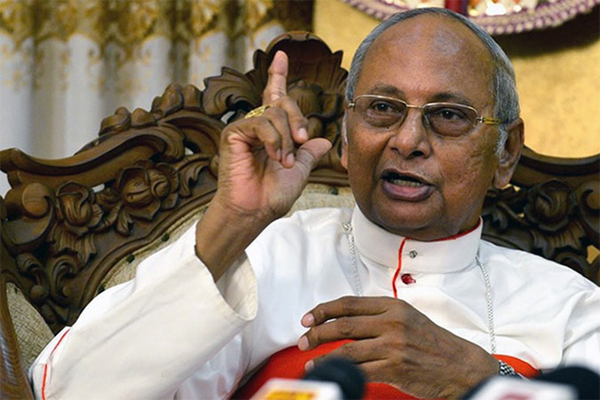
No one could have put it better when describing Cardinal Albert Malcolm Ranjith Patabendige Don, known simply as Malcolm Ranjith. And those words came from a respected member of Colombo’s Catholic community.
Probably because the government appears to be on his side, the Cardinal may not realise that there is widespread disgust over his unending aggression about a supposed international conspiracy behind the Easter bombings of 2019.
He is, of course, not alone. At least two other Catholic priests regularly appear in the media, offering their own spin on the horrendous terrorist attacks of April 21, 2019, which killed more than 260 people and injured hundreds.
But it is Malcolm Ranjith who occupies the heart of this belligerence.
The Islamic State promptly claimed responsibility for the Easter savagery. Nobody denies that they carried out the attacks. The dispute is over whether someone wanted the bloodbath to occur and, if so, whether they egged on the Islamist attackers.
A string of investigations within Sri Lanka and outside has shown that the Islamic State acted on its own. Among those who came to this conclusion are the Federal Bureau of Investigation (FBI) and Scotland Yard.
Malcolm Ranjith, however, insists that elements in Sri Lanka other than ISIS were responsible for orchestrating the bombings with a view to bringing Gotabaya Rajapaksa to power. The former defence secretary played a key role in defeating the Tamil Tigers.
His views echo those of Maulana Azad, a Sri Lankan Muslim who alleged, while claiming asylum in Europe, that it was he who arranged a meeting between the Islamists and Suresh Sallay, a career intelligence officer who was known to be close to Gotabaya.
Neither Maulana nor Malcolm Ranjith has provided any evidence to support these allegations. As far as Maulana is concerned, his testimony has been rubbished by former Tamil militants who have known him for years.
Gotabaya, a younger brother of former President Mahinda Rajapaksa, did storm to power in the election that followed the Easter mayhem. He subsequently appointed Sallay as head of the country’s main intelligence agency, the State Intelligence Service (SIS).
Many find it amusing that an officer like Sallay, who once headed the Military Intelligence, needed a novice like Maulana to get introduced to hardened Islamists in Sri Lanka.
And that, after a closed-door meeting with the would-be bombers, Sallay told Maulana, who was waiting outside, what had transpired during the top-secret discussions.
Both these claims defy logic and common sense.
One is not saying that Sallay did not do what he has been accused of doing. If we have to believe that Gotabaya and Sallay were indeed behind the bombings on Easter Sunday, there must be solid proof. None has been provided yet.
Indeed, except for a lot of bluster one has heard in Sri Lanka’s parliament, there is not an iota of evidence that has become public that can make up a firm legal case against Gotabaya and Sallay.
Insinuations can make for political drama; they won’t stand scrutiny in a court of law.
So, the question that needs to be asked is: How does Malcolm Ranjith know that there was a conspiracy and that the Islamic State needed someone to encourage its members to do what they did?
Has he had access to any intelligence file of any country that others have not seen? Is it possible that the Cardinal knows what the FBI, the Australians, or the British do not? Is this possible?
Are we to believe that everyone except the Prelate is telling a lie?
If the Cardinal possesses details of a conspiracy, why does he not make it public?
There is another aspect to Malcolm Ranjith’s personality that does not inspire confidence.
Here is a man who is supposed to spread Jesus’ teachings and treat everyone as equal in the eyes of God. What is the Cardinal’s record?
Is it not a fact that Malcolm Ranjith maintained a stony silence when the Sri Lankan military bombed churches in the Northern Province during the war against the Tamil Tigers?
Is it not true that numerous innocent Tamils, including Catholics, were killed in these attacks? Did not many Tamil members of the clergy disappear or get killed during the war?
Did Malcolm Ranjith denounce any of these? Did his silence at a time of bloodbath and terrible human suffering not amount to being an accomplice in the war crimes?
Who can forget that the Cardinal – he became one in 2010, a year after he was named the Archbishop of Colombo – ranted against those who wanted international scrutiny into the agonies Tamil civilians underwent.
Sri Lankans won’t approve of outside intervention, he screamed.
And the same Cardinal now wants a further independent, international investigation to unravel what he calls a conspiracy behind the Easter killings. He has made the demand in Geneva. He is also pressing the Vatican.
We assume that a new international probe as sought by him will not affect Sri Lanka’s image. But Sri Lanka would have suffered humiliation if such an investigation were to have taken place into the war crimes of 2008-09.
As a Jaffna Monitor editorial noted, it is no one’s case that sections of the clergy did not collude with the Liberation Tigers of Tamil Eelam (LTTE) when the Tigers were the de facto masters of the northeast. That is another saga.
Coming back to Colombo, not everyone in the Catholic community is happy with what the Cardinal is up to.
As one Catholic said, the Cardinal may have certain reservations or doubts about what happened on Easter Day. He had every right to make his fears public. But to go on and on, in the name of seeking justice, is something else.
“I know many Catholics in and outside Colombo are not happy with the Cardinal,” an elderly Catholic said. “If he has proof, he must give it to the government. What he is doing is propaganda.”
There are other questions too.
Is the Vatican aware of the goings-on in Sri Lanka? Is the Cardinal speaking on behalf of the Vatican? If so, does that mean the Vatican is interfering in Sri Lanka’s internal affairs? If Malcolm Ranjith is speaking on his own behalf, can he do so with his priestly robes on?
Another Catholic in Colombo said he respected the Cardinal when he repeatedly called for peace in the country after the Easter bloodbath.
“I felt proud. But for his appeal, who knows what could have happened? But what he is doing now is not right. It almost looks as if he is acting in concert with the powers that be.”