
By M.R. Narayan Swamy
Guess who would be the happiest in Sri Lanka after Tamil MP Thurairasa Ravikaran warned that Tamils would be forced to again demand Tamil Eelam if Colombo kept weakening the provincial councils?
The Sinhalese-Buddhist-dominated security establishment would be quietly applauding Ravikaran. They can now confidently tell President Anura Dissanayake why the military camps in the north and east cannot be shut, even though the Eelam war ended close to two decades ago.
“If a so-called moderate Tamil leader can threaten another war over Tamil Eelam, imagine what could be lurking in the minds of the sullen young Tamils? This being the case, can we afford to close down our camps?”
This would be the security eco-system’s theme song if and when anyone tells them to return the vast tracts of land they took over from civilians after Eelam War II resumed in 1990.
Indeed, each time a Tamil leader refers to, directly or indirectly, Tamil Eelam and those who led its (earlier) armed struggle, it will be music to the ears of the security services.
What did Ravikaran say?
Speaking in parliament over Colombo’s decision to take control of four district hospitals in Tamil areas, the Ilankai Tamil Arasu Katchi (ITAK) member said: “If the Anura Kumara government snatches provincial powers through anti-Eelam-Tamil micro-politics that absorbs the Provincial Council’s power structures into the central government, we will again demand Tamil Eelam.”
It is of course very much possible that Ravikaran did not mean what he said, that it was political rhetoric, and that it was simply his way of expressing the anger and disgust many Tamils feel vis-a-vis the political establishment.
But this is not how his words will be digested in Colombo, where a two-year-old government which broke ground in Tamil areas by promising to undo some of the historical wrongs is finding itself shackled by a military which cannot stop conjuring up – rightly or wrongly – the lingering ghosts of Tamil Eelam.
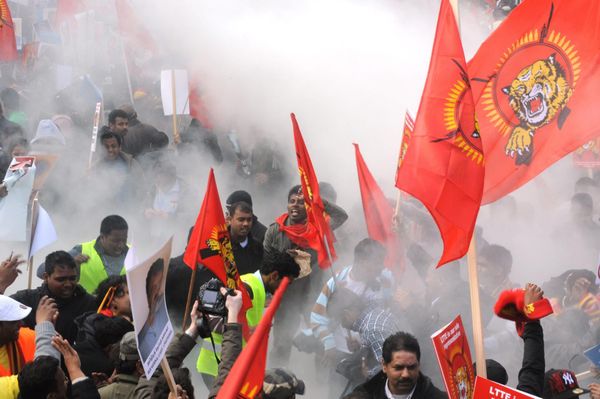
Indeed, every time a diaspora meet in the West raises the Liberation Tigers of Tamil Eelam (LTTE) flag, even in an altered form, each time a memorial is held for Velupillai Prabhakaran or his aides, if and when a Tamil diaspora member tries to finance some violence in Sri Lanka (however ineffective), on every occasion Tamil leaders in Sri Lanka or Tamil Nadu whip up passion over Tamil Eelam or claim that Prabhakaran and his family are still alive, the end result is the same. The security brass will be delighted to make a note: The danger is not over, not yet. They become another justification to continue the global ban on the LTTE.
This is also why the mass gatherings across Sri Lanka’s north and east – the former war theatre -- every November in memory of those killed in the LTTE’s armed campaign kill two birds for Colombo: The public mourning keeps alive the mirage of Tamil Eelam (and creates its own political chemistry in southern Sri Lanka); it also stokes the fires of division between pro- and anti-LTTE Tamils as well as pro-Tigers Tamils and Muslims.
It is not easy to forget the armed struggle that raged from 1983 to 2009, leaving tens of thousands of people dead and many more injured and broken, and forcing hundreds of thousands to flee Sri Lanka for good.
On the contrary, now that 17 years have passed since the guns fell silent, Tamils need to draw the right lessons from all that happened in the name of militancy since the 1970s – the ups and downs, endless internecine killings, assassinations of so-called foes, brutalization of the Tamil society, conscription of children, attacks on Muslims, prolonged war, and the final and crushing military defeat.
An unbiased and honest post-mortem would show that the Tamil society could have been in a better shape today had those who wielded the gun agreed to a compromise at some point of time. The last and best chance for such an opportunity arose in 2002, but the bus was sadly missed.
Unfortunately, those in Sri Lankan politics, with few exceptions, never spoke their minds for fear of upsetting the armed leadership. Few defended the Provincial Councils (first conceived in 1987), and even fewer were willing to fight for them because the Tigers opposed them. Those who stood by them were dubbed “traitors”.
So, today, when a Tamil leader pits the provincial council system against Tamil Eelam, it can only cause amusement in most circles and a certain disdain for the Tamil politicians – for not wanting to learn from history. In any case, irrespective of whether one agrees with it or not, the armed struggle for Tamil Eelam can’t be switched on and off at will. That would amount to disregarding history.
It is known that the quasi-federal system in India faces strain. What if the DMK were to threaten that it will go back to demanding an independent Tamil Nadu (a demand formally given up in 1962) if the powers given to the state governments were tampered with? Their anger may be justified, but no one will take them seriously in India.
Like it or not, the situation is no different in Sri Lanka. A Tamil Eelam sword, which Tamil moderates feel free to wave at their convenience, will not be seen to be made of steel but paper.
Yes, there are power-sharing issues between the Tamil region and Colombo. If these are still not resolved in countries like the United States and India, they are certainly going to persist in Sri Lanka. The Tamil leaders should campaign against the central government, provided there is maximum consensus within the community. Tamil political parties can also take their case in judicial forums as well as among the Sinhalese and Muslims so as to make it clear that provincial powers are not a stepping stone to separatism.
In any case, no one, in Colombo or elsewhere, is going to take Tamil leaders seriously, particularly when they are a house divided, with one section busy seeking political oxygen from right-wing nationalist circles in India.