By: Dr. Gamini Goonetilleke
The Trincomalee Oil Tank Farm stands today as one of the most strategically significant yet historically underutilized energy assets in South Asia. Located in the deep natural harbour of Trincomalee, the facility embodies a convergence of history, geopolitics, and economic potential. In the current global context—marked by energy insecurity, shifting geopolitical alliances, and regional competition—the Trincomalee oil farm offers Sri Lanka a renewed opportunity to transform itself into a regional energy hub. However, this transformation demands clarity of vision, political consistency, and strategic partnerships.
Origins and Construction
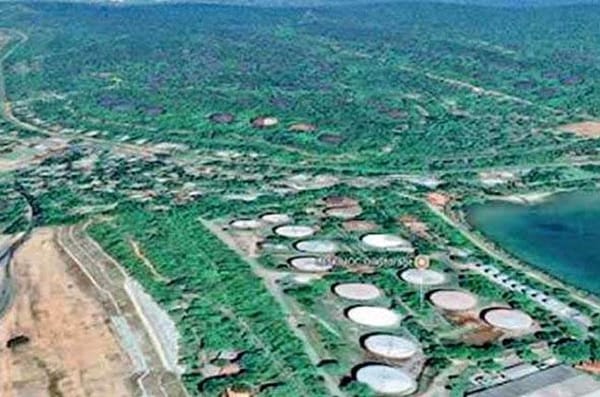
The origins of the Trincomalee oil tank farm date back to the era of World War II, when the British Empire recognized the strategic importance of Trincomalee as a naval base in the Indian Ocean. Construction of the oil storage facility, spread across nearly 600 acres, began in 1924 and continued into the late 1930s. The project was designed to support British naval operations in the eastern theatre, particularly as Japanese expansion threatened Allied supply lines.
The facility originally comprised 101 large storage tanks, each constructed using robust one-inch-thick steel plates and encased by concrete walls approximately one foot thick to protect against aerial attacks. Ingeniously integrated into the natural contours of the terrain, many of the tanks were partially buried, enhancing both structural stability and camouflage. Each tank had an approximate capacity of around 12,000 metric tons of fuel, giving the entire complex a total storage capacity of nearly 1.2 million metric tons—an immense reserve by regional standards even today.
This far exceeds the storage capacity of the Ceylon Petroleum Corporation’s existing facilities and even surpasses the newer storage complex at Muthurajawela, built with Chinese assistance, which has a capacity of approximately 220,000 metric tons.
The Fate of Two Oil Tanks
Out of the 101 tanks, one was destroyed when a Royal Ceylon Air Force plane crashed in the early 1960’s. But the most famous is the destroyed tank number 91 lying on the far edge of the forest. During World War II, the strategic significance of Trincomalee attracted enemy attention. In April 1942, Japanese forces launched air raids on the harbour in what became part of the broader Indian Ocean campaign. One of the oil tanks—commonly referred to as Tank 91—was hit during these attacks and destroyed. This incident underscored both the facility's vulnerability and its importance. While most of the tanks survived the bombardment, the destruction of Tank 91 remains a historical reminder of the oil farm’s wartime role.
Strategic Location and Infrastructure
The selection of China Bay within Trincomalee Harbour was not incidental. China Bay offered deep-water access, allowing large oil tankers to dock safely. The harbour itself is one of the finest natural deep-water harbours in the world, capable of accommodating large naval and commercial vessels with minimal dredging.
A sophisticated pipeline system was constructed to facilitate the transfer of oil from ships directly to the storage tanks. This network of pipelines minimized handling time and reduced vulnerability during wartime operations. The integration of maritime access with inland storage infrastructure made Trincomalee a logistical asset of immense value, capable of supporting sustained naval operations across the Indian Ocean.
Post-Independence Neglect
Following Sri Lanka’s independence in 1948, the Trincomalee oil tank farm gradually fell into neglect. Successive governments failed to recognize or capitalize on its strategic and economic potential. The facility was largely abandoned, with many tanks left unused and the surrounding area overgrown with dense shrub jungle. Infrastructure deteriorated, pipelines corroded, and the once-critical installation became a symbol of missed opportunity.
This neglect was not merely administrative but also strategic. At a time when global energy demand was rising and regional economies were expanding, Sri Lanka failed to leverage a ready-made asset that could have positioned it as a key player in the Indian Ocean energy network.
Early Attempts at Revitalization
In the late 1970s and early 1980s, President J. R. Jayewardene recognized the potential of the Trincomalee oil tank farm and proposed its development. However, these efforts were complicated by geopolitical considerations, particularly concerns from India regarding foreign involvement in a strategically sensitive location so close to its southern coastline.
As a result, the project faced diplomatic resistance and was ultimately abandoned. This marked another missed opportunity, driven by a combination of external pressure and internal indecision.
The Indo-Sri Lanka Accord and Aftermath
The signing of the Indo-Sri Lanka Accord in 1987 brought renewed attention to Trincomalee. The accord included provisions recognizing Trincomalee’s strategic importance and implicitly acknowledged India’s security concerns regarding its use.
During the years of civil conflict in Sri Lanka, the oil tank farm remained largely inactive. Security concerns, lack of investment, and broader regional instability prevented meaningful development. Even after the end of the war in 2009, progress remained slow.
The Role of Trinco Petroleum Terminal – 2022
A significant development occurred in 2022 with the establishment of Trinco Petroleum Terminal (Pvt) Ltd (TPTL), a joint venture between the Ceylon Petroleum Corporation (CPC) and the Indian Oil Corporation (IOC), through its subsidiary Lanka Indian Oil Corporation (LIOC), which had been operating in Sri Lanka since 2003. Under this arrangement, CPC holds a 51% stake, while LIOC holds 49%, reflecting a collaborative approach to developing the Trincomalee Oil Tank Farm.
As part of the agreement, a portion of the oil storage tanks was leased to the Indian partner, while the remaining tanks were placed under Sri Lankan control and earmarked for phased renovation and redevelopment by TPTL, LIOC, and potential international partners. LIOC has since been utilizing approximately 14–15 tanks, primarily for fuel storage and distribution within Sri Lanka.
Although these steps marked meaningful progress, the majority of the tanks have remained underutilized, and the full strategic and commercial potential of the Trincomalee Oil Tank Farm remains unrealized.
Political Opposition and Geopolitical Concerns
Efforts to expand Indian involvement in the development of the oil tank farm were met with strong resistance from nationalist political groups, particularly the Janatha Vimukthi Peramuna (JVP). The opposition was rooted in concerns over sovereignty, national security, and perceived over-reliance on India. This political wrangling delayed decision-making and discouraged investment. The Trincomalee oil tank farm became entangled in broader debates about foreign policy and economic strategy, rather than being treated as a national asset requiring pragmatic management.
From Geopolitics to Geoeconomics
In recent years, there has been a shift in perspective—from viewing Trincomalee primarily through a geopolitical lens to recognizing its geoeconomic potential. The global energy landscape is changing, with increased emphasis on supply chain resilience, regional storage hubs, and diversification of energy sources.
Sri Lanka’s strategic location along major shipping routes in the Indian Ocean positions it ideally to serve as a regional energy hub. Trincomalee, with its natural harbour and existing infrastructure, is central to this vision.
The Tripartite Agreement- 2025
A major breakthrough came in 2025 with the signing of a tripartite agreement involving Sri Lanka, India, and the United Arab Emirates. This agreement aims to jointly develop the Trincomalee oil tank farm, combining Sri Lanka’s strategic location with India’s regional influence and the UAE’s financial and technical expertise. The activation of this agreement marks a turning point. It reflects a pragmatic approach that balances national interests with the need for foreign investment and collaboration.
Importance in the Current Global Context
The importance of the Trincomalee oil tank farm has been heightened by recent global developments, including tensions and conflicts in the Middle East. Disruptions in oil supply chains have underscored the need for strategic reserves and regional storage facilities.
For Sri Lanka, expanding the storage capacity at Trincomalee could provide energy security by maintaining reserves sufficient for up to 60 days of consumption, which at present is sufficient only for 30 days. Renovation of the existing tanks, along with modernization of infrastructure, would significantly enhance the country’s resilience to external shocks.
Moreover, the facility could serve as a storage and redistribution hub for other countries in the region, generating revenue and strengthening Sri Lanka’s economic position.
Vision for Trincomalee as a Comprehensive Energy Hub
The transformation of Trincomalee into a dynamic and sustainable energy hub represents one of Sri Lanka's most significant strategic opportunities in the coming decades. Anchored by its historic oil tank farm at China Bay and supported by one of the finest natural harbours in the world, Trincomalee possesses the rare combination of geography, infrastructure, and strategic location necessary to evolve into a major energy centre in the Indian Ocean region. However, realizing this potential requires a shift from a narrow focus on storage toward a broader, integrated, and forward-looking energy ecosystem.
At the heart of this vision lies the expansion and modernization of petroleum storage and distribution. The refurbishment of the existing oil tanks—many of which date back to the Second World War—along with the construction of new, technologically advanced facilities, will significantly enhance storage capacity, efficiency, and safety. With modern monitoring systems and international-standard operational practices, Trincomalee can function as a reliable regional energy reserve, capable of meeting domestic needs while also serving international markets.
Beyond storage, the development of refining and value-addition industries is essential. Establishing a modern refinery would reduce dependence on imported refined petroleum products and create opportunities for producing lubricants, petrochemicals, and other high-value derivatives. These downstream industries would stimulate industrial growth, generate employment, and encourage the emergence of ancillary sectors, thereby contributing to broader economic development.
Trincomalee’s geographic advantages also extend to the aviation sector. Its proximity to China Bay Airport provides an opportunity to develop a dedicated aviation fuel supply chain, catering to both civilian and military requirements. This would enable the region to function as a refuelling and logistics hub within the Indian Ocean network, strengthening connectivity and enhancing operational efficiency for regional air traffic.
Equally significant is the potential of Trincomalee Harbour to emerge as a major centre for maritime services. Located along key east–west shipping routes, the harbour is ideally positioned to provide bunkering, maintenance, and logistical support to passing vessels. Developing competitive bunkering facilities would increase port revenues and enhance Sri Lanka’s standing in global maritime trade, while integrating energy services with port operations.
In keeping with global trends, the integration of renewable energy sources must form a key component of this vision. Trincomalee’s climatic conditions are conducive to both solar and wind energy generation, allowing for the development of hybrid energy systems that complement traditional fossil fuel infrastructure. Incorporating renewable energy will not only reduce carbon emissions but also align with international sustainability goals, ensuring that the hub remains relevant in a rapidly evolving global energy landscape.
Another dimension that warrants reflection in the development of Trincomalee as an energy hub is the story of Sampur—an example of both missed opportunity and emerging renewal. Strategically located in close proximity to China Bay, Sampur was once envisaged as a key site for a coal power project, later evolving into proposals for a liquefied natural gas (LNG) facility. However, a combination of political opposition, environmental concerns, and shifting policy priorities led to the abandonment of these initiatives. This not only delayed potential gains in energy generation and regional development but also underscored the need for policy consistency and long-term planning in the national energy strategy.
Yet, Sampur’s relevance has not diminished. Its transformation into a ground-mounted solar power facility, commissioned in 2025, marks a significant shift towards sustainable energy development. While its contribution to the national grid when fully operational may be modest (120 MW in two phases) compared to the scale of earlier proposals, it represents an important step in diversifying Sri Lanka’s energy mix and reducing dependence on fossil fuels. More importantly, Sampur’s evolution highlights the potential for integrating renewable energy into the broader vision for Trincomalee. As the energy hub concept matures, Sampur could serve as a model for balancing economic ambition with environmental responsibility, reinforcing Trincomalee’s role in a resilient and forward-looking energy future.
The realization of the energy hub vision depends heavily on robust infrastructure development and enhanced connectivity. Modernizing port facilities, expanding pipeline networks, and improving road and rail links to the rest of the country are essential steps. In addition, ambitious proposals such as undersea pipelines linking Trincomalee with regional partners could further strengthen its role as a critical node in South Asia’s energy network, facilitating cross-border energy trade and cooperation.
Strategic partnerships will play a crucial role in this transformation. Given the scale of investment and technical expertise required, collaboration with international stakeholders is both necessary and beneficial. However, such partnerships must be carefully structured to ensure transparency, equitable benefit-sharing, and the protection of national interests. Drawing on global best practices while maintaining sovereignty over strategic assets will be key to long-term success.
Equally important is the establishment of a stable and consistent policy environment. Investor confidence depends on clear, predictable policies governing taxation, pricing, and operations. A well-defined national energy policy, supported by a strong regulatory framework, will provide the foundation for sustained investment and long-term planning. Regulations must also ensure strict adherence to environmental standards, safeguarding the ecological integrity of the Trincomalee region while enabling responsible development.
Human resource development is another critical pillar. The successful operation of a modern energy hub requires a skilled and knowledgeable workforce. Investment in education, technical training, and capacity-building programs will be essential to equip local professionals with the expertise needed to manage advanced infrastructure and complex operations.
Finally, regional integration offers a powerful pathway for growth. By strengthening energy and economic ties with neighbouring countries, Trincomalee can position itself as a reliable and efficient hub within the wider Indian Ocean region. This will not only enhance energy security but also elevate Sri Lanka’s role in regional and global energy networks.
In essence, the vision for Trincomalee is one of transformation—from a historically significant but underutilized asset into a vibrant, multifaceted energy hub that drives national development, fosters regional cooperation, and secures a sustainable energy future.
Lessons from Past Failures
Sri Lanka’s history with the Trincomalee oil tank farm and the projects in Sampur for power generation is marked by missed opportunities, often due to political indecision, opposition by nationalist political parties, and short-term thinking. Repeated changes in policy, lack of continuity, and politicization of strategic assets have hindered progress.
To avoid repeating these mistakes, there must be a clear, long-term national strategy agreed by the parties concerned. Transparent governance, professional management, and accountability are essential.
Conclusion
In conclusion, the future of Trincomalee stands at a decisive crossroads, shaped by both its historic legacy and its untapped potential. What was once conceived as a strategic wartime asset now presents an opportunity of national significance, particularly at a time when global energy markets are under strain due to ongoing conflict in the Middle East. The convergence of geography, infrastructure, and rising energy demand places Trincomalee in a uniquely advantageous position within the Indian Ocean region.
Realising this vision demands more than ambition—it requires disciplined planning, policy consistency, and a commitment to the national interest over short-term considerations. Investment in modern infrastructure, technological advancement, and human capital must be matched by transparent governance and environmental responsibility. Equally important is the cultivation of strategic partnerships that strengthen capacity while preserving sovereignty.
If approached with foresight and unity, Trincomalee can evolve into a resilient, multifaceted energy hub—one that not only secures Sri Lanka’s energy future but also drives trade, industry, and regional collaboration. It is an opportunity to turn past delays and missed chances into present momentum and lasting success.
The time to act is now. The foundations are already in place; what is needed is the will to build on them.