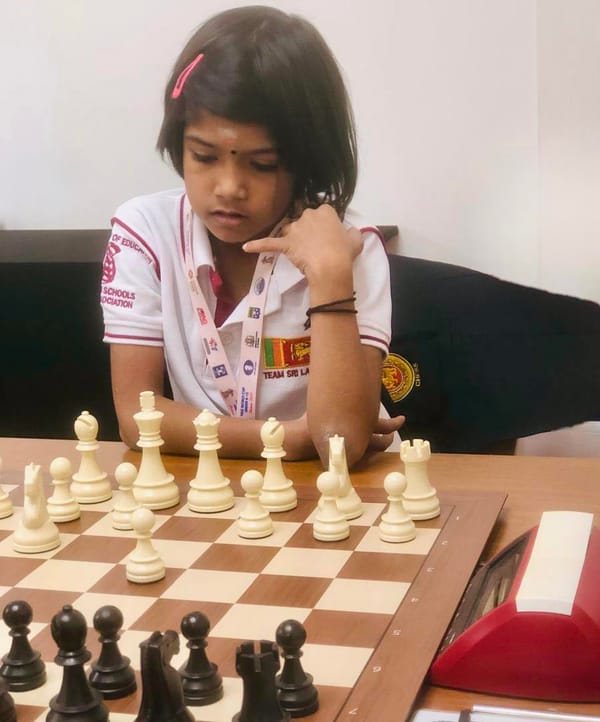
In a remarkable achievement that has electrified Sri Lanka’s chess community, eight-year-old Tharshan Kajishana from Kokuvil Hindu Primary School in Jaffna has secured a bronze medal in the Girls Under-8 category at the FIDE World Cadets Chess Championship 2025, held in Batumi, Georgia.
The tournament, hosted from June 22 to July 3 at the luxurious Grand Bellagio Hotel, drew over 300 young chess talents from nearly 40 countries.
A Historic Moment for the North
Kajishana’s bronze medal was confirmed following her strong performance in the initial seven-round Swiss system phase and a final placement among the top scorers. In her final game, she competed against Indian player Srinikhila Yadavilli, sealing her position on the podium.
A photograph of the young champion smiling alongside FIDE President Arkady Dvorkovich during the award ceremony has gone viral in Sri Lankan chess circles.
“She displayed incredible composure and sharp tactical skills throughout the tournament. Her achievement is historic—not just for Jaffna, but for all of Sri Lanka,” said IA Niroshan Chathuranga, team manager of the Sri Lankan delegation.
The Road to Georgia
Kajishana's qualification for the World Cup was no accident. She earned her place through a rigorous series of national competitions organized by the Chess Federation of Sri Lanka (CFSL), where she proved herself among the country's most promising young talents. Her recent competitive record includes a bronze medal as part of the Under-7 Girls' team at the 18th Asian Schools Chess Championships 2024 in Bangkok, demonstrating her consistent performance at the international level.
Her coaches describe her as a "strategic prodigy with an unusually mature board vision" – qualities that were evident throughout her games in Batumi, where she navigated complex positions with remarkable tactical awareness.
The Bigger Picture: Chess Revival in Jaffna

The achievement comes at a time when chess in the Northern Province is experiencing a renaissance. Speaking to the Jaffna Monitor, Mr. Nantharuban, President of the Jaffna District Chess Association, provided context for this historic moment:
"Although chess in Jaffna experienced setbacks over the past few decades, we've seen a steady revival over the last 3 to 4 years. More students are showing interest and participating actively. However, their progress is often limited by the lack of qualified trainers in the region."
The infrastructure challenges are significant. "Currently, we don't have any FIDE-certified trainers or titled players to provide advanced coaching, " Nantharuban explained. "In countries like India, you'll find a vast network of experienced trainers—Candidate Masters, FIDE Masters, and International Masters—who play a critical role in grassroots development."
The Path Forward
The absence of high-level coaching in the region remains a concern for nurturing talents like Kajishana. "If we could develop even a few coaches with Elo ratings above 2200, it would significantly improve the prospects of our young players," Nantharuban emphasized.
For context, the Elo rating system serves as chess's global ranking mechanism, with scores above 2200 typically indicating titled or highly skilled players capable of providing advanced instruction to aspiring champions.