

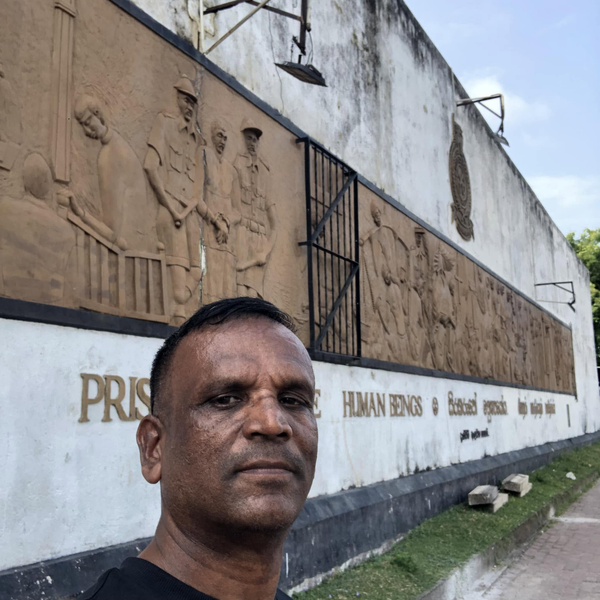
COLOMBO, Sri Lanka — A retired army major and attorney who spent more than three years inside Sri Lanka's largest prison has offered a rare firsthand account of conditions in the country's overcrowded prison system, days after the deadliest prison riot in more than a decade left 28 people dead and intensified scrutiny of long-standing failures in the country's jails.
Ajith Prasanna, who was released from prison earlier this year after serving a contempt-of-court sentence, published the account on Facebook following the July 5–6 violence at Negombo Prison. The clashes killed 28 people, including eight prison officers, making them the country's deadliest prison riot since the 2012 Welikada prison massacre.
Prasanna wrote that several of the officers killed at Negombo had left Welikada Prison on temporary deployment the morning the violence erupted — the same prison where he had spent three and a half years until his release earlier this year.
His account, while based on personal experience and not independently verified, echoes concerns documented for years by prison reform advocates, human rights organizations and government officials about chronic overcrowding, inadequate medical care and deteriorating living conditions inside Sri Lanka's prisons.
Prasanna was sentenced by the Supreme Court in January 2023 to four years' rigorous imprisonment for contempt of court after criticizing judicial decisions during press conferences while practicing as a lawyer. He later received two additional six-month prison terms from the Court of Appeal and the Colombo High Court on similar contempt charges, bringing his total sentence to five years.
He entered Welikada Prison on Feb. 24, 2023, and said he was housed in several wards during his incarceration.
According to Prasanna, prisoners housed in cell blocks are locked inside from 5:30 p.m. until around 6 a.m. without access to toilets, forcing them to use metal containers inside their cells. He described meals as thin and inadequate, said inmates slept on mats laid directly on concrete floors, and wrote that access to dormitory-style accommodation with overnight toilet facilities was considered a privilege rather than the norm.
He said prisoners wore white shorts and short-sleeved shirts, were required to keep their hair closely cropped and were prohibited from growing beards. Convicted prisoners not awaiting appeal worked daily in prison industries including carpentry, masonry, sewing, farming and coir production. Prasanna said he was assigned to the sewing section.
Family members were allowed to bring home-cooked meals only on a handful of religious and national holidays each year, he wrote. New inmates were subjected to full strip searches conducted manually rather than through body scanners — a practice he noted he had previously criticized publicly as a lawyer before later experiencing it himself as a prisoner.
Prasanna described medical services as severely inadequate, alleging that seriously ill inmates sometimes died because they did not receive timely treatment. Prisoners without family visitors, he wrote, often went months without basic necessities such as soap and toothpaste. He argued that rehabilitation programs were largely ineffective, saying that meaningful personal reform depended almost entirely on prisoners themselves.
His account comes as Sri Lanka confronts a prison system operating far beyond its intended capacity.
Prasanna estimated the country's prison population had grown to about 44,000 from roughly 27,000 when he entered prison in early 2023. Official figures point to a similar trend, although slightly lower totals. The justice minister told Parliament in May that about 39,000 people were incarcerated, while the minister overseeing prison reforms said this month that the number had risen to around 41,000.
The country's 36 prisons were designed to hold approximately 10,500 inmates.
Negombo Prison, built to accommodate about 650 prisoners, housed roughly 2,400 inmates when the violence erupted.
Prasanna argued that overcrowding had been driven largely by mass arrests during the government's "Ratama Ekata" anti-narcotics campaign, which he said targeted drug users more often than major traffickers and left thousands detained on remand for extended periods. He estimated that about 30,000 prisoners were incarcerated primarily because of poverty.
He also questioned the circumstances surrounding the Negombo deaths, predicting that subsequent investigations would show many of those killed had not participated in the violence.
Authorities have said prisoners attacked officers and attempted to breach the prison's main gate, prompting officers to use what officials described as the minimum force necessary to restore control. Hospital officials reported that many of the dead had suffered gunshot wounds, while rights groups have questioned whether the use of force was proportionate.
A committee headed by a retired Supreme Court judge is investigating the riot, including how violence that officials initially described as contained on the first day escalated into a far deadlier confrontation the following day.
In his Facebook post, Prasanna also appealed to the Minister of Women and Child Affairs, Saroja Savithri Paulraj, to consider the hardships faced by families of imprisoned breadwinners and said he hoped to advocate for prison reform and support for inmates' families.
The government has since announced a series of reforms, including reopening a colonial-era prison previously earmarked for conversion into a hotel, recruiting about 1,300 additional prison officers after years of frozen hiring, and preparing legislation to allow low-risk remand prisoners to serve their detention under electronically monitored house arrest.
Rights advocates have welcomed those measures but say they will have limited impact unless accompanied by broader reforms aimed at reducing incarceration. Ambika Satkunanathan, a former member of Sri Lanka's Human Rights Commission, told Reuters that the priority should be reducing unnecessary imprisonment and treating drug dependence through community-based programs rather than expanding prison capacity.
Official inquiries into both the 2012 Welikada prison massacre, in which 27 inmates died, and the 2020 Mahara prison riot, which left 11 prisoners dead, identified overcrowding as a central cause of unrest. Many of their recommendations remain unimplemented as Sri Lanka's prison population continues to grow.