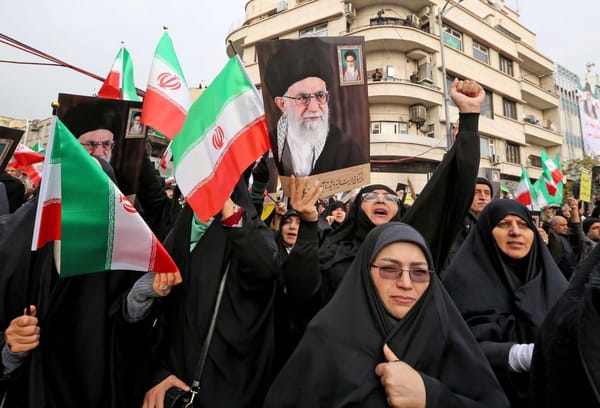
TEHRAN — For 37 years, Ali Khamenei held a country of 90 million people in his hands. He controlled its military, shaped its courts, sanctioned its security forces, and set the terms under which Iranians could speak, assemble, believe, and dissent. On Saturday, March 1, 2026, the morning after Iranian state television broadcast images of missile strikes on military installations in and around Tehran, international outlets reported his death. Iranian state authorities disputed the claim. The ambiguity, characteristically, will outlast the man.
What is not ambiguous is the record. From the fuel-price protests of November 2019, when approximately 1,500 people were killed in a single week according to an Iranian interior ministry document obtained by Reuters, to the uprising that followed the death of Mahsa Amini in September 2022, when the United Nations documented more than 500 deaths and what it called crimes against humanity — the arc of Khamenei's tenure was, in a specific and measurable sense, an arc of escalating lethality.
And it did not slow down at the end. In 2024, the last full year of his rule, at least 972 people were executed under his justice system — the highest recorded total in nearly a decade, according to Amnesty International. By September 2025, that figure had already been surpassed, prompting the rights organization to describe what it called a horrifying assault on the right to life.
THE ARCHITECTURE OF POWER
Khamenei did not govern through a cult of personality, as his predecessor Ayatollah Khomeini had. He governed through institutions — and he controlled them all.
As Supreme Leader, he held constitutional command of the armed forces, appointed senior figures in the judiciary, and set what the constitution calls the general policies of the state — an elastic mandate that, in practice, meant direction over every organ of coercion. The Islamic Revolutionary Guard Corps, mandated to operate under the Leader's supreme command, functioned as his most lethal instrument. The Basij militia, implicated in street-level violence across four decades of protest crackdowns, reported up through the same chain. Revolutionary Courts, insulated from ordinary due process and closed to public scrutiny, prosecuted his critics on national security charges drafted broadly enough to swallow a lawyer, a journalist, a student, or a grieving mother holding a photograph of her dead child.
In March 2012, he personally decreed the creation of a Supreme Council of Cyberspace, institutionalizing the state's capacity to filter information, surveil its citizens, and sever Iran from the global internet at a moment's notice. That capacity would be deployed, deliberately, during the worst nights of the 2019 crackdown — a strategy documented by Amnesty International as a mechanism not merely of communication control, but of concealment.
NOVEMBER 2019: 'WHATEVER IT TAKES'
The protests began over fuel prices in November 2019 and spread with stunning speed across more than 100 cities. Within days, they had become the most serious domestic challenge to the Islamic Republic since the revolution itself.
According to a Reuters investigation sourced to multiple officials close to his inner circle, Khamenei issued a directive: end the protests, whatever it takes.
What it took was catastrophic. The interior ministry document obtained by Reuters cited approximately 1,500 dead. Amnesty International, working methodically through relatives, hospital personnel, burial records, and grave photographs, documented 321 individual deaths. The true toll, investigators acknowledged, was almost certainly higher; the internet blackout and systematic intimidation of victims' families made a complete accounting impossible by design.
Hospitals were not sanctuaries. Contemporaneous reporting described agents entering emergency wards to intimidate medical staff, obstruct care for the wounded, and in some cases, arrest injured protesters brought in for treatment.
No official death toll was ever published. No senior official was charged with any offense.
2022: 'WOMAN, LIFE, FREEDOM'
Three years later, the death of 22-year-old Mahsa Amini in morality police custody on September 16, 2022, ignited protests that swept every province of Iran. The slogan — Woman, Life, Freedom — encoded everything the movement stood for and everything the state had suppressed.
The response was, the United Nations fact-finding mission later concluded, a campaign of gross human rights violations and crimes against humanity. The mission collected over 38,000 pieces of evidence and conducted 285 interviews with victims and witnesses. What investigators found was systematic: lethal force against demonstrators, mass arbitrary detention, torture including sexual violence, and a judicial apparatus that converted coerced confessions into death sentences.
Amnesty International documented rape and other sexual violence used as a deliberate tool of repression — perpetrated against men, women, and children, then dismissed or covered up by prosecutors who received the complaints. A UN investigator documented deliberate targeting of protesters' eyes as a tactic of disfigurement and terror.
Iranian authorities eventually announced a general amnesty, in language that acknowledged without quite admitting the scale of what had occurred. International reporting cited official acknowledgment of tens of thousands detained. More than 500 were killed. The UN fact-finding mission's mandate was later extended. Repression, its investigators noted two and a half years after the protests began, had not relented.
THE EXECUTION SURGE
The rise in executions during the final years of Ali Khamenei’s rule reflected a sharp escalation in the use of capital punishment as an instrument of state authority. Amnesty International documented at least 576 executions in 2022, a surge that followed the nationwide protests triggered by the death of Mahsa Amini and that rights groups said appeared intended to intimidate dissent. The number rose to at least 853 in 2023 — a 48 percent increase — with a disproportionate number of those executed drawn from ethnic and religious minority communities. By 2024, executions had climbed again, reaching at least 972, the highest recorded total in nearly a decade. The pace accelerated further in 2025, when monitoring groups recorded more than 1,000 executions in the first nine months alone, prompting Amnesty International to describe it as the highest number documented in at least 15 years. Rights investigators and United Nations officials warned that the figures, incomplete by nature, likely represented only a partial accounting of the scale of capital punishment carried out under Iran’s judicial system.
THE GENDERED CRACKDOWN
In 2024, Khamenei's government launched the Noor plan — a nationwide deployment of police and morality enforcement agents to confront women and girls over mandatory hijab compliance. UN investigators documented arrests, physical violence in detention, court summonses, and corporal punishment, including flogging, which they classified as state-sanctioned torture.
A reporting application called Nazer was deployed to crowd-source enforcement, transforming ordinary citizens into surveillance instruments. Drones and facial recognition technology supplemented the apparatus. New hijab legislation, advancing through Iran's legal system in the final period of Khamenei's rule, carried potential penalties including long prison terms and, under certain classifications, capital charges. Human Rights Watch described the law as imposing draconian punishments. The UN Special Rapporteur reported that Iran ranked near the bottom of international gender equality indices.
THE PERSECUTED ACROSS FOUR DECADES
The repression Khamenei oversaw was not confined to moments of mass protest. It was, for most of his tenure, a slow, steady pressure.
Baha'is — Iran's largest non-Muslim religious minority — faced what Human Rights Watch has concluded amounts to the crime against humanity of persecution: property seizures, economic exclusion, targeted prosecution, and home demolitions. In 2022, a wave of raids and arbitrary arrests, documented by Amnesty International, intensified pressure on a community that has never stopped being targeted.
The Gonabadi Dervish minority saw more than 300 members arrested in 2018 following a single protest. Journalists, lawyers, and civil society figures who documented any of this faced secondary reprisals — arrests, travel bans, disbarment. In at least one documented case, an individual was abducted from abroad and subsequently executed, a message to the diaspora that physical distance provided no safety.
2025–2026: THE FINAL CRACKDOWN
The final months of Ali Khamenei’s rule were marked by another nationwide uprising — and another violent response from the state.
Protests erupted on December 28, 2025, spreading across major cities and provincial towns with unusual speed. Demonstrators gathered over economic hardship, political repression, and the accumulated grievances of decades. As in previous uprisings, the authorities responded with force. Security personnel fired live ammunition, carried out mass arrests, and imposed sweeping internet shutdowns that severed communication between protesters and the outside world.
Human rights organizations reported mounting evidence of widespread killings and arbitrary detention. Human Rights Watch documented what it described as mass shootings of protesters and bystanders in multiple provinces. Amnesty International and other monitoring groups reported thousands detained, many held in undisclosed locations without access to lawyers or family members.
Iranian authorities did not publish a comprehensive death toll. Iranian state-linked figures later acknowledged more than 3,000 deaths, while independent human rights monitors and medical sources suggested that the true number could be significantly higher. As in earlier crackdowns, families of victims reported pressure to bury relatives quickly and refrain from speaking publicly.
The suppression of the protests — carried out in the final chapter of Khamenei’s leadership — underscored the durability of the security apparatus he had spent decades consolidating, and the extent to which the state continued to rely on coercion to contain dissent.
WHAT HE LEAVES BEHIND — AND WHAT REMAINS UNRESOLVED
Historians and policy analysts are already sorting through competing frameworks for understanding Khamenei's legacy. Some will describe him as an ideologue who never wavered from the revolutionary project he inherited. Others will characterize him as a canny political survivor — cautious, adaptive, and effective precisely because he was not the charismatic figure his predecessor was. Still others will argue that he presided over a system of coercion so structurally entrenched that it acquired a logic beyond any individual directive: that the question of personal agency, in a state built on institutional violence, is ultimately unanswerable.
That debate matters — for accountability, for international law, for the families who filed complaints that went nowhere. But it is not the debate those families are having.
For them, for the relatives who buried sons and daughters after November 2019 and preserved the evidence in testimony and photographs despite every effort to erase it, ideology was never the central question. For them, the question was always simpler:
When would it stop?
The answer, for the first time in a generation, may now be forming. What form it takes — transition, rupture, or continuation under different management — is the story that begins today.