

Israel–Iran War Sparks Petrol Panic in Jaffna

Israel–Iran War Sparks Petrol Panic in Jaffna


Share this post

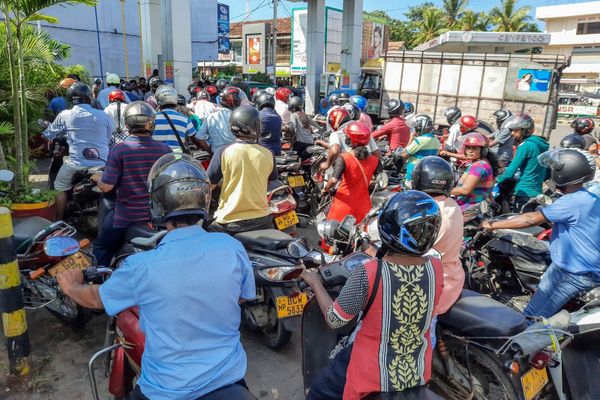
JAFFNA, Sri Lanka — Hours after reports emerged that the United States and Israel had launched coordinated strikes on Iran, motorists across Sri Lanka’s Northern and Eastern Provinces began lining up at fuel stations, fearing that the distant conflict could disrupt fuel supplies to the island nation, which remains heavily dependent on imported petroleum.

Long queues formed outside petrol sheds in Jaffna town by Saturday afternoon, with motorcycles, three-wheelers, and cars stretching for hundreds of meters along key roads. Similar scenes were reported in Batticaloa, Ampara, Mullaitivu, and Vavuniya, according to Jaffna Monitor correspondents in those districts, reflecting a widespread sense of anxiety in Tamil-majority regions that have historically been more vulnerable to supply disruptions.

Residents said memories of Sri Lanka’s crippling fuel shortages during the 2022 economic crisis remained fresh, when days-long queues and nationwide rationing brought daily life to a halt.

“We cannot take chances again,” said a motorcyclist waiting in line near Stanley Road in Jaffna. “It is better to stand in a queue and buy petrol now than to face hardship without it later,” he said.

Officials at the state-run petroleum distribution system, however, urged calm, describing the rush as unnecessary and driven largely by fear rather than actual shortages.

The Chairman of the Ceylon Petroleum Corporation, D. J. Rajakaruna, said fuel stocks in the country and shipments already in transit were sufficient for more than a month. He said petrol stocks would last for 37 days, auto diesel for 35 days, and jet fuel for 47 days.

Rajakaruna said authorities had received reports of panic buying in certain parts of the country following the escalation of the Iran conflict and urged the public not to panic, emphasizing that sufficient fuel stocks were available nationwide.

“This is a pattern we have seen before,” another official, who wished not to be named because he was not authorized to speak publicly, told Jaffna Monitor. “Panic buying itself can create shortages, even when supply is adequate.”

Sri Lanka imports nearly all of its petroleum, making it acutely sensitive to global geopolitical shocks, particularly conflicts involving major oil-producing regions or shipping routes. Analysts say that while immediate disruptions are not inevitable, public perception alone can trigger cascading effects in fragile economies still recovering from the crisis.


Share this post

Be the first to know

Join our community and get notified about upcoming stories

Subscribing...
You've been subscribed!
Something went wrong
The Real Battle for Credibility

The Real Battle for Credibility

This month, I was invited to speak at the second Sri Lanka–India Media Friendship Association (SLIMFA) Media Fest in Colombo, on the theme “Trust, Truth and the Battle for Credibility.” Illness prevented me from attending. I have chosen instead to publish the thoughts I had prepared as this month’s editorial, because the issues they address extend far beyond a conference hall. Where I Stand I come from Northern Sri Lanka, a region devastated by nearly three decades of civil war. My entire chi


Aruliniyan Mahalingam

Aruliniyan Mahalingam

Rights Group Accuses Sri Lanka of Obstructing Chemmani Mass Grave Investigation

Rights Group Accuses Sri Lanka of Obstructing Chemmani Mass Grave Investigation

For three decades, the state’s answer to the families of Jaffna’s disappeared has been that it does not know. A report released this week argues that it has always known — and has spent thirty years making sure that nothing could be done about it. The report, published by the International Truth and Justice Project (ITJP), a London-based group that has documented Sri Lankan war crimes since 2013, lands as excavators returned to the Chemmani salt flats on Tuesday to resume a dig that has already


Our Reporter

Our Reporter

Should Sanctions Extend to a General's Memoir?

Should Sanctions Extend to a General's Memoir?

By M.R. Narayan Swamy Realising that the war for Tamil Eelam would need a constant supply of weapons, Velupillai Prabhakaran set up in 1985 Kadal Pura, a modest sea wing in the Liberation Tigers of Tamil Eelam (LTTE). Over the years, it grew into the formidable Sea Tigers, which threatened to overwhelm Sri Lanka’s navy. Once the fourth and final Eelam War resumed in August 2006, it became payback time. The Sri Lankan Navy rapidly sank in 2007 the LTTE’s awesome warehouse ships, left and right.


M.R. Narayan Swamy

M.R. Narayan Swamy

The Missing Half of Sri Lanka's Post-War Recovery

The Missing Half of Sri Lanka's Post-War Recovery

By Jeevan Thiagarajah Seventeen years after Sri Lanka's civil war ended, the country has run one of the world's more closely studied reintegration experiments — and left another almost entirely undone. On one side, 12,196 former LTTE combatants passed through a state-run rehabilitation programme that concluded in 2021. On the other, hundreds of thousands of state security personnel — soldiers, sailors, airmen, and police who fought the same war — returned home to no equivalent programme at all.


Jeevan Thiyagaraja

Jeevan Thiyagaraja