JAFFNA, SRI LANKA — When a prominent doctor in the Northern Province set out to organise a community programme through his professional civil society network, he expected the usual obstacles: bureaucratic delays, funding constraints, and coordination challenges between departments. What he encountered instead was something entirely different.
According to multiple credible sources who spoke with Jaffna Monitor on condition of anonymity, fearing professional consequences, the doctor was told that his initiative was welcome in the province. There was, however, a condition. The programme had to be conducted through a National People's Power-affiliated civil forum — under the ruling party's organisational label rather than as an independent professional undertaking.
He was not alone in making such claims.
In recent months, civil society actors, professional associations, lawyers, and community organisers across the Northern Province have told Jaffna Monitor that they are witnessing what they describe as a systematic pattern. According to these accounts, the NPP government — particularly its Jaffna District apparatus under Fisheries Minister Ramalingam Chandrasekar, who also serves as the JVP (the NPP’s principal constituent party) district organiser and a member of its national executive committee — has been engaged in a sustained effort to ensure that no significant civic initiative proceeds outside the ruling party’s influence or oversight.
These allegations, repeatedly voiced by local stakeholders, point to what they characterise as an attempt to consolidate political control not only over state institutions, but also over independent civic space in the North.
The pattern does not stop at civic life. It has erupted into Parliament, local councils, and national newsrooms. Tamil political parties from opposing ideological traditions have converged, with unusual unanimity, on the same essential charge: that what the NPP presents as development is functioning, in practice, as political consolidation — and that it is doing so in a province that has had no functioning elected Provincial Council for years.
Sri Lanka does not need to abolish devolved institutions to hollow them out. It can simply substitute them. That, critics across the political spectrum argue, is precisely what is now happening in the North.
Governing Without Elections
The controversy unfolds against a constitutional backdrop that has remained unresolved for years. The Northern Provincial Council has not held elections since 2013. Its mandate expired in 2018. No new election date has been set.
Under Sri Lanka’s 13th Amendment, key subjects including health, agriculture, and local government fall within provincial authority. In the absence of an elected council, those powers remain formally intact but practically dormant.
Multiple political and administrative sources in the North told Jaffna Monitor that NPP Members of Parliament have, in recent months, taken on informal oversight roles in provincial-level sectors. Critics have described them as “shadow ministers” — ruling party MPs participating in sectoral meetings and administrative discussions without a formal constitutional mandate.
The matter was later raised in Parliament by opposition MP Gajendrakumar Ponnambalam, who alleged that Cabinet Minister Bimal Rathnayake had instructed the Northern Province Governor, Nagalingam Vedanayagam, to facilitate such arrangements. Neither the minister nor the governor has publicly addressed those allegations.
Jaffna Monitor sought comment from the relevant ministries and district NPP officials. No response was received at the time of publication.
PRAJA SHAKTHI: THE GOVERNMENT'S CASE
The second and broader fault line is the Praja Shakthi programme, and understanding the controversy requires first taking the government's case seriously.
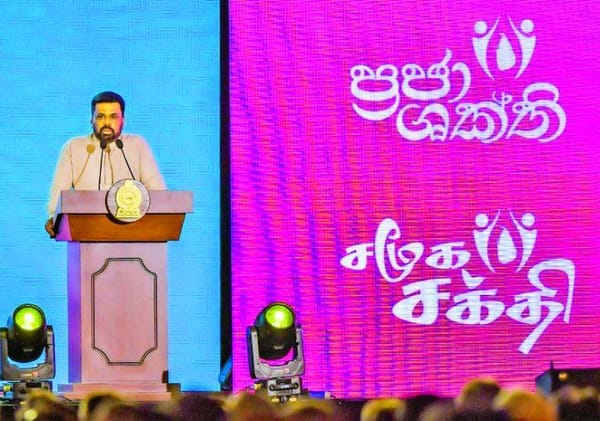
Praja Shakthi is presented as a national movement to eradicate poverty through participatory community-level planning. Official government messaging describes it as a mechanism that integrates ministries and communities, emphasising inclusive and participatory development. Community Development Councils (CDCs) are being established at the Grama Niladhari division level islandwide, with defined roles for chairpersons, secretaries, and members spanning community segments including academics, entrepreneurs, and public servants. Each CDC is composed of twenty-five members, linked to budgeted rural development funds.
In the 2026 budget framework, Rs. 25 billion has been allocated under the programme, with district-level funds to be distributed across the country's 14,008 Grama Niladhari divisions. Government ministers and officials have insisted that public funds will be managed and disbursed through government institutions rather than through committee chairpersons, and that the programme corrects past patterns of ad hoc, patronage-heavy project selection by making village-level spending reflect locally identified priorities.
In the government's telling, this is not a partisan apparatus. It is a planning framework — a necessary and long-overdue reform in how state resources reach Sri Lanka's most vulnerable communities.
WHERE CRITICS SAY THE MODEL TURNS POLITICAL
Critics do not dispute that poverty demands serious local planning — especially in a country still recovering from the catastrophic economic crisis of 2022. Their argument is narrower and sharper: when a new structure becomes the gateway through which development must pass, it can become a tool of political control, regardless of how it is marketed.
Several sources told Jaffna Monitor that the Ministry of Rural Development, Social Security, and Community Empowerment has issued instructions stating that only development proposals approved by Praja Shakthi councils will be implemented at the village level. They quoted Minister Upali Pannilage as saying that Members of Parliament and officials would no longer be permitted to implement projects at their own discretion.
For government supporters, this represents reform — a firewall against the discretionary, patronage-driven spending that has historically plagued Sri Lanka’s development process. For critics, however, it reads as a monopoly: if only proposals approved through this structure can proceed, then whoever influences the structure effectively determines what the village receives — and who receives the credit.
That is precisely why the programme has become combustible in the North and East, where the NPP does not control most elected local government bodies, and where the constitutional framework for provincial self-governance has lain dormant for years.
An Unusual Political Consensus
Tamil political parties, often divided on strategy and ideology, have shown rare convergence in their opposition to Praja Shakthi’s implementation in the North.
The Ilankai Tamil Arasu Kachchi (ITAK) has publicly rejected the programme, describing it as operating parallel to constitutionally mandated local authorities. Several Pradeshiya Sabhas across the Northern Province — administered by different Tamil parties — have also passed formal resolutions opposing the initiative, signalling institutional resistance beyond party lines.
Leaders from across the Tamil political spectrum, including Suresh Premachandran and Douglas Devananda, have warned that with Provincial Councils inactive, newly created administrative structures risk displacing elected bodies rather than strengthening them.
S. A. Jothilingam, a lawyer and political analyst based in Jaffna, has argued that the programme functions in practice as a parallel administrative network in northern districts. He has alleged that local organisers are selected through ruling-party channels rather than through community election. Government officials have not publicly responded to those claims.
CIVIL SOCIETY: THE NARROWING OF INDEPENDENT SPACE
Beyond the formal political structures, the most pervasive experience described to Jaffna Monitor is harder to document — but, sources say, more consequential in daily life.
Multiple civil society figures, professional leaders, and community organisers spoke with Jaffna Monitor about a pattern they describe as systematic: independent groups are being pressured, sometimes explicitly, sometimes through more ambient signals, to operate under NPP-affiliated civil forums. Initiatives framed as independent civic work are encouraged — or, sources say, effectively required — to be conducted under an NPP label. The message, in the formulation that recurs across these conversations, is consistent: you are welcome to do good work in this province, but you will do it through us.
Sources also told Jaffna Monitor that independent civil and professional bodies in the North are facing obstacles in securing direct access to President Anura Kumara Dissanayake. Requests for personal meetings from Northern professional organisations have, according to multiple accounts, been filtered — and in several cases blocked — by NPP structures in Jaffna led by Chandrasekar.
Access to the country’s elected head of state — a democratic norm routinely exercised by citizens and professional bodies elsewhere in Sri Lanka — is, these sources allege, being managed as a party-controlled resource, dispensed selectively on the basis of political alignment.
Civil society — traditionally an independent sphere capable of engaging, questioning, and, when necessary, challenging the state — risks being repositioned as an auxiliary to party infrastructure.
As one senior observer put it, the concern is this: in the Northern Province, legitimacy appears to move upward only through partisan pathways — and whoever controls those pathways ultimately shapes the province’s political and administrative space.
WHY THIS HITS HARDER IN THE NORTH
In much of Sri Lanka, political parties use development engagement to strengthen grassroots networks. The JVP, in particular, developed disciplined and deeply embedded structures across the South over decades, primarily while operating outside state power.
The North is different. The JVP entered it without a comparable grassroots base. Now, several political observers say, governance itself is becoming the vehicle for building one. By positioning party-linked structures at the centre of development approvals and administrative coordination, the ruling coalition is — critics argue — using state proximity to cultivate a local political infrastructure it previously lacked. So far, they note, the strategy appears effective.
But in the Northern Province, this approach carries historical weight. The region’s postwar memory includes long periods when civic space narrowed, and legitimacy flowed through a single dominant authority. That history is not abstract; it remains a lived experience for many.
Several political observers warn that if governance begins to resemble a single-channel system — where civic activity, development access, and institutional legitimacy are perceived to pass primarily through one political structure — the consequences could prove counterproductive. In a province shaped by conflict and contested authority, attempts to centralise influence are more likely to generate resistance than stability.
In the North, political consolidation that appears excessive does not necessarily strengthen democracy. It risks weakening it — and may ultimately backfire on the JVP itself.