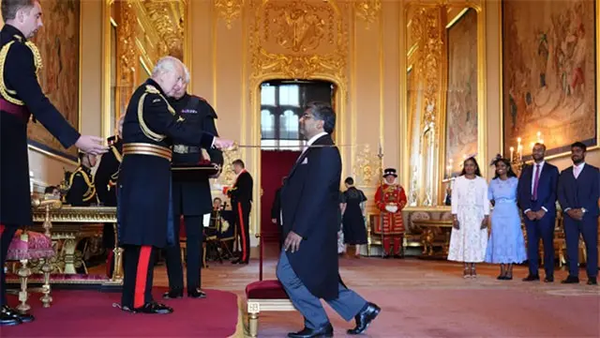
More than four decades after he left a war-shadowed Jaffna on a scholarship, Professor Nishan Canagarajah knelt before King Charles III at Windsor Castle on Tuesday and rose a knight.
During the investiture ceremony in Berkshire, the British monarch touched the shoulders of the kneeling academic with a sword to formally confer the honour of Knight Bachelor. Sir Nishan, Vice-Chancellor of the University of Leicester, was named in the 2026 King's New Year Honors for his "inestimable contribution to higher education," with particular recognition for his work championing diversity and inclusion.
He was accompanied at the ceremony by his wife, Thabitha, and their children Aarabi, Sujan, and Dheeran.
"I am deeply honoured and grateful to receive this award from King Charles," Sir Nishan said afterward. "As a boy from the once war-torn land of Sri Lanka, to being recognised by royalty is quite a remarkable journey. It is because of the transformative power of education and the opportunities it presents that this has been possible."
That journey began far from the ceremonial grandeur of Windsor. Growing up in Jaffna, Sir Nishan lived in rented homes his family moved between every few years. Both his parents were teachers, but money was scarce. In an interview with Jaffna Monitor, his first since the knighthood was announced, he recalled a childhood shaped by want.
"Even something as simple as playing football could become a challenge — I did not always have the money to buy boots and often had to borrow them from other players," he said. "There were times when we went to school without food, simply because finances were stretched."
The hardest years, he said, fell between the ages of 12 and 15. His father died when Sir Nishan was 15; the schoolboy spent three nights at his father's bedside in Jaffna Hospital before he passed away on the third. Only later did the family learn how many debts had accumulated over the years.
He came of age as Jaffna burned — from the destruction of its public library to the violence of 1983 — and watched classmates and seniors choose the path of armed struggle. Many did not return.
"Many of my friends joined the armed groups, and tragically, many of them lost their lives," he said. "On the one hand, you saw friends and people around you taking up arms, and I often asked myself whether I was being selfish by not doing the same." He chose education instead, a decision he described as a "constant moral dilemma" for which, even now, he does not claim a clear answer.
The turning point came after his A-Levels, when his school principal nominated him for a scholarship established to support students from the North in the aftermath of the 1983 riots. Selected after an interview with a panel of professors from Colombo, he took up a place at Christ's College, Cambridge — the first in his school batch to graduate from any university.
From that opening, Sir Nishan built a career in engineering research and university leadership across Bristol, Birmingham, and, since 2019, Leicester. His central conviction, he said, was forged in Jaffna.
"The real problem we face globally is not a lack of talent, but a lack of opportunity," he said. "It does not matter whether you are a migrant or a native — if you are given the opportunity, you can achieve remarkable things."
His rise carries particular weight in British higher education. Sir Nishan is the first minority ethnic vice-chancellor at Leicester — a university in what is often described as the United Kingdom's first majority-minority city. Under his leadership, the institution has become one of the country's most diverse, with roughly 69 percent of its students drawn from minority ethnic backgrounds and 38 percent from highly disadvantaged areas.
He has directed much of his energy toward opening doors he once needed opened for himself, from literacy programmes for Afghan refugee women in Leicester to research partnerships in Sri Lanka. In 2023, he opened a Centre for Digital Epidemiology at the University of Jaffna, now linked with universities in Britain.
Asked what single lesson he would offer a young person in Jaffna studying for O-Levels or A-Levels, Sir Nishan did not hesitate.
"Grasp every opportunity, because you never know where it might take you," he said. "Don't be afraid. You never know what you can achieve."
When the honour was announced, he marked it not with dignitaries but with about forty friends — many of them Sri Lankans he had gone to school with in Jaffna.