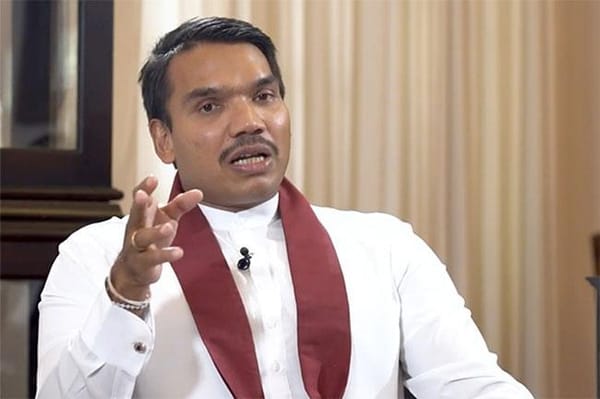
COLOMBO — Sri Lankan investigators have obtained legal authority to detain Suresh Sallay, the former Director of the State Intelligence Service, for up to 90 days under the Prevention of Terrorism Act (PTA), marking the most high-profile arrest in the nearly seven-year investigation into the 2019 Easter Sunday bombings.
Sallay, a retired Major General, was en route to his office at the Pathfinder Foundation in Colombo when officers from the Criminal Investigation Department intercepted and arrested him, according to officials familiar with the operation, as part of ongoing efforts to determine whether intelligence failures — or actions by former intelligence officials — contributed to the coordinated suicide attacks that killed 279 people and injured hundreds at churches and luxury hotels across the country.
A career spanning both of the country’s intelligence services
Sallay, who comes from Sri Lanka’s Malay Muslim community, is widely regarded as one of the most influential and shrewd intelligence figures of his generation, and notably the only officer known to have led both the State Intelligence Service and the Directorate of Military Intelligence.
His leadership roles placed him at the center of national security operations during and after the civil war, as well as during the politically turbulent years that followed the Easter attacks. During the final phases of the war, military officials credited intelligence operations under his leadership with helping identify and target key LTTE positions and senior figures, including S. P. Thamilselvan, the head of the LTTE’s political wing, who was killed in a 2007 airstrike.
A national trauma still without closure
The Easter Sunday attacks of April 21, 2019 — carried out by Islamist extremist suicide bombers linked to a local network inspired by the Islamic State — shattered Sri Lanka’s sense of postwar stability and dealt a severe blow to its tourism-dependent economy.
Subsequent investigations, including presidential commissions and parliamentary inquiries, found that multiple intelligence warnings from foreign and domestic sources — including detailed alerts from Indian intelligence — had been received in the weeks before the attacks but were not acted upon in time.
Nearly seven years later, one of the central unanswered questions remains why such specific warnings did not translate into preventive action.
The Channel 4 allegations and the Azad Maulana testimony
The evidentiary thread that appears to have contributed to Sallay’s arrest traces in part to a 2023 documentary by Channel 4, in which Azad Maulana — described as a former spokesperson linked to the Tamil Makkal Viduthalai Pulikal (TMVP) and its leader, former minister Sivanesathurai Chandrakanthan, widely known as Pillayan — alleged that Sallay had met members of the National Thowheed Jamaath (NTJ), the Islamist extremist network responsible for the Easter Sunday attacks, prior to April 2019.
Maulana claimed he had facilitated a meeting between Sallay and individuals connected to the group, and alleged that the attacks were intended to create a climate of insecurity that would politically benefit former President Gotabaya Rajapaksa.
Sallay has categorically denied the allegations. He has stated that he was serving in Malaysia in an official diplomatic capacity during the period in question and had visited Colombo only briefly for official duties. He has also filed defamation actions against individuals and entities who repeated the claims publicly.
Chandrakanthan, or Pillayan, has himself been held in detention under the Prevention of Terrorism Act since April 2025 and is understood to be under active interrogation in connection with the Easter Sunday investigations. Authorities have not confirmed whether testimony linked to Pillayan’s network formed part of the evidentiary basis for Sallay’s arrest, stating only that the detention was carried out on what investigators described as “adequate evidence.”
The Channel 4 documentary and Maulana’s testimony have generated intense debate in Sri Lanka, with some political figures and analysts questioning the credibility and motivations of witnesses, while others have called for an independent and transparent legal process to determine the reliability of the claims. No court has yet established criminal liability against Sallay in connection with those allegations.
Detention under the Prevention of Terrorism Act
Authorities have invoked the Prevention of Terrorism Act (PTA) to detain Sallay, a law that allows extended detention without immediate indictment in national security cases. The move carries an institutional irony: a statute used for years across Sri Lanka’s security state — including during periods when Sallay led the Directorate of Military Intelligence and later the State Intelligence Service — is now being used against him.
His arrest has also drawn criticism from several political figures and commentators, including some who have historically defended the PTA as an essential instrument of national security.
Support from victims’ families and religious leaders
Sri Lanka’s Catholic Church, which lost more than 160 worshippers in the attacks, has repeatedly called for an independent and credible investigation into the events and the institutional failures surrounding them. Following Sallay’s arrest, Church leaders said investigators must be allowed to carry out their work without interference or political pressure.
Victims’ families and advocacy groups have welcomed the detention as a sign that investigators may now be examining responsibility at higher levels.
A crucial distinction in the allegations against Sallay
A key fact shaping the legal and political significance of Suresh Sallay’s arrest is what he is — and is not — accused of. On April 21, 2019, the day of the Easter Sunday bombings, Sallay was not serving in Sri Lanka’s intelligence leadership and was not part of the country’s active security chain of command. He has said he was in India at the time, attending a year-long course at the National Defence College in New Delhi, a claim that could be independently verified through official records.
His earlier career had already taken him outside Sri Lanka’s core intelligence structure. After serving as Director of Military Intelligence until 2016, he was reassigned as Minister Counsellor at the Sri Lankan High Commission in Malaysia, a diplomatic posting he held until 2018. He was appointed Director of the State Intelligence Service only in December 2019, months after the attacks and shortly after Gotabaya Rajapaksa assumed the presidency.
For that reason, investigators are not examining Sallay’s role in the intelligence lapses or institutional failures widely documented in the immediate lead-up to the bombings. Instead, the allegations — which Sallay has denied — relate to whether he may have had any prior contact with, or indirect involvement in, networks linked to the perpetrators, outside formal state structures.
Six days after the Easter Sunday bombings, Gotabaya Rajapaksa declared his presidential candidacy. He later won the November 2019 election on a national security platform and appointed Sallay to head the State Intelligence Service within weeks of assuming office. That sequence — the attacks, the candidacy, the election, and the appointment — forms the factual basis cited by those advancing the conspiracy theory, although no court has established wrongdoing so far.
Political reactions and caution over due process
The arrest has drawn caution and criticism from several political figures and former officials, reflecting broader divisions over how the investigation should proceed. Ali Sabry, a former foreign and justice minister, described the detention as a troubling development for the intelligence and military establishment, warning that officers who had once “placed their lives on the line to protect the nation” now appeared to be drawn into what he characterised as a political battlefield shaped by competing narratives. While acknowledging that accountability was essential, he said it must be pursued “through law, evidence, and responsible leadership, not through theatrics designed to mislead or divide,” and cautioned that undermining national security institutions could weaken morale within the armed forces.
Sinhala nationalist leader Wimal Weerawansa went further, alleging that the broader political objective behind the arrest was to eventually implicate former President Gotabaya Rajapaksa. He argued that intelligence work, by its very nature, often requires contact with extremist or militant networks, and said such engagement should not automatically be construed as wrongdoing. As an example, he pointed to the killing of then LTTE political head S. P. Thamilselvan in a precise airstrike in 2007, widely believed to have been enabled by intelligence linked to Suresh Sallay. He stated that obtaining actionable intelligence on senior LTTE figures would necessarily have required infiltration or communication channels within militant circles. He then asked: if Sallay had been in contact with an LTTE member in order to locate and eliminate Thamilselvan, would that make him an LTTE member—or a supporter of the Tigers?
An uncertain legal path ahead
Sallay has not been formally charged. Under the Prevention of Terrorism Act, investigators may question him during the detention period, after which authorities must either file charges supported by evidence or release him.
Legal analysts say the case could become one of the most consequential accountability tests in recent Sri Lankan history, with implications for the credibility of both the security establishment and the justice system. Some legal experts and civil liberties advocates say the development also highlights the sweeping powers granted under the Prevention of Terrorism Act — a law long criticised by human rights groups as draconian — and serves as a reminder that the same legal framework once defended as essential to national security can also be applied to former senior officials and others who operated within, or supported, that system.
In parallel, informed sources who spoke to Jaffna Monitor said that determining who ultimately orchestrated the Easter Sunday attacks remains the responsibility of state investigative agencies. They said the existence of organised, well-funded extremist radicalisation linked to the attacks is no longer in dispute, having been documented in official investigations and court proceedings involving the perpetrators and their associates. At the same time, analysts emphasised that such radicalisation was confined to specific individuals, networks, and environments, and should not be used to stigmatise the wider Muslim community.
How the Sri Lankan state confronts the reality of extremist threats while upholding due process, civil liberties, and public confidence in its institutions may prove to be one of the defining challenges in the period ahead.