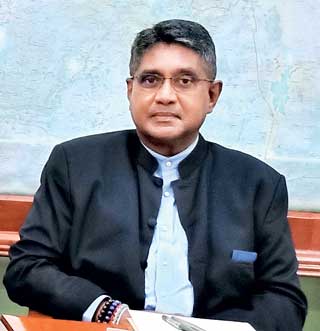

COLOMBO, Sri Lanka- Former Foreign Minister G. L. Peiris delivered a blistering indictment of the Sri Lankan government Wednesday, accusing it of abandoning the nation's economic interests and diplomatic standing in the wake of the torpedoing of the Iranian warship IRIS Dena, declaring that the country now "has no foreign policy whatsoever."
Speaking at a joint opposition media briefing on Wednesday, Mr. Peiris described the sinking of the IRIS Dena as an unprecedented event since World War II, emphasizing its occurrence just 19 nautical miles off the island's southern coast. The attack, which resulted in the loss of at least 106 lives according to Mr. Peiris, has drawn Sri Lanka into the periphery of a widening geopolitical crisis involving the United States, Israel, and Iran.
"The situation we are facing today with regard to the Middle East crisis is a unique one," Mr. Peiris said. "There are incidents which have taken place which are without parallel at any time since the conclusion of World War II. Not since 1948 has a warship — indeed any other ship — been attacked and sunk within the exclusive economic zone of any country. It has not happened ever since the end of World War II. But it has now happened, and it has happened within Sri Lanka's exclusive economic zone — not only exclusive economic zone, but it has actually happened within Sri Lanka's continental shelf."
The IRIS Dena, an Iranian frigate, was torpedoed on March 4 by a U.S. submarine in international waters but within Sri Lanka's 200-nautical-mile exclusive economic zone (EEZ), where Sri Lanka holds rights to marine resources but not full sovereignty over navigation. The vessel had been returning from India's International Fleet Review in Visakhapatnam, a multinational naval exercise that included participants from over 40 countries, including the U.S. and Iran. U.S. Defense Secretary Pete Hegseth described the strike as a "quiet death," marking the first time a U.S. submarine has sunk an enemy surface vessel since 1945.
Sri Lankan authorities mounted a rescue operation, recovering bodies and saving 32 survivors, who were treated at hospitals in Galle. A second Iranian vessel, the IRIS Bushehr, later entered Sri Lankan waters and was taken into custody, with its 208 crew members offloaded amid U.S. pressure not to repatriate them to Iran. Foreign Minister Vijitha Herath emphasized that Sri Lanka's actions were guided by the United Nations Convention on the Law of the Sea (UNCLOS) and humanitarian obligations, without aligning with any belligerent party.
Mr. Peiris, however, dismissed these efforts as mere compliance with international law rather than proactive leadership. “Sri Lanka has engaged in certain humanitarian operations, but that is a mandatory obligation under international law,” he said. “It is not an act of great kindness or magnanimity. It is something to which the government of Sri Lanka is bound under international humanitarian law. They have therefore done neither more nor less than fulfill their mandatory obligations.”
He lambasted the government's silence on the broader implications, questioning whether the attack aligned with the "rules-based international system" that Sri Lanka has long supported. "Sri Lanka has not said one word whether this is justifiable, whether it is in accordance with the rules-based international system which we had all taken for granted up to now," Mr. Peiris asserted. "Is this incident compatible with those basic norms? Can this be defended or justified in any way? These are matters in respect of which there has not been any clear stance adopted by the government of Sri Lanka."
The former foreign minister, a veteran diplomat and constitutional scholar, highlighted the economic fallout for Sri Lanka, a nation still recovering from a 2022 financial crisis that led to widespread shortages and protests. The incident, he warned, threatens the island's vital shipping lanes and export economy. "Even if you leave aside for the moment the ethics of the situation, this has an immediate and crucial bearing on the economic life of our people," Mr. Peiris said. "The economy of this country, which is fragile enough already, this incident has a horrendous impact on Sri Lanka's lifeline, its exports."
He pointed to potential disruptions at the Port of Colombo, one of Asia's busiest transshipment hubs, where ships might reroute to avoid perceived risks. Insurance premiums could skyrocket, eroding the competitiveness of key exports like tea — of which Iran is a major buyer — and apparel. "There's every danger of ships bypassing the Port of Colombo because of the violence and the turbulence so close to our country," he said. "What about insurance premiums? Insurance companies are going to significantly enhance their premiums. This will not only impact on tea... but this has a far-reaching impact on the total range of the country's exports, including apparel. Our exports will cease to be competitive because of the exorbitant insurance premiums that we will be called upon to pay."
Mr. Peiris urged the government to activate the Colombo Security Conclave, a regional forum comprising Sri Lanka, India, Maldives, Mauritius, and Bangladesh, aimed at ensuring maritime peace in the Indian Ocean. "Sri Lanka has at its disposal an institution which is ideally equipped to safeguard and protect the vital economic interests of this country," he said. "The purpose of this organization is to ensure peace, serenity, and tranquility around our seas... Sri Lanka must get active. It cannot remain noncommittal, disengaged, and evasive."
The conclave, established in 2020, focuses on countering nontraditional threats like piracy and climate change, but Mr. Peiris argued it could mitigate spillover from "big power rivalry" in the western Indian Ocean into the Bay of Bengal. He attributed the government's inaction to a "lack of political will and resolve," calling it a "calamity" and a "disaster" for the nation's prosperity.
In a poignant contrast, Mr. Peiris invoked Sri Lanka’s storied diplomatic history under earlier leaders. He recalled the role of Prime Minister Sirimavo Bandaranaike in mediating the 1962 border dispute between India and China, noting that his father, Glanville Peiris, then director general of external affairs, personally delivered messages from Colombo to Jawaharlal Nehru and Chinese leaders.
He also cited the 1951 speech in San Francisco by J. R. Jayewardene — then finance minister of Ceylon — who urged the victorious powers not to seek vengeance against Japan and supported renouncing reparations, a gesture of magnanimity that Peiris said is still remembered in Tokyo.
Mr. Peiris further pointed to the role of President Ranasinghe Premadasa in establishing World Habitat Day and to President Ranil Wickremesinghe’s address to the United Nations General Assembly in 2023, outlining Sri Lanka’s recovery from economic crisis.
"These are a pathetic contrast to the present position of evasion, silence, and a refusal to accept responsibility," Mr. Peiris said. "The question is not about whether Sri Lanka's foreign policy is good or bad... Buffeted by wind and wave without any conscious attempt to formulate a foreign policy, the sad truth is Sri Lanka now has no foreign policy whatsoever."
The government has not immediately responded to Mr. Peiris's remarks.
The sinking has amplified concerns over the Middle East war's global reach, with the U.S. action drawing condemnation from Iran and raising questions about freedom of navigation in the Indian Ocean. Environmental experts warn of potential marine pollution from the wreckage, prompting Sri Lanka to monitor its waters closely.