

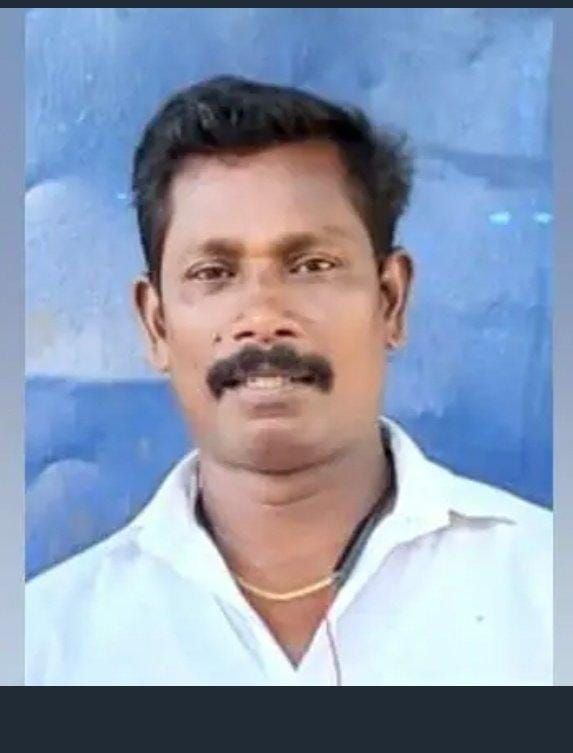
CHENNAI, India — A Sri Lankan Tamil refugee who served as chairman of a rehabilitation camp management committee in India’s southern state of Tamil Nadu was hacked to death recently in an attack police say may have stemmed from internal disputes within the camp.
The victim, Sivakumar, also known as Kanna, 42, was originally from Murungan in Mannar district in northern Sri Lanka. Police said he was attacked by a group of assailants while walking near the Sri Lankan Tamils Rehabilitation Camp in Pethikuppam, close to Gummidipoondi in Tiruvallur district.
The attackers used sharp weapons, inflicting multiple deep cut injuries. Sivakumar was rushed to the Gummidipoondi Government Hospital, where doctors declared him dead shortly after arrival.
The killing quickly triggered unrest inside the camp, which houses about 2,770 residents from 937 families. More than 300 residents gathered outside the hospital in protest, and supporters of the victim reportedly damaged property belonging to the families of suspected attackers. Protesters also briefly blocked the Grand Northern Trunk (GNT) Road, causing temporary traffic disruptions.
Police from the Gummidipoondi SIPCOT Police Station said they had arrested six suspects, including two women, in connection with the killing. Investigators said the suspects belong to the same family and that the attack may have been motivated by prior disputes within the camp, possibly linked to grievances over the distribution of resources or other internal issues.
The body was transferred to Ponneri Government Hospital for a post-mortem examination. Authorities have since strengthened police security in and around the camp while investigations continue.
Refugee Community in Tamil Nadu
Tamil Nadu hosts tens of thousands of Sri Lankan Tamil refugees, most of whom fled the island’s decades-long civil war, which ended in 2009.
According to official figures from the Tamil Nadu government’s Department for the Welfare of Non-Resident Tamils, about 57,000 to 58,000 refugees from roughly 19,500 families live in more than 100 rehabilitation camps across 29 districts in the state as of 2025–2026.
Broader estimates, including figures cited by Chief Minister M. K. Stalin in February 2026, place the total number of Sri Lankan Tamils living in Tamil Nadu — including those outside the camps — at around 89,000. Nearly 40 percent were born in India, and many families have lived in the state for more than three decades.
Most camps are located in rural or semi-urban areas and provide basic shelter along with monthly cash allowances, subsidized rations, limited healthcare services, and access to education for children. The typical cash allowance ranges from about 1,000 to 1,500 rupees for the head of a household, with smaller payments for spouses and children.
Despite these provisions, living conditions in many camps remain difficult. Residents and humanitarian groups frequently cite overcrowding, inadequate sanitation, unreliable access to clean water, and poor housing, often consisting of small concrete rooms or simple thatched structures shared by multiple families.
India classifies the refugees legally as “foreigners,” a designation that restricts formal employment opportunities. As a result, many residents rely on informal, low-paid work when they are permitted to leave the camp premises.
While most camps have remained relatively stable over the years, officials and observers say long-standing pressures — including resource shortages, disputes over housing or ration allocations, and disagreements over camp administration — have occasionally fueled tensions among residents, sometimes resulting in protests or internal conflicts.
A Generation Growing Up in Exile
More than fifteen years after the end of Sri Lanka’s civil war in 2009, thousands of Sri Lankan Tamil refugees in Tamil Nadu still do not know what their future will look like.
In many camps, a new generation has grown up far from the war that brought their parents here. Nearly 40 percent of the roughly 89,000 Sri Lankan Tamils estimated to be living in the state today were born in India, according to state officials. Many have never set foot in Sri Lanka.
They attended local schools, speak Tamil in the accents of Tamil Nadu, and have built their friendships and working lives in the towns and villages around the camps where their families settled decades ago. For many of them, Sri Lanka is less a place they know than a story passed down at home.
Community leaders say that most refugees would prefer to stay in India if they were given a secure legal status. Younger residents, in particular, often see returning to Sri Lanka as a step into the unknown — a place where they have few connections and uncertain prospects.
Perumal, a 28-year-old resident of a camp in northern Tamil Nadu who was born in India and now works informally in a nearby town, said the idea of returning feels distant.
“I’ve never known any other country,” he said. “My school was here. My friends are here. Even the work I do now is here. Sri Lanka is something my parents talk about, but for me it’s not a place I’ve lived. If we go back, we would have to start again from nothing.”
In another camp, Sumathi, a mother in her forties whose children were all born and educated in India, said many families feel caught between two countries.
“My daughter married a local Tamil boy here,” she said. “We don’t have land or close relatives left in Sri Lanka. For the young people especially, this is the place they know as home. Living like this — without clear status — makes everything uncertain.”
Tamil Nadu’s political leaders have repeatedly urged the central government in New Delhi to address the issue. In February 2026, Chief Minister M. K. Stalin wrote to Prime Minister Narendra Modi, asking the government to consider citizenship pathways, long-term visas or other legal protections for refugees who have lived in the state for decades, particularly those registered before 2015.
So far, progress has been slow. Only a small number of Sri Lankan Tamil refugees have obtained Indian citizenship, often through individual legal cases.
For most families, life continues in a kind of waiting — not fully part of Indian society, yet uncertain about returning to Sri Lanka. What began as temporary refuge during wartime has, over the years, turned into something closer to a permanent life in between.
Police officials said further details about the motive behind the recent killing at the Gummidipoondi camp are expected to emerge as the investigation continues.