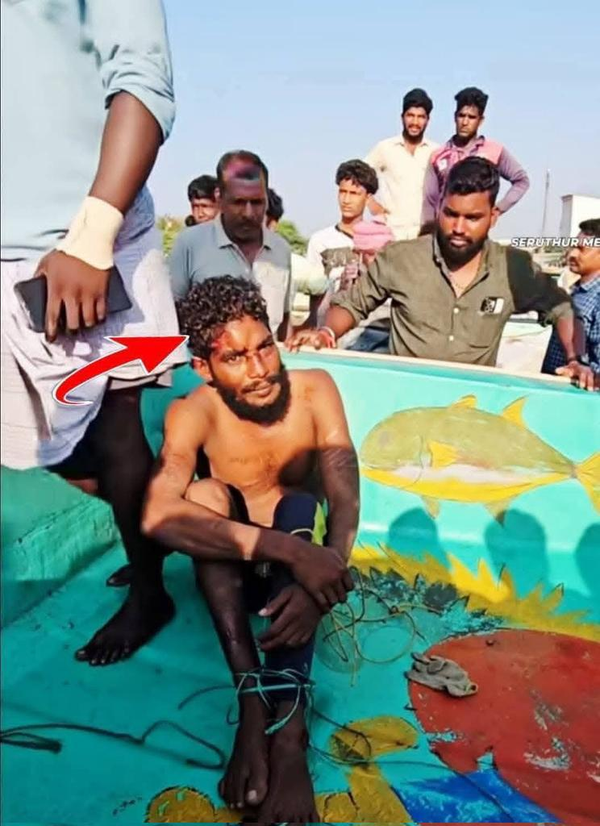
JAFFNA, Sri Lanka — A Tamil fisherman from Jaffna was severely beaten after being detained at sea by a group of Indian fishermen, according to Sri Lankan fishing associations, Indian police accounts and widely circulated video footage, in an episode that has once again exposed the volatile maritime tensions of the Palk Strait.
The fisherman, a 29-year-old man from Vallai in Sri Lanka’s Jaffna District, is being treated at Nagapattinam Government Medical College Hospital in Tamil Nadu, where doctors said he required 15 stitches for injuries to his head, nose, limbs and ankles. Indian authorities confirmed the incident but did not publicly release his identity.
Police in Vedaranyam, India, said the confrontation occurred late Sunday off the Nagapattinam coast after Indian fishermen alleged that two Sri Lankan men had boarded their vessel. Members of the Indian crew reportedly described the Sri Lankan fisherman as a “pirate,” a characterization strongly disputed by Sri Lankan fishing organizations and community leaders.
Representatives of Tamil fishing cooperatives in Sri Lanka’s Northern Province said there was no credible evidence of organized piracy in the Palk Strait and argued that such accusations obscure the deeper conflict over illegal bottom trawling by Indian vessels in Sri Lankan waters. They said northern Sri Lankan fishermen have for years been forced into defensive measures to protect their nets, fishing grounds and livelihoods from repeated incursions.
“I am 60 years old, and I have been fishing since childhood,” said Francis Ithayaraja, president of the Annai Velankanni fishing village in Mayiliddy, in an interview with Jaffna Monitor. “In all my years at sea, I have never heard of Sri Lankan Tamil fishermen being described as pirates.”
Mr. Ithayaraja said Sri Lankan fishermen may occasionally drift beyond the maritime boundary only because of neerpaadu — traditional ocean current patterns — or mechanical failures. He accused Indian fishermen of routinely crossing into Sri Lankan waters to engage in bottom trawling, a destructive fishing practice banned in Sri Lanka because of its severe ecological impact.
“But Indian fishermen regularly cross into our waters,” he said. “As Sri Lankan Tamil fishermen, we do not have the heart to damage another man’s net or engine, let alone act like pirates. This narrative is being manufactured by sections of Indian fishermen to falsely portray us as sea pirates, so that their own unethical activities in our waters can be concealed.”
Bottom trawling has long been one of the central grievances of northern Sri Lankan fishing communities, many of whom are small-scale fishermen still rebuilding after the country’s decades-long civil war. Local associations say repeated incursions by Tamil Nadu trawlers damage coral ecosystems, destroy breeding grounds and rip apart fishing gear, making the issue not merely a border dispute but a matter of economic survival.
A senior source within the northern fishing community, speaking to Jaffna Monitor on condition of anonymity, acknowledged that isolated incidents involving Sri Lankan fishermen may occasionally occur, including the theft of catch from Indian vessels. However, he stressed that such acts were not representative of the broader Sri Lankan Tamil fishing population and should not be conflated with organized criminality or piracy. Multiple local sources also maintained that the latest assault took place within Sri Lankan waters, renewing concerns over maritime boundary violations and the continued presence of Indian fishing vessels in contested areas.
The assault has triggered widespread anger in northern Sri Lanka. Notably, while many Tamil nationalist politicians remained publicly silent, Namal Rajapaksa, an opposition lawmaker and member of Parliament, sharply condemned the violence and called for stronger state intervention. He described the incident as deeply alarming and urged the government to ensure the fisherman’s safety and secure his return, while criticizing Tamil Nadu politicians for frequently invoking solidarity with Sri Lankan Tamils on political rights issues while remaining silent when Sri Lankan Tamil fishermen face violence on Tamil Nadu’s shores.
Neither the Indian nor Sri Lankan governments immediately issued substantive responses. Previous diplomatic efforts and bilateral working groups have repeatedly failed to produce a durable solution to the long-running fisheries conflict.