
By: Jeevan Thiagarajah
A Travesty of Justice in the Northern Province
In the annals of public service recruitment, few stories are as harrowing or as indicative of systemic failure as the plight of the Health Services Volunteers in the Northern Province. This is a saga marked by a cruel travesty of justice, where the hopes of the most vulnerable were raised and dashed by the very system designed to protect them.
The most damning aspect of this tragedy is that letters of appointment to government service were indeed issued. For every recipient, this document represented the culmination of an arduous interview process and years of dedication. Yet these letters were rendered effectively meaningless. In a shocking turn of events, records of these appointments were destroyed in certain files, and some public servants — including those present at a meeting with the Secretary to the President — were reluctant to divulge the truth, leaving the appointees in a legal and administrative limbo. One of them, I believe, died by suicide.
For over six months, the women health workers staged a silent protest on the roadside outside the Governor's Secretariat, enduring the elements and the indifference of the state. They were ignored by the powers that were. It fell to the Governor, who assumed office in October 2021, to resurrect this dying matter. He found a situation mired in obfuscation; he reconstituted the missing papers and sought to deliver justice.
The Governor met with the protestors and took up their cause. When the NPP government assumed office, a delegation of health volunteers visited the Health Minister’s office, and Governor confirmed the facts presented. He followed up with a petition to the Human Rights Commission to underscore the severity of the denial of their rights.
To understand the depth of this injustice, one must look at the timeline of events that led these workers to the streets.
Background & Context
Post-Conflict Era: Following the end of the conflict, the Northern Province experienced a severe shortage of Public Health Midwives and Health Service Assistants (Junior).
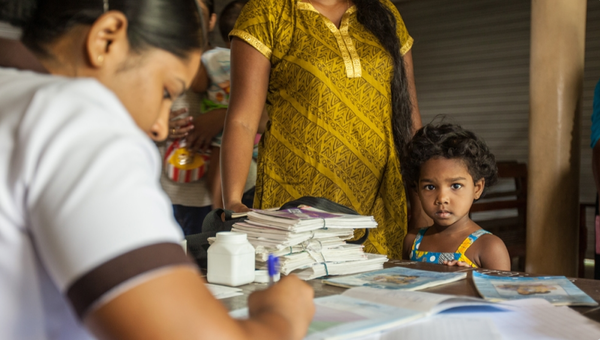
Volunteer Engagement: To bridge this gap, Medical Officers of Health (MOHs) and hospitals engaged volunteers. These volunteers delivered both preventive and curative healthcare services, assisting midwives and performing minor staff duties.
Chronological Sequence of Events
2014: The Ministry of Public Administration issued Circular No. 25/2014. The volunteers could not apply for permanency under this circular because it was reserved for substitute, casual, and contract workers, whereas these volunteers fell outside those categories despite fulfilling the 180-day service requirement.
2015: The first known correspondence regarding the recruitment of Health Service Assistants (Junior) Grade III was recorded.
June 2017: Consequent to a request made by these volunteers, when the former President Maithiripala Sirisena visited Jaffna, the matter was brought to the highest level of attention.
July 26, 2017: A meeting chaired by former Secretary to the President, Mr. Austin Fernando, was called for at the Presidential Secretariat. At that meeting, the Northern Provincial Council (NPC) was represented by Mr. A. Pathinathan (Chief Secretary), Mr. L. Llangovan (Secretary to the Governor), Mr. C. A. Mohanras (Secretary to the Public Service Commission), and Mr. S. Thiruvaharan (Secretary, Ministry of Health & Indigenous Medicine, Social Services & Rehabilitation, Probation & Child care Services & Women's Affairs). In that meeting, the NPC team submitted a name list of 820 persons as Volunteer Health Workers who had been working on a volunteer basis for a long period. However, there was no fruitful outcome of this meeting.
2018: A total of 454 vacancies for Health Service Assistants were identified in the Northern Province.
March 28, 2019: The Department of Management Services approved the recruitment of 454 Health Service Assistants.
September 12, 2019: Just two months before the Presidential election, the former Governor of NPC, Dr. Suren Raghavan, gave a list containing 1,923 persons as Volunteer Health Workers and requested the NPC Secretary of the Ministry of Health to interview them.
Late 2019:
Out of the 1,923 listed, only 1,631 turned out for interviews.
The 389 Volunteer Health Workers referred to in the letter under reference are those selected out of the list submitted by the former Governor.
November 25, 2019:
The Secretary of the Provincial Ministry of Health issued appointment letters to selected candidates (Section 3 refers to 454 candidates selected for these letters).
These appointees were directed to assume duties on this date.
Post-November 2019: The issued appointments were withheld immediately after the declaration of the Presidential Election.
December 20, 2019: The Secretary to the Treasury (Ministry of Finance) issued a letter halting the recruitment process.
October 26, 2020: Management Services Circular No. 02/2020 was issued, mandating that all recruitment for PL category positions be conducted through the Department of Multi-purpose Development Task Force.
March 2021: Governor Charles sought the intervention of the President to remedy the matter. In her plea, she stated: "Under the circumstances, since they were already issued with appointment letters but not allowed to assume duties due to the subsequent Government policy may I suggest Your Excellency that the issue may be treated as a special case on humanitarian grounds and allow the provincial authorities to fill the 454 vacancies by deviating from provisions laid down in Management Services Circular No. 02/2020 with selectees referred above please."
April 29, 2021: A letter (Ref: PS/GPA/05/DG) was sent by Chandima Wickramasinghe, Additional Secretary for the Secretary to the President, to Major General (Rtd.) Nanda Mallawarachchi, Director General of the Department of Multipurpose Task Force, regarding the recruitment of the 389 selected candidates.
A Way Forward: Training and Certification
With the past marred by political interference and administrative failures, a pragmatic solution has emerged to resolve this humanitarian crisis. The proposal is to ask those who were selected if they are willing to be trained and certified under a specialized Program for Care Workers. This initiative aims to transform the tragedy into an opportunity for professional development.
Key Facets of the Proposed Training Program:
Objective: To train in the Northern Province in caregiving at minimum or no cost.
Learning Outcomes: Trainees will gain knowledge in the concept of health, preventive healthcare, mental health services, and curative healthcare services.
Target: The program aims to initiate NVQ Level 3 caregiver training courses at six centers in the Northern Province, following the NAITA curriculum.
Capacity: At least 40 candidates trained at each center.
Locations:
DGH Kilinochchi
DGH Mullaitivu
DGH Vavuniya
DGH Mannar
BH Tellipalai
BH Pointpedro
Curriculum Overview (120 Hours Total): The training is comprehensive, covering essential skills such as:
English Language Skills(OPTIONAL) : Basic speaking and writing (8 hours).
Health Concepts: Introduction to health and healthcare spectrum (8 hours).
Health System: Sri Lankan health system and clinical governance (6 hours).
Communication: Developing effective skills and positive attitudes (12 hours).
Specialized Care: Caring for terminally ill, immobile, and mental health patients (20 hours).
Elderly & Special Needs: Care for the elderly and special needs patients (20 hours).
Hospital Care: Caring for acute and chronic patients (20 hours).
Logistics & Safety: Safe transportation of patients (10 hours).
Nutrition: Food and nutrition for mothers and ill patients (10 hours).
Infection Prevention: Waste management and hygiene concepts (6 hours).
Implementation and Stakeholder Coordination
To ensure this solution is viable and executed with the urgency it demands, a coordinated administrative effort is essential. DCS Training, PD Health, RDHS of respective areas, the Department of Social Services, and the Commissioner Cooperatives directed by the Governor needs to be actively involved in the implementation process.
The cost of bursaries should be supported by donor funding to alleviate the financial burden on the trainees. Once certified, the graduates should be organized into Care Worker Cooperatives linked with Local Government Hospitals in the area. They could also run care homes. This model ensures they receive an income and that standards of care are maintained. While this solution provides a path to dignity and employment, it must be noted that what these workers still lack—and justly deserve—is a government pension. This initiative is a critical step toward rectifying a wrong that has lasted far too long.