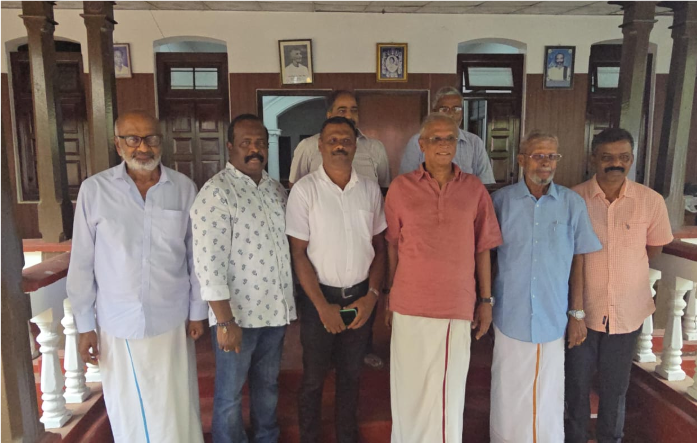
Former allies from the now-defunct Tamil National Alliance (TNA) have resumed discussions on forming a united political front, raising the possibility of a reconstituted alliance ahead of the next electoral contest.
The Ilankai Tamil Arasu Kachchi (ITAK), the TNA's principal constituent, and the Democratic Tamil National Alliance (DTNA)—a coalition of parties that broke away from the TNA—held talks at ITAK's Martin Road office in Jaffna last week to explore coordination on key political issues.
ITAK General Secretary M.A. Sumanthiran told reporters the parties were exploring ways to coordinate their political efforts. "We intend to work jointly on matters such as the Provincial Council elections and the broader political solution," he said.
Provincial Council Elections: the Immediate Priority
DTNA senior leader Suresh Premachandran said exerting pressure on the central government to hold long-delayed Provincial Council elections was the immediate priority.
"Right now, the key objective is to push for the Provincial Council elections. We do not know whether the government will actually hold them. If and when elections are announced, decisions regarding an electoral alliance will be made," Premachandran stated.
He noted that Tamil political parties had reached a general understanding that unity was essential. "There is now a broad consensus that Tamil representatives and Tamil political parties must work together if we are to guide the future of the community along the right path. Only by coming together can we protect the Tamil people's existence and secure political power for them."
Both parties agreed that the suspension of Provincial Council elections for several years had weakened democratic governance in the Northern and Eastern Provinces. "We jointly insisted that elections must be held immediately and that full powers must be devolved, as intended by the Constitution," Premachandran said.
Seeking Common Ground on Political Solution
The discussion also touched on long-standing issues involving a sustainable political settlement for the Tamil people. "We have discussed several matters related to advancing a long-term political solution. We plan to continue these conversations so that all parties can agree on a common framework," Premachandran said.
Premachandran confirmed that the DTNA has already conducted discussions with the Tamil National People's Front (TNPF) led by Gajendrakumar Ponnambalam, while ITAK has also extended an invitation to engage with them. "We are prepared to speak with any party that wishes to work together on securing the rights of the Tamil people."
Complex Political Alignments
The ITAK–dTNA rapprochement comes amid shifting alignments in Tamil politics. The dTNA had earlier reached an understanding with the Tamil National People’s Front (TNPF) following the local government elections—ostensibly to secure control of local councils. However, sources indicate that the dTNA has since largely stepped away from that arrangement.
According to informed sources, dTNA leaders personally informed the TNPF leadership of their intention to engage with ITAK before entering into talks. The TNPF delegation, however, did not disclose at the time that it had already received a written invitation from ITAK.
“Just like the invitation sent to you, we have also invited the Cycle party (TNPF) in writing,” ITAK leaders reportedly told the TNPF delegation during a subsequent meeting—much to their surprise.
Sources close to ITAK said the party is making a concerted effort to draw the TNPF into a broader Tamil political understanding. However, they acknowledged that securing TNPF’s agreement on core issues such as the 13th Amendment would be “almost impossible.”
If an ITAK–dTNA alliance is finalised, sources suggest that Douglas Devananda’s Eelam People’s Democratic Party (EPDP) could also be brought into the arrangement. In several local and municipal councils, the EPDP has already extended support to ITAK in forming administrations.
Reviving the 2020 Document
ITAK and the dTNA are examining whether a document submitted to then-President Gotabaya Rajapaksa in December 2020 can be adopted as their joint political position. Jaffna Monitor learns that dTNA leaders have agreed, in principle, to accept the document as a basis for discussion.
'Unity Is Essential'
Meanwhile, dTNA leader and PLOTE leader Dharmalingam Sitharthan has called on Tamil nationalist parties to unite under a single political umbrella, warning that continued fragmentation would further weaken Tamil political aspirations.
“We want to bring together all Tamil parties committed to Tamil nationalism,” Sitharthan said, noting that discussions were already underway as parties prepared to move into the next phase of political engagement.
He pointed to growing public disillusionment in the aftermath of recent elections, arguing that unity had become an urgent political necessity. “Unity is essential. Tamil nationalist parties have a responsibility to respond to public expectations by coming together,” he said.
The renewed push for engagement comes in the wake of what many in the North described as a significant electoral breakthrough by the Sinhala-majority National People’s Power (NPP) in traditionally Tamil-majority areas.
“Only now do our Tamil parties appear to have realised that unity is the only way forward,” said Ganapathy, a resident of Jaffna.
From LTTE Directive to Fragmentation
The Tamil National Alliance (TNA) was forged in the early 2000s under the direction of the LTTE and projected as a unified Tamil political voice. The alliance was assembled swiftly, with little room for consultation among its constituent parties—in those years, defying LTTE directives was not a luxury Tamil politicians could afford.
So long as strategic direction flowed from the LTTE leadership, the alliance appeared cohesive. Following the LTTE’s military defeat in May 2009, however, the TNA began to fragment, as constituent parties pursued separate political paths.
By the time of the last parliamentary election, the Ilankai Tamil Arasu Kachchi (ITAK) was the only party remaining within the TNA. Contesting as an “alliance of one” would have been farcical; ITAK therefore chose to contest under its own party banner.