NPP’s Garden Lizard Lesson in Northern Politics

NPP’s Garden Lizard Lesson in Northern Politics


Share this post

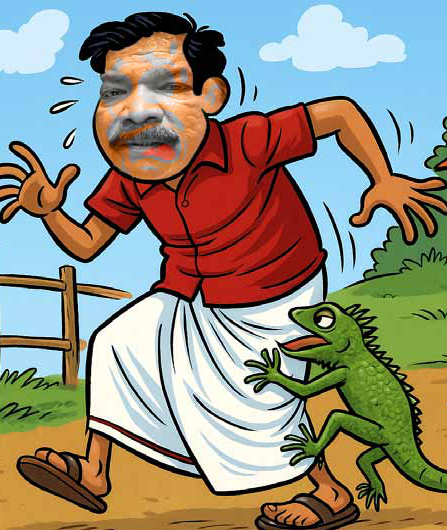
If you're looking for a metaphor to sum up the NPP’s misguided political saga in the North, look no further than the old Tamil saying: "வேலியில் போகும் ஓணானை எடுத்து வேட்டியில் விட்டுட்டு குத்துதே, குடையுதே என்றானாம்" (“They took the garden lizard headed for the fence, tucked it into their veshti, and now complain that it’s biting and scratching.”)

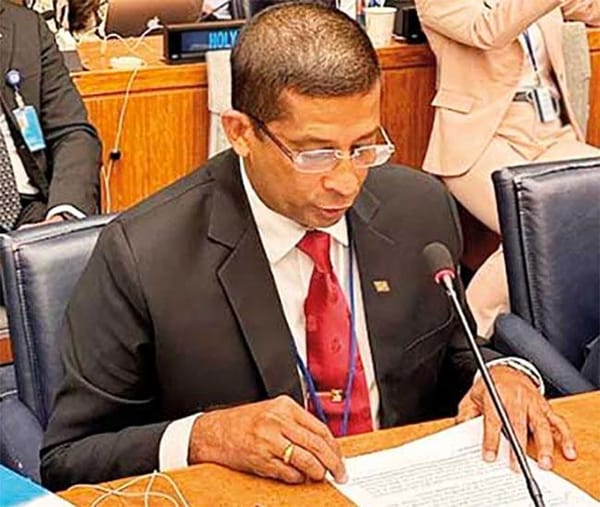
That, in essence, is the story of Naveena Ravanan—real name Pon Suthan—a self-styled firebrand Tamil nationalist who briefly honeymooned with the NPP at a time when the party was hell-bent on fielding anyone with a pulse for the local government elections. He didn’t contest himself, but his sister and a few ready-made loyalists ran under the NPP flag. In recent weeks, Ravanan has returned to the streets of Iyakkachchi, staging dramatic protests against the very party he was recently feasting with.

It’s worth recalling what we wrote in our last editorial: in their desperate bid to secure local seats, the NPP flung open its doors to opportunists, political crooks, and jokers like him. And now, predictably, it’s come back to bite them. After the NPP came to power, Ravanan repositioned himself as their face in Pallai. The once-fiery nationalist—who used to shout slogans of ethnic purity and hail Prabhakaran as Suriya Devan to keep his diaspora funders happy—suddenly began quoting Karl Marx and Friedrich Engels, as if he were born waving the red flag. His once fringe meetings quickly became headline events, attended by no less than Prime Minister Harini Amarasuriya and NPP’s Northern organiser Bimal Rathnayake, who even visited his farm for a meal—an event Ravanan triumphantly flaunted on Facebook.

But the romance soured fast. After the NPP refused to appoint his sister to a representation seat in the local council, Ravanan flipped. He launched a crusade— staging press conferences, leading protests, and now portraying himself as the aggrieved victim. And so, people are asking the obvious question: Why was he welcomed into the NPP in the first place?

One can only hope that the NPP’s Northern leadership has learned a lesson or two from this absurd episode. If not, they’d better keep their veshtis tighter next time.


Share this post

Be the first to know

Join our community and get notified about upcoming stories

Subscribing...
You've been subscribed!
Something went wrong
PSTA: When the Victims Rewrite the Law That Once Destroyed Them

PSTA: When the Victims Rewrite the Law That Once Destroyed Them

There exists a particular species of political betrayal that cuts deeper than ordinary duplicity. It occurs when those who survived state terror become its architects, when victims of arbitrary detention design new systems of indefinite imprisonment, when revolutionaries who once faced torture codify powers enabling it. Sri Lanka stands at precisely such a moment. The National People’s Power government—led by the Janatha Vimukthi Peramuna, a party whose members were “disappeared,” tortured, and


Kaniyan Pungundran

Kaniyan Pungundran

What Sri Lanka and Gaza Teach Us About the Futility of Armed Struggle

What Sri Lanka and Gaza Teach Us About the Futility of Armed Struggle

“I object to violence because when it appears to do good, the good is temporary; the evil it does is permanent”. Mahatma Gandhi Times of war create the illusion that only force can resolve irreconcilable differences. Some social theorists even justify the inevitability of violence in achieving social change on the basis that groups in power rarely relinquish that privilege voluntarily. In this context, the armed conflicts that plagued Sri Lanka for three decades and continue to unfold in Gaza


Prof. Mahesh Nirmalan

Prof. Mahesh Nirmalan

A Peacemaker’s Belated Wisdom

A Peacemaker’s Belated Wisdom

By: M.R. Narayan Swamy Reading this otherwise invaluable book will give the impression that academic-turned-politician G.L. Peiris was a distant observer of Sri Lanka’s peace process (which collapsed) and not the government’s chief negotiator with the Liberation Tigers of Tamil Eelam (LTTE) and a key player in a dialogue that had been expected to end a protracted and bloody conflict. Peiris raises several vital issues that he feels led the peace process to unfortunately unravel, trig


M.R. Narayan Swamy

M.R. Narayan Swamy

The Promise and Limits of AI in Mental Healthcare

The Promise and Limits of AI in Mental Healthcare

Artificial intelligence (AI) today permeates almost every sphere of modern life, from finance and defence to education and healthcare. While its recent explosion has captured global attention, the roots of AI stretch back several decades. The intellectual groundwork was laid in 1950, when British mathematician Alan Turing posed a revolutionary question in his paper “Computing Machinery and Intelligence”: Can machines think? A few years later, in 1955, computer scientist John McCarthy formally co


Dr Ruwan M. Jayathunga

Dr Ruwan M. Jayathunga