

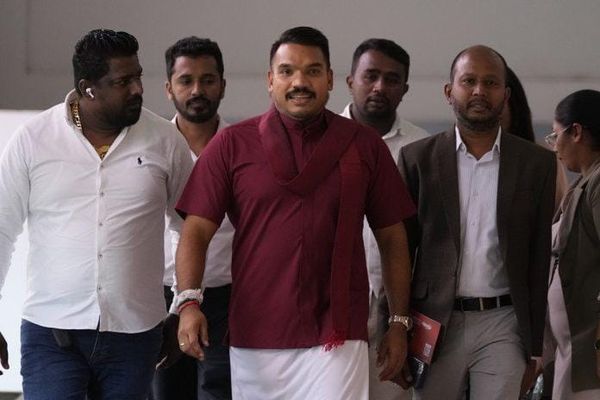
The Cambridge Union has cancelled a scheduled speaking event featuring Namal Rajapaksa following sustained pressure from the Tamil diaspora. The decision, announced after what the Union described as “urgent and serious discussions,” was justified on the grounds that it did not believe “a balanced and open discussion on this subject” was possible at present.
The invitation had sparked coordinated opposition from Tamil student organisations across the United Kingdom, who accused both the Cambridge Union Society and the Oxford Union of platforming a representative of the Rajapaksa political dynasty, which they hold responsible for grave wartime abuses, including the shelling of civilian “No-Fire Zones,” enforced disappearances, and systematic sexual violence.
The pressure succeeded in Cambridge. Rajapaksa remains scheduled to speak at the Oxford Union on February 25.
The immediate outcome may appear to be a victory for activists. Yet a more complicated question lingers beneath the celebration: What, precisely, was gained?
A Platform for Scrutiny — or a Stage to Be Denied?
The Cambridge Union is not a ceremonial venue. It is a debating chamber known for adversarial questioning, where speakers are subjected to challenge rather than celebration. It is also an institution whose proceedings carry global visibility.
Namal Rajapaksa’s appearance would not have been a coronation. It would have been a confrontation.
For Tamil students — many of them descendants of survivors of Sri Lanka’s civil war — the event presented a rare opportunity: to question, in a globally recognised forum, a member of the country’s most controversial political family. Allegations documented by United Nations panels, human rights organisations, and investigative journalists could have been put directly to him, publicly and on record.
That opportunity has now evaporated.
The Precedent
This is not without historical echo. In 2010, Mahinda Rajapaksa was invited to address the Oxford Union. Following threats of large-scale protests by Tamil activists, the event was cancelled.
The former president left without facing public questioning in that forum. The protest movement drew attention to its cause. But the anticipated cross-examination never occurred.
Fifteen years later, a similar scenario is unfolding — this time involving the next generation of the same political family.
The Optics of Cancellation
When a controversial speaker is disinvited, the narrative rarely centres on the substance of the accusations. Instead, attention shifts to the cancellation itself. The speaker is then able to frame the episode as an instance of intolerance or an unwillingness to engage.
A debating society, by design, does not confer endorsement. The Cambridge Union was explicit in stating that its events are not “uncritical platforms.” That distinction matters. A debate chamber offers something protests outside its doors cannot: the possibility of direct questioning before a diverse audience, with a record that endures.
Cancellation closes the room. It does not close the argument.
The Oxford and Cambridge Unions have, in recent years, demonstrated that hosting controversial figures does not mean shielding them. In November 2025, former Israeli Prime Minister Ehud Olmert — who led Israel during Operation Cast Lead in 2008–2009 and has since faced war crimes complaints in Germany, Canada and the United Kingdom — addressed the Oxford Union. His appearance did not proceed without challenge. Inside the chamber, students questioned him directly about the civilian toll of the Gaza offensive. Outside, approximately 60 protesters blocked the entrance, leading to three arrests. The event was covered extensively by Oxford’s student press, including Cherwell and The Oxford Student.
The Union reiterated that platforming a speaker “does not equate to supporting their positions — it allows those positions to be questioned and held to account.” The exchange that unfolded inside the chamber — the questions posed, the answers offered — now forms part of the public record. The protests outside, however forceful, left no comparable record of what was said or how it was defended.
Strategy and Accountability
None of this lessens the weight of Tamil grief or the seriousness of the allegations tied to the final months of Sri Lanka’s civil war. The record of civilian suffering is extensive and well-documented by international bodies, journalists, and human rights organisations.
But the issue before British debating societies is not the morality of that demand. It is the strategy by which it is pursued.
Accountability is not always strengthened by exclusion. Often, it is sharpened by exposure. Public questioning in internationally recognised forums has, in other contexts, shaped reputations, altered political narratives, and forced uncomfortable clarifications into the open. When such platforms are available, their significance lies less in who is invited than in what is asked — and how the answers are recorded.
The Oxford Union now confronts a choice similar to the one Cambridge has made. Activists, too, face a decision. They can seek cancellation or enter the chamber and press their case directly, in full view of a global audience.
One path ensures that a speech does not occur. The other ensures that questions cannot be avoided.
History rarely remembers a cancelled invitation. It remembers the questions asked—and the answers given.