
By Reuven Azar, Israel’s Ambassador to Sri Lanka and India.
The following is submitted in response to the opinion article by Kazem Gharibabadi, Deputy Foreign Minister for Legal and International Affairs of Iran, titled "The Strait of Hormuz: New Arrangements Under International Law," published in Jaffna Monitor.
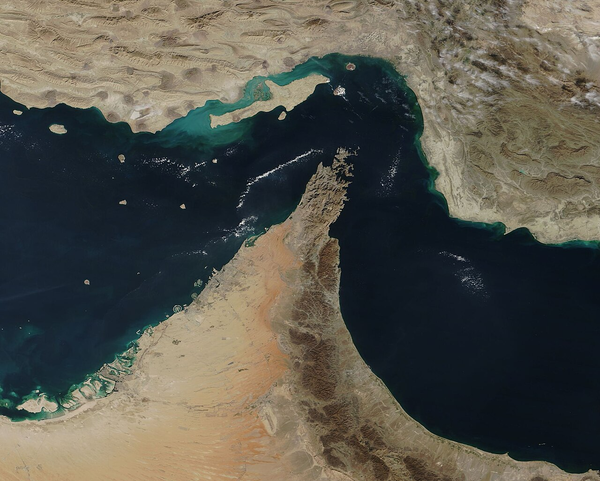
The Strait of Hormuz is one of the world's most vital maritime corridors. Roughly one-fifth of global oil trade passes through this narrow waterway connecting the Persian Gulf to the wider international maritime system. Its stability is therefore not merely a regional concern; it is a matter of global economic security.
For centuries, the international community has operated on a simple principle: straits used for international navigation must remain open, secure, and free from political coercion. That principle is now under challenge by the rogue regime in Tehran.
Ridiculous attempts to justify restrictions on transit through the Strait of Hormuz by relying on pseudo-legal terminology, or by claiming that a single coastal state may unilaterally redefine the rules governing one of the world’s most critical waterways, are preposterous.
This proposition has no basis in international law.
The Strait of Hormuz Was Never Threatened by Israel
Claims that recent regional tensions have caused "severe and widespread harm" to the Strait of Hormuz itself are entirely detached from reality.
The physical integrity of the strait has not been compromised by Israel’s — or the United States’ — actions. Israel has conducted no operations targeting the strait, its shipping lanes, or its maritime infrastructure. No Israeli actions have obstructed civilian navigation through Hormuz.
The instability surrounding the Strait today stems not from Israel, but from threats and violent extortion by Iran.
The danger to Hormuz is not external aggression against the strait. The danger is the attempt to weaponise the strait itself.
Israel has conducted no military operations in or around the Strait of Hormuz. Israeli vessels have not mined its waters. Israeli aircraft have not struck its shores.
What the Iranian regime has constructed is a legal fiction — an invented predicate designed to cloak a political decision.
Transit Passage Is Non-Suspendable
The legal framework governing international navigation is clear. The United Nations Convention on the Law of the Sea (UNCLOS) establishes the right of transit passage through straits used for international navigation. Transit passage is continuous, unobstructed, and non-suspendable.
No state has the authority to selectively interrupt that principle for political leverage.
The Strait of Gibraltar remains open regardless of geopolitical tensions between states in the region. Spain and Morocco do not impose arbitrary restrictions on international transit. The Strait of Malacca continues to function as an open international passage despite competing strategic interests among regional powers. Singapore and Malaysia do not use maritime transit as a political weapon.
These straits remain open because the international community recognises a fundamental truth: international waterways belong to all nations, and no single state may hold the global economy hostage to its political grievances.
The same principle must apply to Hormuz.
Self-Defence Is Not Aggression
Much has been said in recent years about "aggression" in the Middle East. Yet any serious examination of the region's instability must confront an unavoidable reality: the Islamic Revolutionary Guard Corps, under direct command of the so-called "Supreme Leader" of Iran, has spent decades attacking Israel, building a network of terrorist armies and developing weapons of mass destruction, in contradiction to its stated commitments.
It is the IRGC that has supplied missiles and means to produce them to the Houthis in Yemen, enabling attacks on international shipping. It is the IRGC that has taken over Lebanon through Hezbollah, destabilized Syria and Iraq, and supported the murderous Hamas & PIJ terrorist organisations that have ruthlessly massacred Israeli civilians on October 7.
It is the Iranian regime — not Israel — that has called openly and repeatedly for the annihilation of a fellow United Nations member state, in contradiction to the UN charter.
Israel's defensive actions — whether against missile launches, drone attacks, or the infrastructure of groups openly committed to our destruction — are precisely that: defensive. To characterise the exercise of self-defence as "aggression" is to strip the word of all meaning.
The World Will Not Accept Maritime Extortion
Iran’s attempts to impose new arrangements in the Strait of Hormuz are not a measured response to changed circumstances. Rather, they are an attempt to leverage geography into geopolitical coercion.
This is why the international response has been swift and unified. The UNSC, the United States, China, India, the European Union, and practically all nations have rejected Iran's actions. They recognise that if one nation is permitted to close an international natural waterway based on unilateral grievances, no shipping lane is safe. The precedent would be catastrophic.
No amount of pseudo-legal mumbo jumbo coming out of an Iranian official can transform piracy and extortion into common practice.
The Strait of Hormuz will remain open. This is not merely Israel's position. It is the position of the global community, and of every nation that depends on the free flow of maritime commerce.
Iran's attempt to hold the world's supplies hostage will not succeed. The international community has both the legal authority and the collective will to ensure that these critical waters remain what they have always been: open to all, controlled by none.
Editor’s Note: The views expressed in this opinion article are those of the author and do not necessarily reflect the editorial position of Jaffna Monitor. We welcome informed responses, counterarguments, and dissenting perspectives in the form of letters to the editor.