

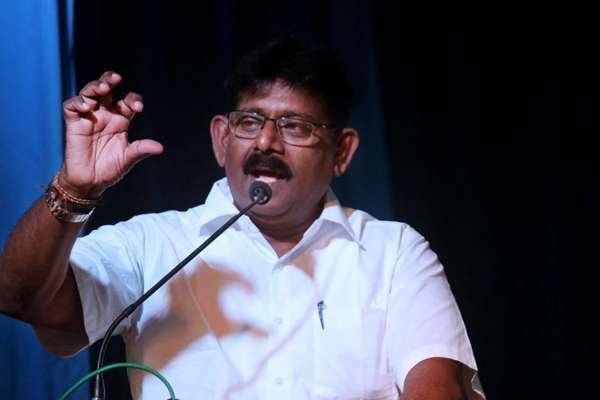
Public criticism of Tamil Nadu political leaders by Sri Lankan Tamils risks alienating millions of their supporters and weakening long-standing political solidarity, P. Ayngaranesan, leader of the Tamil National Green Movement, has warned.
Ayngaranesan made these remarks while addressing a contemporary political discourse organised by the Tamil National Green Movement at the Divine Life Society Hall in Nallur (Divya Jeevana Sangam) recently.
He said that indiscriminate public attacks on Tamil Nadu leaders were politically counterproductive and harmful to the Sri Lankan Tamil cause.
“When we publicly and harshly criticise Tamil Nadu leaders we personally disagree with, we must recognise the bitter reality that we are distancing not only those leaders, but also their crores of followers—from us and from the Eelam Tamil issue itself,” he said.
Ayngaranesan acknowledged that many Eelam Tamils continue to harbour a deep emotional grievance that the Tamil Nadu government, led by Kalaignar M. Karunanidhi, which was in power during the final phase of the Sri Lankan war in 2009, could have intervened to halt the conflict. He said this sentiment, which continues to persist, was understandable.
However, veteran journalists whom Jaffna Monitor spoke to note that even a genuine intervention by the then DMK-led Tamil Nadu government would have had limited capacity to alter the eventual outcome of the war, as military decision-making rested firmly with the Sri Lankan state, while foreign policy and coercive leverage lay with New Delhi, where the Congress-led central government was determined to decisively defeat the LTTE.
Ayngaranesan cautioned that political engagement with Tamil Nadu could not be sustained purely on the basis of emotion. “While such feelings are natural, the political reality is that we must approach Tamil Nadu with political clarity and pragmatism,” he said.
Recalling the sacrifices made by ordinary people in Tamil Nadu for the Eelam Tamil cause, Ayngaranesan referred to individuals such as Muthukumar, who self-immolated in protest. Despite this history, he observed that public interest in Tamil Nadu regarding the political struggles of Eelam Tamils has declined significantly since the end of the war.
He attributed this decline partly to the failure of Sri Lankan Tamil political leadership to maintain consistent political engagement with Tamil Nadu in the post-war period.
“Throughout our Tamil national liberation struggle, the people of Tamil Nadu have always stood as our rear support base. We must not, by our own actions, sever this umbilical-cord relationship,” he said.
Stressing that the support of Tamil Nadu’s nearly seventy million Tamils remains vital, he urged activists and political actors in Sri Lanka to refrain from intervening in Tamil Nadu’s internal party politics and to avoid what he described as “half-baked and reckless” political commentary.
The event was attended by activists, political observers, and members of the public and formed part of a broader discussion on contemporary Tamil politics.
Owing to the rise of social media and mainstream television channels, Tamil Nadu politics has come to play an increasingly integral role in the political consciousness of Sri Lankan Tamil youth. With almost everyone now active on social media, public criticism of Tamil Nadu leaders has become widespread.
However, this trend—often driven by emotion rather than deep political understanding—frequently provokes strong and hostile reactions from Tamil Nadu political leaders and their party supporters, further straining already delicate relationships. Against this backdrop, political observers say that Ayngaranesan’s remarks represent a rare and sensible appeal from a Sri Lankan Tamil political leader.