By M.R. Narayan Swamy
“Please don’t harm me! Yes, I am a Tiger. I was told to keep a watch on you, so I came here. Please don’t have me killed!”
This is how a young spy sent by the Tamil Tigers spoke in visible despair after being identified by Douglas Devananda, a sworn enemy of the Liberation Tigers of Tamil Eelam (LTTE).
The incident took place a few years before the LTTE went down fighting in 2009. A Sri Lankan minister, then, Douglas, was presiding over a camp organized by his Eelam People’s Democratic Party (EPDP) in Colombo.
One of the oldest entrants into Tamil militancy, Douglas occupied a high place in the LTTE’s hit list. Eventually, he earned the dubious record of surviving the maximum number of assassination attempts by the Tigers.
That day, there was no tip from anywhere that a member of the LTTE intelligence wing had sneaked into the EPDP meeting.
As an EPDP veteran recalls, it was Douglas himself who, using his sixth sense, sensed the danger. As everyone prepared to leave after the event, he surprised the LTTE spy by asking him to stay behind.
The LTTE agent, thinking he had been betrayed by someone, immediately broke down and admitted that he had been sent by the Tigers to conduct a recce to facilitate an assassination attempt that would have followed.
Douglas told the frightened LTTE captive that he won’t be killed.
“We will send you back to (Velupillai) Prabhakaran,” he told the spy, referring to the LTTE leader. “Tell him you got caught, but the EPDP let you go. Ask Prabhakaran if he would spare someone in similar circumstances.”
The young man was one of the countless former LTTE cadres whom Douglas either spared or saved, both during the war and after the conflict waged by the Tigers against Sri Lanka came to an end in May 2009.
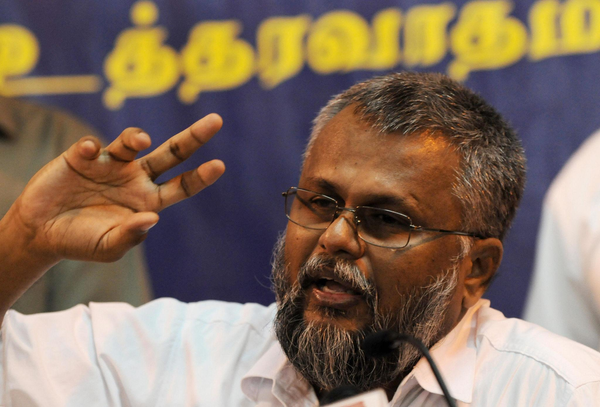
Douglas, now 68, doesn’t tomtom this aspect of his controversial politico-military life and politely declines to give a specific answer when asked how many Tigers he has saved from certain death.
It is one of his close associates based in Europe who says the total would be “very large”.
Douglas said in a brief interview that the first lot of Tamils he saved from a murderous LTTE frenzy were members of the Tamil Eelam Liberation Organisation (TELO).
This was in April-May 1986, when the LTTE, in its attempt at exterminating all rivals in militancy, launched a sudden and brutal crackdown on the TELO in Jaffna and elsewhere, leaving hundreds dead.
Douglas, who then headed the EPRLF military wing, said hundreds of unarmed TELO members fleeing for their lives took refuge in EPRLF offices and camps.
“The number we saved was in the hundreds,” he said. “We did something similar when the LTTE ‘banned’ PLOTE (People’s Liberation Organisation of Tamil Eelam) and cracked down on its members.
He added: “The same considerations drove me to save many LTTE and pro-LTTE activists and fighters later, although the Tigers had repeatedly tried to kill me.”
Towards the end of 1986, Douglas was sacked by the ERPLF amid internal squabbles as well as an unsavory incident in Madras, which led to the death of an Indian national, in which he was implicated.
As the years rolled by, groups such as TELO, EPRLF, and PLOTE entered mainstream politics in Sri Lanka, ironically supporting the very LTTE that had killed many of their leaders and members.
Douglas, who later formed the EPDP, however, refused to compromise with the LTTE. Once the Sri Lankan establishment provided weapons and money to his group, he became the Tigers’ Tamil enemy number one.
Frustratingly for the Tigers, Douglas defeated the proverbial cat to survive around a dozen bids by the LTTE to do away with him, some more gory and more scheming than the others.
Prabhakaran was desperate to see Douglas dead and gone.
One huge LTTE failure occurred in October 1995 when its gunmen barged into Douglas’ residence-cum-office on Havelock Road in Colombo, firing away rockets and AK-47s.
The moment he heard rapid gunfire, Douglas realised the danger. Thinking fast, he sprang out of an upper-floor window and disappeared into a nearby park with select guards – where he remained in hiding through the night.
It was early in the morning when he telephoned President Chandrika Kumaratunga (who would later be partly blinded while surviving an LTTE suicide bomber) to say he was alive.
“Please don’t worry. Everything is under control,” a relieved president told him, adding that the intelligence agencies had caught an LTTE spy sent to infiltrate her Colombo home to poison her drinks.
Douglas remarked in a lighter vein that the LTTE chief would not attempt anything similar on him, as he would know that he (Douglas) did not consume liquor.
Douglas’ colleagues credit two traits that helped him to repeatedly trip the Tigers, becoming something of an enigma and, in the eyes of his loyalists, a legend of sorts.
Douglas, who was an MP for over 15 years and a minister in successive governments, says he understood that the LTTE was a murderous organisation which would never forgive its enemies, armed or unarmed.
He cites the example of Maheswary Velautham, a Tamil human rights lawyer who was associated with the EPDP and whose efforts led to the release of scores of Tamil detainees, LTTE members included.
“But she did not understand the LTTE. She thought that because of her work, the LTTE would not harm her. I thought differently. I always knew they would love to kill me. It is another matter that they could not succeed.”
Velautham, 55, was shot dead by three masked gunmen dressed in army uniforms at her family home in Karaveddy, Jaffna, while she was visiting her ailing mother. The LTTE never claimed responsibility for the killing, possibly because of her work in the field of human rights.
One front-ranking LTTE member Douglas saved after surrendering to the military in 2009 was S.G. Shanthan, among the best-known singers of pro-Tiger songs.
In later years, Shanthan penned songs eulogising the EPDP chief, only to be pulled up by the pro-LTTE diaspora.
According to Douglas, EROS leader Velupillai Balakumar and his son contacted him towards the end of the war and attempted to flee LTTE-controlled territory by sea. However, they were intercepted and detained by the Sea Tigers.
He said several LTTE leaders also got in touch with him towards the end of the war as the military advanced rapidly. However, Douglas did not name these leaders or say whether any of them secured his assistance.
But a close aide told Jaffna Monitor that Douglas “worked very hard” in saving several of the 12,000 LTTE fighters who surrendered in 2008-09.
“He ensured that these Tigers were not killed... In a handful of cases, however, he did not succeed. Some of those he saved later joined the EPDP. They remain with us even today,” the aide said.
One LTTE associate who conducted reconnaissance on Tamil politician and constitutional lawyer Neelan Tiruchelvam, who was assassinated by an LTTE suicide bomber in 1999, now lives in a Nordic country, telling those who know him that he is alive “only because of Douglas.”
This is one of the biggest ironies of the Tamil armed struggle in Sri Lanka – a Tamil saved numerous members of the very same LTTE, which repeatedly tried to bump him off.
But did not the EPDP also kill its rivals and LTTE supporters?
The aide says, “Perhaps that’s true. But we all lived in a highly militarised society where almost every difference was being settled by the gun, primarily by the Tigers.
“The LTTE and pro-LTTE media dubbed people like us ‘paramilitaries’, as if that one word gave the Tigers the right to kill those they did not like. The LTTE killed hundreds of our people, not to speak of the many other Tamils they killed. And they have no remorse for their crimes.”
Not everyone in the EPDP was happy with Douglas’ generosity vis-à-vis the Tigers. Some in the EPDP had bitter differences with their leader on this issue.
Indeed, one leading LTTE member who joined the EPDP after the war later quit Douglas’ party in an ugly parting of ways.
Douglas says it is all about karma.
“I used to say that let Prabhakaran meet me with 100 supporters. He and I will have a debate. I guarantee that when the debate is over, at least 50 of his people would join me…
“Yes, the LTTE assassinated by character, threw plenty of mud at me, but they could not break my spirit, and they could not finish me off.
“It is all karma. Prabhakaran’s karma led him to his death. My karma helped me to survive.”