

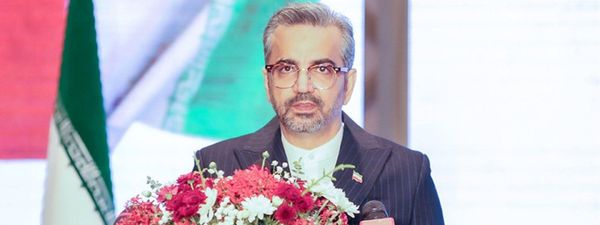
Iran's ambassador to Sri Lanka, Dr. Alireza Delkhosh, used the country's National Day reception on Wednesday to make a broad case for expanded bilateral cooperation, while defending Tehran's record on economic resilience, technological progress, and foreign policy independence.
The event, held at the ITC Hotel in Colombo to mark the 47th anniversary of the 1979 Islamic Revolution, drew a cross-section of Sri Lanka's political and diplomatic establishment. Health and Mass Media Minister Dr. Nalinda Jayatissa; Fisheries Minister Ramalingam Chandrasekar; Secretary to the President Dr. Nandika Sanath Kumanayake; and Western Province Governor Hanif Yusoof were among the government figures in attendance, alongside members of Parliament, senior military officials, including Army Commander Lieutenant General Lasantha Rodrigo, and members of the diplomatic corps.
Indian High Commissioner Santosh Jha and Russian Ambassador Levan S. Dzhagaryan were also present, along with several other ambassadors and heads of diplomatic missions.
Sri Lanka Acknowledges Historic Ties
Speaking at the reception, Health and Mass Media Minister Nalinda Jayatissa described Sri Lanka’s relationship with Iran as one grounded in a long and shared history. He thanked Iran for its contributions to development initiatives in Sri Lanka, describing Tehran as a reliable partner during some of the country’s most difficult periods — including the years of conflict, the aftermath of the 2004 tsunami, the Covid-19 pandemic and the recent phase of economic stabilisation.
The outcomes of that cooperation are visible across the country, he said. Referring to the Uma Oya Multipurpose Development Project — widely known as the Uma Oya Hydropower Complex — he described Iran’s financial and engineering support as a testament to what sustained bilateral collaboration can achieve.
Iran's Case for Independence
In his keynote address, Ambassador Delkhosh framed the Islamic Revolution as a defining moment in Iran's political and cultural trajectory. He said the country's constitution was built on principles of "human dignity, justice, independence, and the rejection of domination."
He reiterated Tehran's longstanding foreign policy doctrine of "neither East nor West," presenting it as a commitment to balanced engagement and mutual respect rather than alignment with any major power bloc. Iran, he said, views itself as a responsible and independent actor guided by dialogue, multilateralism, and cooperation — with particular focus on combating terrorism, extremism, and drug trafficking.
Sanctions, Resistance, and Economic Claims
A significant portion of the address was devoted to what Iran frames as its "Economy of Resistance" — the policy of economic self-reliance developed in response to decades of American sanctions.
The ambassador described the sanctions as unjust, and said Iran had nonetheless achieved growth in industrial output, expanded its non-oil exports, and made progress toward a diversified economy.
Technology Ambitions
Ambassador Delkhosh also highlighted Iran's scientific and technological aspirations, citing advances in nanotechnology, robotics, artificial intelligence, and information technology. He referenced plans for a national space infrastructure programme, including the Chabahar Space Base, with a target completion date of 2031.
On healthcare, he said Iran aims to generate six billion euros annually from health tourism and position itself as a regional hub for specialised medical services. He added that Tehran maintains cooperation with the World Health Organization and the Group of Eight countries on international health matters, and has achieved a high degree of self-sufficiency in pharmaceutical production.
Nuclear Programme and Regional Tensions
The ambassador touched on Iran's nuclear programme, stating that Tehran had engaged in multiple rounds of dialogue and had agreed to continue discussions — a reference to the extended and often stalled negotiations that have defined the issue for more than two decades.
He also addressed recent hostilities, stating that in June 2025, Iranian territory was subjected to military strikes by Israel, followed by direct U.S. involvement. He said the attacks targeted nuclear facilities, infrastructure, and civilian areas, and that Iran had responded in accordance with international law.
The ambassador also criticised Israel's military operations in Gaza, citing civilian casualties.
Bilateral Outlook
Turning to the future of Iran–Sri Lanka relations, Ambassador Delkhosh said the two countries share deep historical and civilisational ties. He expressed Tehran's readiness to strengthen cooperation in trade, investment, energy, agriculture, and science and technology, arguing that expanded collaboration could support employment and sustainable economic growth in both nations.
For Sri Lanka, deeper engagement with Iran could open doors to energy partnerships and trade diversification — priorities for a government still managing the aftermath of the country's worst economic crisis. However, any expansion in ties will need to be balanced against the complex geopolitical implications of closer alignment with a country under heavy Western sanctions.
The ambassador concluded by expressing hope that the coming years would mark a new chapter in Iran–Sri Lanka relations.