JAFFNA, Sri Lanka — At the Jaffna bus stand, the overnight service to Colombo fills steadily. Some passengers carry small backpacks; others clutch thick plastic folders secured with elastic bands. Many have made this journey before.
They are not travelling for work or leisure. They are heading south to fulfill a visa requirement — specifically, to provide biometric fingerprints at a visa application centre. The appointment itself may take only a few minutes. The journey will consume most of a night.
For many residents of Sri Lanka’s Northern Province, it is a ten-hour trip simply to press their fingers onto a scanner and return home the following day.
A Limited Office in a Region of High Demand
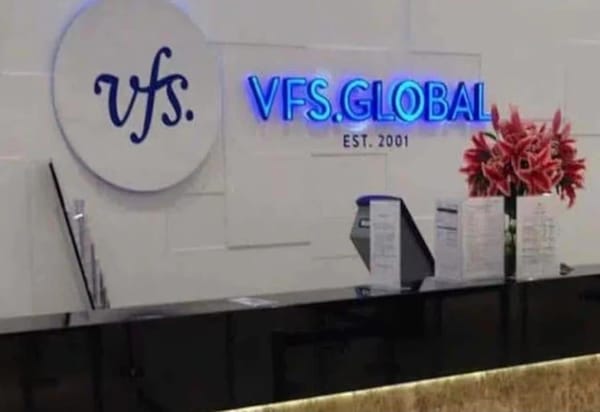
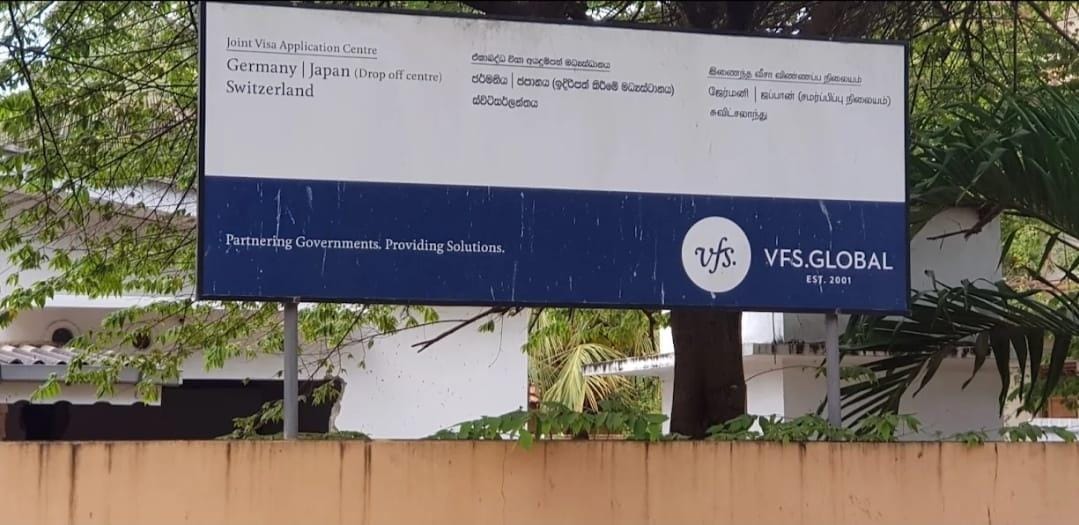
VFS Global, the world’s largest outsourced visa processing company, operates a visa-related centre in Jaffna at 89, Brown Road. Yet the services available there vary by country.
The centre processes visa applications for Germany and Switzerland, collects biometrics for Australia, and serves as a document drop-off point for Japan. But for the United Kingdom, Canada, France, and other countries home to large Sri Lankan Tamil diaspora communities, applicants must travel to Colombo.
Residents say that distinction carries disproportionate consequences in a region deeply connected to diaspora communities formed during decades of war and migration.
“We have a passport office here. We have an international airport. There is already a VFS office in Jaffna,” said Maragatham, an elderly woman preparing to visit her son in Canada. “Why can’t all visa applications be accepted here?”
A professor who recently travelled south to apply for a British visa framed the question more broadly:
“If some countries can process visas from Jaffna, why can’t the United Kingdom? Why can’t Canada? In the era of artificial intelligence, is it reasonable to ask people to travel 400 kilometres simply to submit documents and provide biometrics?”
The Numbers
According to a senior source familiar with operations at the VFS Global Visa Application Centre in Colombo — located at No. 675, Dr. Danister De Silva Mawatha — the centre processes roughly 90 applications on a typical working day.
More than 60 of those applications, the source said, originate from residents of the Northern Province, predominantly Jaffna.
If accurate, that would mean roughly two out of every three applicants in Colombo are travelling from a region where a VFS facility already exists, albeit one with limited country coverage.
“The majority of applicants are coming from the North,” the source said. “Many of them could be served there if services were expanded.”
What the Policy Costs
For Northern residents, the burden is not abstract.
A senior consultant physician said he recently stepped away from his clinical duties to travel to Colombo to provide his biometric fingerprints. He completed postgraduate training in Britain, once held permanent residency there, and still maintains a valid U.K. driving licence.
“Even with that background, I had to travel 400 kilometres to submit documents and give biometrics,” he said. “I had to arrange cover for my patients. The ward needed me. I went to give a fingerprint.
“It makes you feel reduced,” he added. “As though your time and your work do not matter.”
A retired public health inspector described taking official leave and spending a night in Colombo, with total expenses exceeding 20,000 rupees for transport, accommodation, and meals.
“It is not just bus fare,” he said. “You lose time, income, and energy. For many elderly people, it is physically difficult.”
The Northern Province remains closely tied to communities in Britain, Canada, Australia, and across Europe. Visa applications are often linked to family reunions, medical visits, academic conferences, weddings, and, at times, final goodbyes.
Biometrics in Jaffna — But Selectively
VFS officials and industry sources say biometric collection has occasionally been arranged in Jaffna for bulk groups, often coordinated through tour operators. But such visits are not routine.
A VFS officer, speaking on condition of anonymity, said the company is operationally prepared to expand services in Jaffna. Authorization, however, rests with diplomatic missions.
“We are ready,” the officer said. “But the request has to come from the embassies. We cannot decide unilaterally.”
Under standard practice, embassies and high commissions determine where biometric data may be collected, even when administrative processing is outsourced.
A Question of Access
Policy analysts say the disparity may reflect administrative design rather than deliberate exclusion. Visa logistics are typically handled by consular units and may not always command attention at higher diplomatic levels.
“This is largely an operational decision,” said one Colombo-based analyst familiar with consular systems. “If senior diplomats were fully aware of the scale of demand from the North, there is no technical barrier to expanding services.”
Residents, however, frame the issue not as convenience but as access — whether proximity to the capital should determine the ease with which citizens connect to the wider world.
Nearly fifteen years after the end of the civil war, many in the North say centralisation continues to shape daily life in quiet, cumulative ways.
Tonight, the overnight bus will fill again. By morning, dozens more passengers will step off in Colombo, press their fingers to a scanner, and begin the long journey back north — their identity confirmed in seconds, the effort to reach that moment measured in hours.