

Anti-Sand Mining Whistleblower Killed; Family Alleges Deliberate Hit-and-Kill

Anti-Sand Mining Whistleblower Killed; Family Alleges Deliberate Hit-and-Kill


Share this post

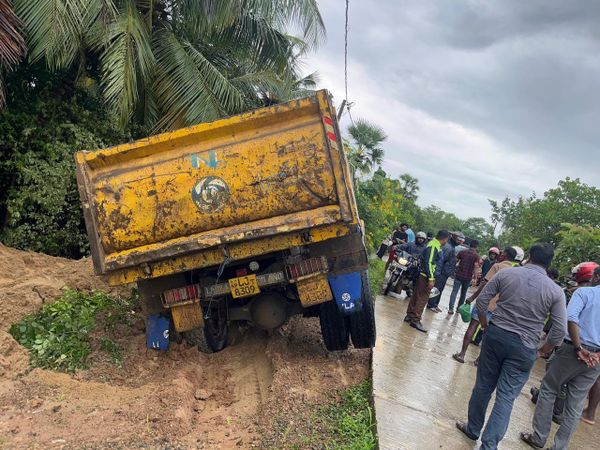
A 35-year-old activist who had repeatedly reported illegal sand mining was killed after being struck by a tipper lorry carrying illicitly mined sand — in what his family alleges was a deliberate attack.

Selvaratnam Sopanath, a resident of Thiruvaiyāru, died on the spot near Mottai Bridge on Wilson Road in Kilinochchi.

According to relatives, Sopanath was travelling on a motorcycle with his wife from Kilinochchi town towards Iranamadu when the incident occurred. As he attempted to pull over to the side of the road, a sand-laden tipper approached from behind at high speed.

“Sensing danger, his wife jumped off the motorcycle and ran to the opposite side of the road,” a family member said. “The tipper then veered directly towards him, struck the motorcycle, and dragged him under its rear wheels. Sand from the vehicle spilled over him.”

Sopanath died instantly from his injuries.

CCTV footage examined

Relatives say closed-circuit television footage from the area corroborates their account and shows the tipper's movements before impact. Jaffna Monitor has not independently verified the footage.

The vehicle involved in the incident was reportedly transporting sand illegally excavated from the Thiruvaiyāru area — operations that Sopanath had been actively opposing for several months.

History of complaints

Family members said Sopanath had lodged multiple complaints with police stations in both Kilinochchi and Vavuniya regarding ongoing illegal sand mining in the region. He had also contacted the national emergency hotline 119 to report the operations.

"He had been threatened before. He knew the risks but continued to speak out," a relative told Jaffna Monitor. "This cannot be an accident. We believe this is a planned killing to silence him."

Growing concerns over illegal sand networks

The incident has reignited concerns over illegal sand mining operations in the Northern Province and the dangers faced by residents who oppose them.

Environmental activists and community groups have long warned that illegal sand miners operate with near-total impunity, often backed by political interests, criminal elements, and even sections of the police. Those who resist these operations routinely face threats and intimidation. Activists also allege that this network is further shielded by a wide circle of lawyers — including, incidentally, several who publicly present themselves as Tamil nationalists — who defend the accused in court and help them evade accountability.

Sand mining, particularly from riverbeds and coastal areas, has emerged as a lucrative illegal trade in northern Sri Lanka, driven by construction demand. Environmental groups say unregulated extraction damages ecosystems, depletes groundwater, and destabilises river banks.


Share this post

Be the first to know

Join our community and get notified about upcoming stories

Subscribing...
You've been subscribed!
Something went wrong
What Sri Lanka and Gaza Teach Us About the Futility of Armed Struggle

What Sri Lanka and Gaza Teach Us About the Futility of Armed Struggle

“I object to violence because when it appears to do good, the good is temporary; the evil it does is permanent”. Mahatma Gandhi Times of war create the illusion that only force can resolve irreconcilable differences. Some social theorists even justify the inevitability of violence in achieving social change on the basis that groups in power rarely relinquish that privilege voluntarily. In this context, the armed conflicts that plagued Sri Lanka for three decades and continue to unfold in Gaza


Prof. Mahesh Nirmalan

Prof. Mahesh Nirmalan

A Peacemaker’s Belated Wisdom

A Peacemaker’s Belated Wisdom

By: M.R. Narayan Swamy Reading this otherwise invaluable book will give the impression that academic-turned-politician G.L. Peiris was a distant observer of Sri Lanka’s peace process (which collapsed) and not the government’s chief negotiator with the Liberation Tigers of Tamil Eelam (LTTE) and a key player in a dialogue that had been expected to end a protracted and bloody conflict. Peiris raises several vital issues that he feels led the peace process to unfortunately unravel, trig


M.R. Narayan Swamy

M.R. Narayan Swamy

The Promise and Limits of AI in Mental Healthcare

The Promise and Limits of AI in Mental Healthcare

Artificial intelligence (AI) today permeates almost every sphere of modern life, from finance and defence to education and healthcare. While its recent explosion has captured global attention, the roots of AI stretch back several decades. The intellectual groundwork was laid in 1950, when British mathematician Alan Turing posed a revolutionary question in his paper “Computing Machinery and Intelligence”: Can machines think? A few years later, in 1955, computer scientist John McCarthy formally co


Dr Ruwan M. Jayathunga

Dr Ruwan M. Jayathunga

Cricket in Jaffna: Past, Present, Future and the Debate Over a New International Stadium

Cricket in Jaffna: Past, Present, Future and the Debate Over a New International Stadium

Cricket occupies a unique and powerful place in Sri Lanka’s national identity. No other sport evokes the same depth of passion or collective pride. The 1996 Cricket World Cup victory transformed cricket from a popular pastime into a unifying national obsession—an emblem of hope, joy, resilience, and belonging. For decades, Sri Lankans have believed that cricket transcends geography, ethnicity, class, and political divisions. From the urban centres of Colombo, Galle, and Kandy to the rural heartl


Dr. Gamini Goonetilleke

Dr. Gamini Goonetilleke