By: M.R. Narayan Swamy
American dancer Jane Sherman fell in love with Sri Lanka at first sight.
The train journey from India to the island nation may have been ghastly but the teenager, who would later become famous, was wide awake at dawn in 1926 to see the sun come up over the luscious green foliage in the country. She was full of admiration for the blue sea water, and described the people in Sri Lanka as “cleaner than Indians”.
During the time she spent in Sri Lanka, Jane gave full marks to “one of the finest city beaches in Asia” at Mount Lavinia, a short distance from Colombo, and said she had never seen another country with so much water – “such a relief after dry, dusty India”.
She also waxed eloquently about the Sri Lankan countryside: silvery waterfalls; slender, swaying bamboo; hills; rice fields; and thatched-roof villages.
Sir Arthur Conan Doyle, writer and celebrated creator of the legendary Sherlock Holmes, visited Ceylon, as Sri Lanka was then known, twice and did not hesitate to call it a “paradise”.
The first time he came to the country was in 1921 when he was writing his serialized essays titled The Wanderings of a Spiritualist. On his second trip, he sang praises of Sri Lanka as he drove from Colombo to Kandy (he called it Candy).
Sir Doyle gave a fine description of everything he saw along the route: overhanging trees, half-grown rice fields, tea groves, rubber plantations, banana gardens, and the omnipresent coconut palms. Like all foreigners, he said the Royal Botanical Gardens at Peradeniya was “unmatched for beauty in the world”. The writer dubbed Kandy, the old capital, “a dream city”.
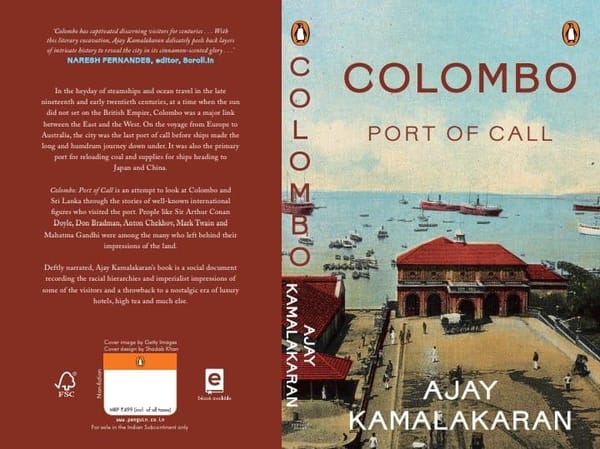
Jane’s and Sir Doyle’s sweeping praise of Sri Lanka is part Indian writer Ajay Kamalakaran’s eminently readable book, which is an attempt to look at Colombo and Sri Lanka as a whole in the heyday of steamships and ocean travel through the stories of well-known international figures who visited the port.
Kamalakaran, a gifted writer, is himself in love with Sri Lanka and its people where he counts many people (mostly Sinhalese) as close friends, akin to family members. He calls Sri Lanka a “highly photogenic country, with an easy-going, hospitable and friendly populace” as well as “a traveller’s delight”. Nothing could be more apt.
The more Belgian traveller Jules Leclercq saw of the capital Colombo, the more he fell in love with the city. “If one liked to believe that there are cities in paradise, such cities must have similar streets (as Colombo),” he would write. “Here the streets are majestic avenues, running under a canopy of foliage that neither sun nor moon crosses.”
Jules also took an instant liking for Galle. After an excellent lunch at Mount Lavinia, he said he understood why poets call Ceylon the Emerald Isle. He described Anuradhapura the “Rome of the Buddhist world”. But like most other foreigners, he was disappointed in Kandy with the Temple of the Tooth.
Akin to Jules, American writer, humourist and essayist Mark Twain, who gave two talks at the old Town Hall at Pettah, too embraced Colombo most lovingly. His description: “An Oriental town, most manifestly; and fascinating.”
Mary Thorn Carpenter, daughter of American politician Jacob B Carpenter, who visited Sri Lanka around 1890, was taken in by the lush vegetation of the jungle after crossing the Kelani River. She was captivated by the breadfruit, jackfruit and mango trees as well as ferns and creepers. She didn’t like that the English on the island considered the locals to be ‘vile’. She loved the Ceylon tea: “Light in colour, very mild and refreshing.” On her last evening in Colombo, Carpenter went to the Galle Face Green to walk on what she said was “a glorious promenade”.
The next year, in 1891, Crown Prince Nicholas, heir to the throne of the Russian Empire, not only was full of praise for Sri Lanka’s natural beauty but was among the few notable foreigners who expressed sympathy for the Tamil plantation workers brought from southern India. He called them “lean and miserable-looking men” who wore out their lives in the mountains of Ceylon “under conditions of great hardship, borne down by the debts incurred in the passage from India”.
Mahatma Gandhi and his aides were more than impressed by the receptions and welcomes in Sri Lanka, comparing them favourably with the warmest and the most enthusiastic ones he had received anywhere in India. According to the book, the Mahatma was touched by the generosity of the average Sinhalese and developed a great degree of fondness for the people of Ceylon. This was in November 1927.
The apostle of peace said Colombo surpassed Cape Town (South Africa) in beauty. “The natural scenery that I see about me, in Ceylon, is probably unsurpassed on the face of the earth.” Gandhi also spoke eloquently about Buddhism, which he said had left an indelible impress upon Hinduism. Like Nicholas, the Mahatma too was saddened to see the plight of the Tamil workers in the tea plantations. Before ending his three weeks in the island nation, Gandhi also visited Jaffna where too he got a spirited welcome.
Addressing the Indian community in Jaffna, the Mahatma said: “Though I was prepared for the scenery in Lanka, the scenery I have witnessed has surpassed all expectations … Ceylon seemed to be a fragrant, beautiful pearl dropped from the nasal ring of India.”
All Sri Lankans should read this book. Praise is due to Kamalakaran for the deep research he has done to uncover the sparkling observations of some of the leading personalities who visited Sri Lanka -- and fell in love with the country -- in an earlier era. The author’s own admiration for Sri Lanka in evident all through the book.
Title: Colombo: Port of Call; Author: Ajay Kamalakaran; Publishers: Penguin Books (Random House); Pages: xxxi + 273; Price: Rs 599 (INR)