

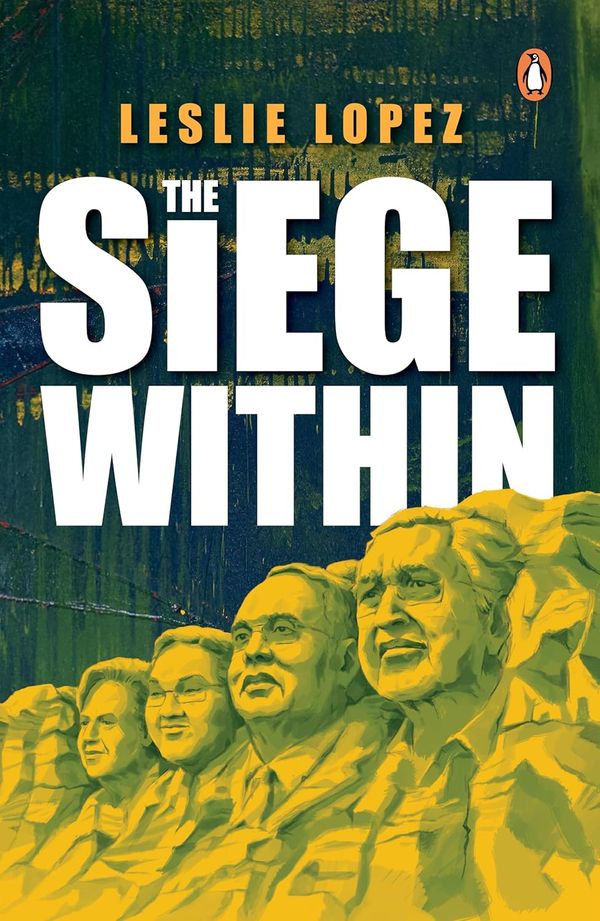
Leslie Lopez’s The Siege Within isn’t just another retelling of the 1MDB scandal. It’s an unflinching autopsy of Malaysia’s political carcass – a place where stolen billions are treated like family silver and leaders loot with the polite smile of a country club chairman.
Lopez, a veteran journalist with the scars to prove it, turns his scalpel on the thick, toxic hide of Malaysian politics to reveal the anatomy of the world’s greatest financial heist. His subject? The rise and fall of Najib Razak – son of a prime minister, prime minister himself, a self-styled aristocrat, and the man who treated the nation’s treasury like his personal ATM.
Using thriller pacing and courtroom drama beats, Lopez weaves a tale packed with enough characters to fill a royal wedding reception. There’s the old political strongman Mahathir Mohamad, who ruled Malaysia with an iron fist wrapped in batik for 22 years, only to return at 93 to slay his one-time protégé, Najib Razak.
There’s Anwar Ibrahim, once Mahathir’s heir, then his enemy, then his ally again in a Shakespearean tragedy written with durian ink. And of course, there’s Jho Low – the pudgy, baby-faced Wharton boy with a taste for Cristal, yachts, and Leonardo DiCaprio’s friendship, who siphoned off $4.5 billion like it was loose change under his grandma’s sofa cushions.
Lopez shows how Najib’s desperation to keep Mahathir’s shadow off his back birthed 1MDB. He needed a war chest to keep UMNO’s warlords fed, their loyalty greased with cold hard cash. Enter Jho Low, a man with no moral compass, just an internal GPS set to Money, Power, Repeat. Together, they built a fraudulent empire on fake oil deals, shadowy Gulf state investments, and the wild optimism that no one was watching.
But people were watching. Lopez was one of them. In 2013, his piece The Big Gamble dropped like a bomb, exposing Goldman Sachs’ complicity and PetroSaudi’s phantom oil ventures. Low didn’t flinch. Najib didn’t panic. Their only concern was bad PR among the sharks of the United Malays National Organisation (UMNO) — not the electorate, not the country, not the grand idea of Malaysia itself.
Lopez writes of Low as a man obsessed not with brushing up against the edge of legality but vaulting past it – his business deals engineered like chemical weapons, structured for maximum destruction with plausible deniability. Najib, for his part, was too busy flexing his First Lady’s diamond collections and playing kingmaker to care.
When the wheels finally came off in 2018, it wasn’t just Najib who fell. The entire UMNO edifice crashed, ending 61 years of rule. Mahathir returned to power in an unholy pact with his old rival Anwar. Two years later, he quit, and Anwar finally got the top job – a nation’s tragicomedy closing another act.
The Siege Within is not an easy read. It’s not meant to be. It’s an unvarnished mirror held up to the face of Malaysia’s promise, showing the pockmarks and rot beneath its gleaming towers. It’s a story about greed – not just of money, but of power, status, and the desperate need to never lose them.
Read it if you want to understand how a nation gets robbed in broad daylight by men in tailored suits. Read it if you want to know what happens when a country forgets who it belongs to. Or don’t. Just don’t say you weren’t told.